The Earth has never been a stable backdrop. Long before the appearance of human beings, continents drifted, oceans opened and closed, climates tipped, rivers changed their beds, forests migrated and species appeared, moved or disappeared. Some regions that are desert today knew savannahs, lakes and extensive drainage networks, while others, currently temperate, were covered in ice. On geological timescales, the landscapes we know represent transitory states within a far longer history. The living itself takes part in this permanent transformation by modifying soils, chemical cycles, nutrient flows, humidity, temperature and even the composition of the atmosphere. Our human experience nevertheless unfolds over so short a span that we readily take the world we have known for a reference and interpret certain changes as anomalies to be corrected.
This difficulty runs through much of conservation and restoration policy. Protecting an environment always presupposes choosing what one wishes to preserve. Restoring a forest, a river, a wetland or a grassland implies a comparison with an earlier state, a set of functions or a trajectory judged preferable. Yet that historical reference moves too. The ecosystems we call natural often bear the imprint of centuries of agriculture, grazing, hunting, fire, forest clearance, water management and species movements. The concept of shifting baselines describes this progressive drift of references: each generation tends to regard as normal the state it has known, although that state may already correspond to a profoundly transformed or impoverished version of the environment. Before restoring, one must therefore know what allows a transformation to be qualified as degradation. The framework proposed here shifts the view: rather than measuring only the gap with the past, it examines what the system remains able to produce as responses after the transformation.
Movement belongs to the history of the living
The Sahara illustrates this difficulty particularly well. Its present immensity gives the impression of a climatic frontier established forever, whereas North Africa has known several far wetter periods over the past hundreds of thousands of years. Lakes, rivers, grasslands and abundant fauna then occupied territories that are today profoundly arid. These transformations were bound up with the Earth's orbital variations, changes of insolation, shifts of the African monsoon and feedbacks between vegetation, soils and atmosphere. The desert advanced and retreated long before human beings had technical means capable of transforming territories on a continental scale. The end of the last African Humid Period nevertheless continues to fuel research on the respective share of climatic mechanisms, vegetation feedbacks and ancient human activities. This discussion shows above all that natural and human dynamics can be intertwined well before the industrial era.
This history obliges us to distinguish the fluctuation of arid zones from contemporary desertification. Land subjected to overgrazing, erosion, destruction of its plant cover or unsuitable water management can rapidly lose part of its ecological capacities. Restoring such soils may become indispensable. Reproducing the appearance of a past landscape, by contrast, offers few guarantees when the climate, the uses, the soils or the species have already changed. A coherent restoration seeks rather to recover functions, relations and capacities for adaptation than to rebuild an old photograph.
The notion of an impoverished system likewise deserves clarification. A poor environment is not recognised solely by the number of species it contains or the quantity of visible vegetation. A single-species plantation may be dense, productive and perfectly green while displaying low functional diversity, considerable vulnerability to certain disturbances and heavy dependence on outside intervention. Conversely, a temporarily dried-out wetland may host a succession of communities adapted to hydrological alternation and retain considerable functional richness. Impoverishment also shows itself through the simplification of food webs, the loss of redundancy between organisms fulfilling similar functions, habitat fragmentation, the alteration of water and nutrient cycles, the reduction of genetic diversity or the disappearance of possibilities of recolonisation after a disturbance.
No single indicator suffices to capture this complexity. A forest may keep numerous species while becoming hydrologically fragile. A catchment may show good water quality while having lost much of its ecological continuity. A grassland relatively poor in biomass may fulfil functions impossible to replace with a far more productive plantation. Understanding the trajectory of a system requires crossing the views of ecologists, hydrologists, climatologists, agronomists, geologists and soil specialists with those of historians, geographers and anthropologists. The functioning of the living naturally overflows the boundaries of our disciplines.
When a local improvement displaces the problem
Recent history provides several examples in which an intervention rational at the local scale produced major consequences at the scale of the system. The Aral Sea offers one of the most spectacular cases. From the middle of the twentieth century, much of the water of the rivers feeding it was diverted to irrigate the arid regions of Central Asia and to develop cotton growing in particular. Farmland gained in productivity while the water reaching the sea progressively diminished. Within a few decades the sea collapsed, the fisheries disappeared and immense areas of former seabed were exposed. The salts and contaminants present in the sediments were then dispersed by the winds, while the disappearance of that body of water also modified the local climate.
The intervention had met part of its objective in the irrigated territories, but it rested on too narrow a reading of the water cycle. A resource available upstream simultaneously ensured other functions downstream. Removing it from the system created benefits in one space and losses in another. Many environmental developments follow the same logic in less spectacular forms: improving a local indicator may displace the cost onto another territory, another epoch or another component of the system.
The Kissimmee River in Florida tells a comparable story. Much of its meandering course was transformed in the twentieth century in order to speed the evacuation of water and better control flooding. The hydraulic result was effective, but the meanders, the seasonal overflows and the associated wetlands fulfilled several essential ecological functions. Their disappearance profoundly transformed habitats and local biodiversity. A few decades later, the American authorities undertook a restoration of the old channels and the floodplain. The river's curve, once treated as an inefficiency, finally appeared as a component of its functioning.
The same change of perspective is found in the Netherlands, where contemporary programmes give rivers back space by moving dykes inland, recreating floodplains or allowing certain zones to be temporarily occupied by water. Safety then rests as much on the space available to absorb variations as on the infrastructure meant to contain them. This change expresses a deep shift: planning seeks more to work with the river's dynamic than to suppress each of its manifestations.
Forest-fire management offers another revealing example. Through much of the twentieth century, many forest policies sought to extinguish fires as quickly as possible. Over time, managers observed that several ecosystems had evolved with frequent and relatively moderate fires. Those fires limited fuel accumulation, recycled nutrients, opened spaces and took part in the renewal of certain plant communities. Their prolonged suppression sometimes favoured a densification of the understorey and a considerable accumulation of combustible matter, subsequently increasing the potential for far more intense fires. Prescribed burning has progressively regained a place in some territories.
This practice also reveals a deeper difficulty: restoring an ecological dynamic rarely benefits every function at the same moment. A burn reduces some risks while temporarily destroying organisms and releasing carbon. Rewetting a wetland favours water-dependent species and modifies the conditions met by those that occupied the drier phases. Restoring a predator transforms the pressure exerted on its prey. An ecological corridor reconnects fragmented habitats but may also become a route of diffusion for certain pathogens or invasive organisms. The complexity of the living far exceeds the opposition between human interests and nature. Ecological processes themselves can come into tension.
When more green does not mean more resilience
Tree planting clearly shows the limits of a reading founded on a few visible indicators. In the collective imagination, more trees readily means more nature. Not all ecosystems, however, are meant to become forests. In northern Scotland, vast peat bogs were drained and planted with conifers during the twentieth century. These operations increased the wooded area while progressively degrading a far older system. A peat bog depends on a water-saturated soil. Drainage causes the drying and oxidation of peat accumulated over millennia, modifies specialised habitats and disrupts carbon and water flows. Some restoration programmes today consist in felling the plantations, blocking the drains and rewetting the soils.
The apparent contradiction disappears as soon as ecological value ceases to be measured solely by the quantity of biomass or the number of visible trees. A functional peat bog may appear less productive than a plantation while retaining essential hydrological, biological and climatic functions. This finding also shows the limits of a reading founded solely on ecosystem services. Giving a value to water filtration, pollination, carbon storage or flood regulation has made visible processes long ignored, but this grid readily reduces the living to what it directly supplies to human societies. A river may produce energy, transport sediment, allow certain species to reproduce, supply drinking water and feed wetlands. Maximising one of these functions often modifies the others.
This difficulty also has a social dimension. A plain returned to flooding may protect a large city downstream while reducing the cultivable land of those who live there. A protected area may preserve an essential habitat and limit certain uses on which a rural community depends. An ecological corridor may improve habitat connectivity while imposing new land constraints. Every environmental policy thus produces a geography of benefits, costs and risks. Determining a desirable ecological trajectory also amounts to asking who benefits from it, who bears its constraints and who genuinely has the means to take part in the choice.
What remains possible afterwards
The preceding examples share a common structure. In several cases, an intervention improved a visible indicator while reducing certain capacities of the system to respond to subsequent transformations. Irrigation raised yields around the Aral Sea while removing a decisive share of the water needed to maintain the system downstream. Straightening the Kissimmee accelerated flood evacuation while suppressing part of the environments that naturally slowed and absorbed the water. Afforesting certain peat bogs increased forest area while altering hydrological functions and a carbon stock accumulated over millennia.
The framework proposed here starts from this regularity: a transformation becomes worrying when it durably reduces the system's capacity to produce several responses to future changes. The point of comparison then shifts from the past state toward what remains accessible after the transformation. This way of looking at an environment suits novel ecosystems particularly well — assemblages of species without any real historical equivalent, formed under the effect of migrations, introductions or new climatic conditions. When the past no longer supplies a directly reproducible model, the remaining capacities become a more relevant reference.
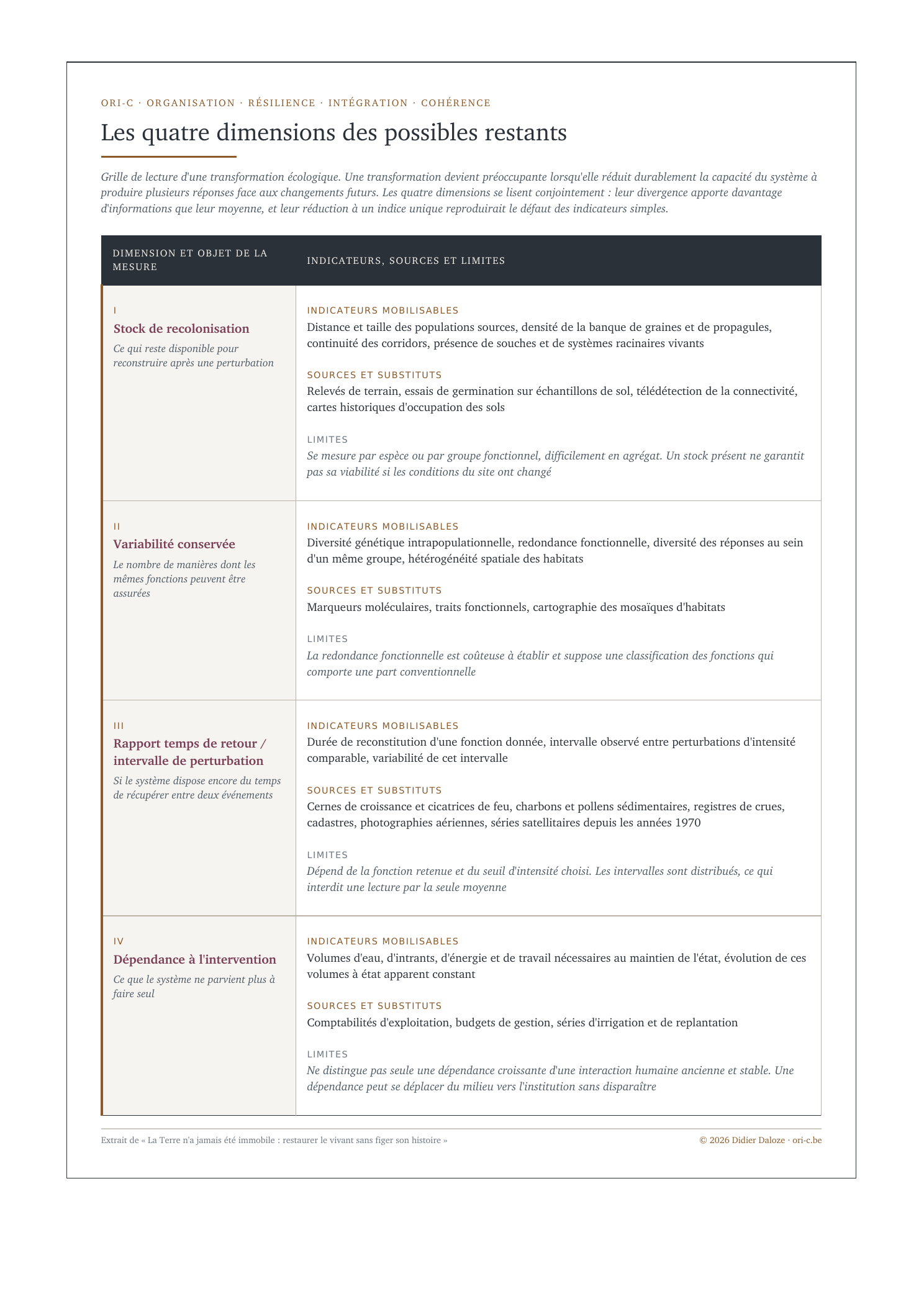
Four dimensions make it possible to explore this framework. The first concerns the stock of recolonisation : the presence and proximity of source populations, banks of seeds, eggs or spores, habitat continuity, living stumps and root systems. Their maintenance preserves for the system the means of rebuilding certain populations and functions after a disturbance. Their disappearance closes trajectories even when the landscape quickly regains a vegetated appearance.
The second concerns preserved variability : genetic diversity within populations, the presence of several organisms able to fulfil similar functions, habitat heterogeneity and diversity of responses to a single disturbance. In the framework proposed here, having several ways of ensuring a function amounts to preserving more responses when conditions change. A single-species plantation may thus display a high biomass while offering a far narrower range of responses to a disease, a drought or another disturbance targeting the dominant characteristics of the stand.
The third concerns the ratio between the return time of a function and the interval between disturbances. When events return faster than a component of the system can reconstitute itself, their effects accumulate. A forest facing severe droughts more closely spaced than certain stages of its regeneration, a peat bog subjected to new drying before recovering its hydrological functioning, or a reef struck by bleaching episodes before assemblages have reconstituted all follow this logic. The ratio varies with the function observed; its interest comes precisely from this capacity to distinguish different speeds of recovery within one and the same environment.
How this ratio is computed
This temporality can be reconstructed well beyond contemporary ecological monitoring. Tree rings record episodes of stress and certain fire histories, lake sediments and peat cores preserve pollen, charcoal and other traces of ancient changes, while administrative archives, flood registers, land registers, aerial photographs and satellite series extend observation over several decades or centuries. These sources do not all measure the same thing, but confronting them makes it possible to reconstruct the rhythms at which a territory has changed and recovered.
The fourth dimension concerns dependence on outside intervention. Irrigation, fertilisation, pumping, dyke maintenance, repeated suppression of certain disturbances or regular replanting can durably maintain a state. A growing dependence becomes worrying when preserving the same functions demands ever more water, energy, labour or outside correction. The signal then comes from the gap between a relatively stable appearance and the increase in the means needed to maintain it. This reading distinguishes a growing dependence from an old and stable human interaction. Some grasslands, heaths and agricultural mosaics rich in biodiversity have rested for centuries on regular practices; their functioning already belongs to a socio-ecological history in which humans are part of the system.
These four dimensions interact and would lose much of their interest if reduced to a single index. A high plant cover may mask a growing water consumption. A high species diversity may coexist with a fragmentation that weakens the possibilities of recolonisation. An intervention may long maintain an attractive landscape while progressively increasing its dependence. Their divergence often carries more information than their average.
The framework becomes useful when it produces hypotheses that observation can confront with the real. Under comparable conditions, environments with very different capacities of recolonisation should display different trajectories after certain disturbances. A restoration that rapidly increases plant cover while developing a water demand above the available resources should become more vulnerable during dry episodes. A system whose maintenance needs continually rise should reveal that dependence when inputs decrease. These predictions can be refined, corrected or abandoned as observations accumulate. The possibility of being contradicted by the real is part of the framework.
It remains to specify what it does not seek to do. It designates no ideal trajectory and ranks no values. It distinguishes above all the transformations that preserve several possibilities from those that durably close some of them. A society may choose a transformation that removes options in exchange for a benefit considered essential. It must then own that as a trade-off rather than present the intervention as neutral.
The case of introduced species shows this difference well. A new species may locally increase species richness while reducing native populations, homogenising certain habitats or entailing a durable dependence on control operations. The number of species may then rise while certain possibilities of the system diminish. Other introductions integrate without causing any clearly demonstrated loss of local functions or capacities. Refusing them nonetheless may remain a legitimate choice in the name of biological heritage, the integrity of local lineages or an intrinsic value granted to native species, but the argument then changes register. This distinction separates what belongs to observation from what belongs to collective choice.
An asymmetry remains between trajectories. Extinction definitively closes a possibility, whereas other transformations can be partly corrected. A novelty that locally adds a state while suppressing an irreplaceable possibility therefore never reduces to a simple accounting balance of the number of species or functions present.
Two reforestation programmes, four dimensions: a comparative scenario
To make this grid more concrete, imagine two programmes conducted in the same Sahelian bioclimatic zone, on comparable areas and with the same objective of restoring degraded land. This is a stylised scenario, meant to show how the four dimensions can lead to reading differently two interventions that appear similar in the usual indicators.
The first programme rests mainly on planting: production of seedlings in a nursery, selection of several suitable species, planting out, protection of the young trees and support during their establishment phase. The second favours assisted natural regeneration: protection of the stumps, roots and shoots already present in the plots, selection of certain shoots, and combination with local water-harvesting techniques such as zaï, half-moons or stone bunds.
After a few years, simple indicators may show similar results: area treated, number of stems, plant cover or biomass. The grid proposed asks something else. The stock of recolonisation of the planting programme depends notably on the diversity and provenance of the plant material used, whereas assisted regeneration draws directly on part of the biological stock already established on the site. The comparison changes if the seedlings come from genetically diverse and well-adapted material or if, on the contrary, local regeneration rests on populations already much impoverished. The method used therefore does not suffice to determine the result; it modifies the parameters that must be observed.
The same logic applies to variability. A plantation using few species or few provenances concentrates ecological responses more, whereas a regeneration mobilising a diverse local pool may preserve more heterogeneity. The reverse remains possible when a site is so degraded that its local stock has already lost much of that diversity. The grid precisely avoids automatically granting superiority to one technique.
The ratio between return time and disturbance interval then makes it possible to look at the speed at which the two systems become autonomous. A young seedling whose root system remains shallow and a shoot connected to an old stump do not necessarily pass through a severe drought occurring two years after the intervention in the same way. This difference becomes measurable: time needed to reach sufficient water autonomy, mortality after drought, capacity to recover and speed of reconstitution.
Dependence on intervention finally offers another reading. The first programme may require, depending on local conditions, watering, replacement or physical protection during its establishment. The second may depend more on rules of use, on the rights granted to farmers over the trees preserved, or on protection against certain pressures. A material dependence may thus be replaced by an institutional dependence. The comparison consists less in asking which one disappears than in knowing which one remains sustainable over time.
The scenario then produces a simple prediction. If the two programmes appear equivalent after five years but respond differently to a severe multi-year drought, the initial indicators will have masked a difference of capacity. If they react in the same way despite very different profiles across the four dimensions, the discriminating power of the framework will have to be reviewed. The scenario thus becomes a way of formulating tests rather than a demonstration obtained in advance.
The Great Green Wall and the scale of the Earth system
The large greening programmes conducted in some arid regions of China show how complex these interactions become when the intervention changes scale. They have made it possible to increase plant cover, stabilise certain soils and limit various forms of erosion. They have also shown that a substantial increase in vegetation modifies the water cycle. In some basins, increased evapotranspiration reduces the moisture available in soils or watercourses; elsewhere, interactions between vegetation and atmosphere take part in the regional recycling of moisture. The result depends on the climate, the soil, the species used, the plant density and the scale considered. The progression of plant cover therefore does not suffice to answer the question of long-term viability.
The African Great Green Wall belongs directly to this reflection. The initial idea centred on a vast tree barrier has evolved toward a far broader approach founded on a mosaic of land uses, natural regeneration, soil restoration, agroforestry and water conservation. The FAO today explicitly describes the initiative as an integrated approach resting on different systems of vegetation and land use rather than as a simple « wall of trees ».
This evolution better matches the complexity of Sahelian dynamics. It also reminds us that no single method can be generalised across the whole Sahelian belt. In some heavily degraded landscapes, the FAO notes that enrichment with well-adapted native species, combined with rainwater-harvesting works, may be more effective than a natural regeneration that is too slow or has become insufficient. The relevant distinction therefore opposes less planting and regeneration than a restoration adapted to the real capacities of the site versus an intervention applied independently of them.
Modifying plant cover over very large areas also acts on albedo, evapotranspiration, surface temperatures, atmospheric humidity, dust and the exchanges of energy between soil and atmosphere. When the areas concerned reach millions of hectares, these modifications extend beyond the territory directly restored. The atmosphere, water and material transfers follow their own continuities and ignore administrative boundaries.
At this scale, ecological intervention touches part of the functioning of the Earth system. Restoring soils or favouring plant regeneration remains profoundly different from a geoengineering project designed deliberately to modify the planetary climate. The scale nevertheless brings the two questions together on one essential point: an intervention founded on natural mechanisms can acquire a systemic reach once it extends far enough. Calling a solution natural says nothing about the extent of its consequences. Planting a few hectares, restoring a catchment and modifying land cover over several million hectares engage neither the same feedbacks nor the same responsibilities.
Preserving the possibility of correcting our own errors
Not all transformations present the same level of risk, and reversibility exists by degrees. An agricultural practice can be modified within a few years, whereas a rewetted peat bog recovers certain functions without reconstituting, on a human timescale, the centuries of peat already lost. A forest can regenerate, sometimes with a different composition, whereas the extinction of a species definitively closes a trajectory. Some ecological or hydrological regimes can also cross thresholds beyond which return becomes extremely difficult.
Research on regime shifts and tipping points reinforces the importance of this question. Complex systems can absorb a growing pressure for a long time before rapidly changing their functioning. A lake subjected to excessive nutrient inputs, a forest weakened by several successive droughts or a progressively dried peat bog can reach states whose restoration becomes far more difficult than the prevention of their degradation. Waiting for visible collapse then leaves little room to act.
Reversibility can become a criterion in the design of projects. Intervening progressively where scale permits, keeping control areas, maintaining little-transformed refuges, preserving sufficient genetic diversity, comparing several strategies and avoiding the uniform application of a single solution all make it possible to learn before committing the whole territory. A transformation carried out in stages preserves more possibilities of correction than a homogeneous change applied simultaneously on a very large scale.
Ecological reversibility nevertheless represents only part of the problem. An intervention also creates economic, legal and social commitments that can lock in far faster than the environment itself. A dyke protects a space, that space becomes developable, housing appears, loans are taken out, and the organisation of the territory ends up depending on the presence of the structure. A few decades later, the plain may remain physically available to recover a flood-expansion function, but returning it to the river becomes socially and economically far more difficult.
An industrial plantation may in turn create a supply chain, a processing plant, jobs, supply contracts and sometimes commitments tied to carbon permanence. An irrigated perimeter distributes water rights and supports investments built around the future availability of that resource. The initial solution thus creates its own path dependence: the more activities are structured around it, the more costly and conflictual it becomes to call it into question.
This dimension adds a question to the preceding four: how many actors will have an interest, in fifteen or twenty years, in maintaining this intervention, and what capacity will they have to prevent its revision? The answer does not condemn the project, but it informs us about a form of reversibility rarely measured in ecological studies.
Design choices can limit certain lock-ins: revisable rather than permanently fixed rights, review clauses at regular intervals, guarantees for decommissioning where that might become necessary, or financing that avoids making any later adaptation economically impossible. Lock-in is not, moreover, always unfavourable to the living. A protection status, a transboundary agreement or a use right guaranteed to a community may likewise make certain decisions hard to undo while preserving ecological possibilities. The question then bears on what we choose to render durably difficult to modify.
Ecological time far exceeds political time
Our decision calendars rarely match the temporalities of the living. A parliamentary term lasts a few years, a funding programme often less than a decade, whereas a forest, an aquifer, a deep soil or a food web may respond over several decades. Some effects become visible when those initially responsible for the project have long since left their posts. A plantation may rapidly stabilise a soil while slowly modifying deep water reserves. A dyke may effectively protect a zone for several decades while in parallel favouring an urbanisation that will make any future breach far more costly. A greening programme may show spectacular results after ten years and reveal its limits before extreme droughts much later.
This difference of temporality mechanically favours rapid indicators that are easy to communicate. Numbers of trees planted, hectares restored, volumes of water stored or tonnes of carbon estimated make it possible to show that an action took place within the calendar of those who decided it. Functional diversity, capacities of recolonisation, changes in water reserves or growing dependence on maintenance call for far longer monitoring. Their low institutional visibility comes as much from this temporality as from the real difficulties of measurement.
Managing the living therefore requires institutions able to carry a memory beyond political alternation. Long-term observatories, accessible data series, multi-year funding, independent evaluations and regular procedures of revision can ensure that continuity. The International Commission for the Protection of the Rhine offers an example of cooperation organised at the scale of a large transboundary basin. Its work brings water quality, ecological functioning, flood management and other uses of the Rhine into a perspective shared by several States.
On a more local scale, the French water development and management schemes rest on Local Water Commissions organised around catchments. In the Authion basin, local authorities, user representatives, professional organisations, associations and administrations take part in the same planning structure. The commission's present composition remains organised in three colleges representing these different categories. These arrangements make neither conflicts nor power relations disappear, but they illustrate an essential idea: bringing the territory of decision as close as possible to that of the ecological process concerned. A river remains the same system when it crosses several borders, and an atmospheric circulation does not stop when it changes jurisdiction.
Participating does not mean having the same power
Involving the populations concerned improves knowledge of the territory and makes visible social consequences that technical expertise may underestimate. This participation does not efface power relations. A large company, an administration, an environmental organisation, an isolated farmer and a resident have very different amounts of time, legal expertise, financial means and capacity to influence. An open procedure may reproduce existing inequalities when the best-organised actors occupy most of the decision space.
Participation also has a cost in time, and some situations demand rapid action. Interminable consultations may favour the groups with the most availability, while those who directly live the consequences sometimes have little time to take part in technical meetings. Consultation also loses its meaning when it serves only to validate a decision already taken. Credible participation requires accessible data, transparent rules, sufficiently diverse representation and a real capacity to modify the decision.
Local knowledge likewise brings valuable understanding. Some societies have long developed modes of management resting on the observation of seasons, fire, water, vegetation and animals. Extensive grazing, certain forms of agroforestry, collective water management or ancient burning practices show that human interaction can sustain ecological dynamics instead of simply interrupting them. Their interest lies notably in their temporal depth: several generations of observation may reveal changes that a recent scientific programme still struggles to measure. Confronting them with scientific knowledge widens the analysis and reconnects timescales that our institutions often separate.
From control to care
Adaptive management takes on its full meaning in this context. It regards an intervention as an action meant to evolve according to the environment's responses. Projects can be deployed progressively, compared across several territories, accompanied by control areas and monitored long enough to identify unexpected effects. The quality of an environmental policy then depends as much on its capacity to learn as on the decision taken at the outset.
This way of acting comes close to a broader notion, that of care. Caring for an ecosystem amounts to observing, repairing where the situation demands it, adjusting practices, following responses and sometimes reducing or withdrawing an intervention when its effects become counterproductive. Care recognises an autonomy in the living system and admits that it has trajectories of its own. It thus offers an alternative to two opposite reflexes: abandoning entirely an already deeply degraded environment, or intervening permanently to maintain a chosen form artificially.
A growing dependence on our interventions can, moreover, become a warning signal. If maintaining the same state demands ever more water, energy or upkeep, part of its stability has been transferred to the means we supply it. Some environments have nevertheless long rested on regular human interaction. What is at stake is then to distinguish the interaction that sustains a viable dynamic from the one that continually compensates for the consequences of its own weakening.
Which value do we want to preserve?
Behind all these decisions remains an ethical question irreducible to an indicator. Why preserve an ecosystem? Because it supplies water, food, fertile soils, carbon storage or protection against certain disasters? Because future generations should have possibilities comparable to ours? Because the species and processes of the living have a value independent of their human usefulness?
These justifications may converge or lead to different choices. A forest optimised for carbon storage may offer less diversity than a mosaic of environments. A river developed to produce energy judged necessary may lose part of its ecological functions. A wetland of great biological value may come into conflict with important agricultural needs. Recognising an intrinsic value in the living does not make these tensions disappear. It simply means that its value no longer depends exclusively on what it supplies to human beings.
Science can measure populations, model water, compare scenarios, estimate risks and identify the transformations that close certain possibilities. It cannot automatically rank essential human needs, the survival of a species, the conservation of a landscape and the interests of generations not yet present. That share of the choice belongs to ethics and politics. Making it explicit prevents a trade-off between values from being presented as a mere technical conclusion.
Referring these choices to collective deliberation does not entirely resolve the problem, since several concerned parties have no direct voice in it. Future generations are absent by definition. Other species are too, while the weakest human actors may be formally represented while remaining dominated in the negotiation. Several institutions have tried to answer this difficulty. In Wales, the Future Generations Commissioner has an independent role provided by law in order to promote consideration of the long-term effects of public decisions and to defend the capacity of future generations to meet their needs.
Other experiments go further in representing the living. In New Zealand, the 2017 act relating to the Whanganui River recognises Te Awa Tupua as a legal person whose rights and responsibilities are exercised by designated representatives. This arrangement obviously does not give the river a literal voice; it modifies the legal framework through which its interests can be defended.
These experiments do not remove the problem of representation. No one can question an unborn generation or ask a peat bog which trajectory it prefers. The framework of remaining possibilities offers a more limited answer here: rather than claiming to know future preferences, it seeks to avoid needlessly removing the choice. Preserving several trajectories nevertheless has a present cost, borne by very real people. Environmental justice therefore returns to the centre of the problem: preserving tomorrow's possibilities cannot rest systematically on the same populations today.
This perspective transforms certain contemporary debates about conservation. Transmitting exactly the forest, the river or the savannah we have known will sometimes become impossible in a changing climate. Assisted migration provides a particularly revealing example: deliberately moving certain populations toward territories that have become climatically favourable may preserve their capacity to persist while transforming local communities and introducing new interactions. The practice remains debated because it confronts two visions of conservation: maintaining a historical composition, or preserving possibilities of survival when the conditions that produced that composition disappear.
Transmitting open paths
Valuing the dynamic of the living cannot serve as a pretext for the rapid destructions caused by habitat fragmentation, pollution, resource overexploitation or climate change. The speed and scale of certain human transformations exceed the adaptive capacities of many organisms and durably simplify systems. The opposite error would be to seek to maintain everywhere the landscapes and species distributions corresponding to a precise era while the conditions that produced them are already changing.
Between these two extremes lies one of the major ecological challenges of our century: recognising the dynamics that sustain the capacities of the living, restoring those we have profoundly altered, avoiding irreversible thresholds as far as possible, distributing the costs and benefits of our decisions more fairly, and preserving enough options to correct our own trajectories.
The Earth has functioned for billions of years through exchanges, disturbances, migrations, feedbacks and transformations. Our technical power now allows us to influence these dynamics over immense areas and within a few decades. This capacity creates a new responsibility: intervening where degradation demands it without forgetting that we act inside a system whose responses always exceed part of our forecasts.
Protecting the living finally amounts less to choosing the form the world must preserve than to preserving the conditions that will still allow it to change. Our responsibility then bears on the transmission of species, landscapes and resources, but also of systems still able to produce their own responses, with enough diversity, space and freedom to continue their history without our wish to do well having closed off in their stead the paths they could still have taken.
Indicative bibliography
Moving references and novel ecosystems
Pauly, D. (1995). Anecdotes and the shifting baseline syndrome of fisheries. Trends in Ecology & Evolution, 10(10), 430.
Hobbs, R. J., Higgs, E., & Harris, J. A. (2009). Novel ecosystems: implications for conservation and restoration. Trends in Ecology & Evolution, 24(11), 599–605.
Resilience, redundancy and response diversity
Holling, C. S. (1973). Resilience and stability of ecological systems. Annual Review of Ecology and Systematics, 4, 1–23.
Elmqvist, T., Folke, C., Nyström, M., Peterson, G., Bengtsson, J., Walker, B., & Norberg, J. (2003). Response diversity, ecosystem change, and resilience. Frontiers in Ecology and the Environment, 1(9), 488–494.
Thresholds, regime shifts and early-warning signals
Scheffer, M., Carpenter, S., Foley, J. A., Folke, C., & Walker, B. (2001). Catastrophic shifts in ecosystems. Nature, 413, 591–596.
Scheffer, M. et al. (2009). Early-warning signals for critical transitions. Nature, 461, 53–59.
Suding, K. N., Gross, K. L., & Houseman, G. R. (2004). Alternative states and positive feedbacks in restoration ecology. Trends in Ecology & Evolution, 19(1), 46–53.
Disturbance regimes, ecological memory and return times
Turner, M. G. (2010). Disturbance and landscape dynamics in a changing world. Ecology, 91(10), 2833–2849.
Johnstone, J. F. et al. (2016). Changing disturbance regimes, ecological memory, and forest resilience. Frontiers in Ecology and the Environment, 14(7), 369–378.
Hughes, T. P. et al. (2018). Spatial and temporal patterns of mass bleaching of corals in the Anthropocene. Science, 359(6371), 80–83.
Pickett, S. T. A. (1989). Space-for-time substitution as an alternative to long-term studies. In G. E. Likens (ed.), Long-Term Studies in Ecology: Approaches and Alternatives, 110–135. Springer.
Sahara and the African Humid Period
deMenocal, P. et al. (2000). Abrupt onset and termination of the African Humid Period: rapid climate responses to gradual insolation forcing. Quaternary Science Reviews, 19(1–5), 347–361.
Claussen, M. et al. (1999). Simulation of an abrupt change in Saharan vegetation in the mid-Holocene. Geophysical Research Letters, 26(14), 2037–2040.
Wright, D. K. (2017). Humans as agents in the termination of the African Humid Period. Frontiers in Earth Science, 5, 4.
Development cases
Micklin, P. (2007). The Aral Sea disaster. Annual Review of Earth and Planetary Sciences, 35, 47–72.
Koebel, J. W. (1995). An historical perspective on the Kissimmee River restoration project. Restoration Ecology, 3(3), 149–159.
Rijke, J., van Herk, S., Zevenbergen, C., & Ashley, R. (2012). Room for the River: delivering integrated river basin management in the Netherlands. International Journal of River Basin Management, 10(4), 369–382.
Peat bogs and afforestation
Friggens, N. L. et al. (2020). Tree planting in organic soils does not result in net carbon sequestration on decadal timescales. Global Change Biology, 26(9), 5178–5188.
Large-scale greening and the Great Green Wall
Feng, X. et al. (2016). Revegetation in China’s Loess Plateau is approaching sustainable water resource limits. Nature Climate Change, 6, 1019–1022.
Reij, C., Tappan, G. G., & Smale, M. (2009). Agroenvironmental transformation in the Sahel: another kind of “Green Revolution”. IFPRI Discussion Paper 00914.
Garrity, D. P. et al. (2010). Evergreen agriculture: a robust approach to sustainable food security in Africa. Food Security, 2, 197–214.
FAO. (2020). Restoration in Action Against Desertification: A manual for large-scale restoration to support rural communities’ resilience in the Great Green Wall Programme.
FAO. Great Green Wall for Ecosystem Restoration and Peace. Forest and Landscape Restoration Mechanism.
Assisted migration
Hoegh-Guldberg, O. et al. (2008). Assisted colonization and rapid climate change. Science, 321(5887), 345–346.
Ricciardi, A., & Simberloff, D. (2009). Assisted colonization is not a viable conservation strategy. Trends in Ecology & Evolution, 24(5), 248–253.
Adaptive management, commons and governance
Walters, C. J. (1986). Adaptive Management of Renewable Resources. Macmillan.
Ostrom, E. (1990). Governing the Commons: The Evolution of Institutions for Collective Action. Cambridge University Press.
Ostrom, E. (2009). A general framework for analyzing sustainability of social-ecological systems. Science, 325(5939), 419–422.
International Commission for the Protection of the Rhine. The Rhine and the three pillars of sustainable management.
Local Water Commission of the Authion SAGE / Gest'eau. SAGE of the Authion catchment.
Future generations and representation of the living
Well-being of Future Generations (Wales) Act 2015.
Future Generations Commissioner for Wales. Role and functions of the Commissioner.
New Zealand Parliament. (2017). Te Awa Tupua (Whanganui River Claims Settlement) Act 2017.
Lock-ins and path dependence
Arthur, W. B. (1989). Competing technologies, increasing returns, and lock-in by historical events. The Economic Journal, 99(394), 116–131.
Pierson, P. (2000). Increasing returns, path dependence, and the study of politics. American Political Science Review, 94(2), 251–267.
Unruh, G. C. (2000). Understanding carbon lock-in. Energy Policy, 28(12), 817–830.
Ecosystem services
Millennium Ecosystem Assessment. (2005). Ecosystems and Human Well-being: Synthesis. Island Press.
© 2026 Didier Daloze · ori-c.be — Author and designer of the ORI-C framework. All rights reserved.