From transformation to memory
Reality never presents itself as a collection of finished objects. Every structure carries the effects of the interactions, constraints and transformations that made it possible. Part of those effects disappears. Another part remains inscribed in trajectories, forms, compositions and relations. The present thus preserves a historical depth.
This history runs through physics, cosmology, biology, living systems and knowledge. Moving from one level to another involves changes of regime: the mechanisms that stabilise a particle, a star, a cell or a society are not identical. Their continuity is nevertheless built around a single problem, that of lasting in the midst of transformations.
Interactions produce differences. Some differences become traces. Preserved traces form a material history. Living systems mobilise that history in their functions. The observer turns part of the traces into representations. Numbers and geometries stabilise operations. Civilisation reintroduces those representations into the world.
From matter to knowledge, history gradually changes status. It is first inscribed in structures, becomes functional in living systems, collective in cultures, then symbolic and reflexive in human systems. At each stage an organisation preserves certain dependencies, transforms its constraints and opens new possibilities without leaving materiality behind.
| What lasts never lasts through its constituents alone. |
|---|
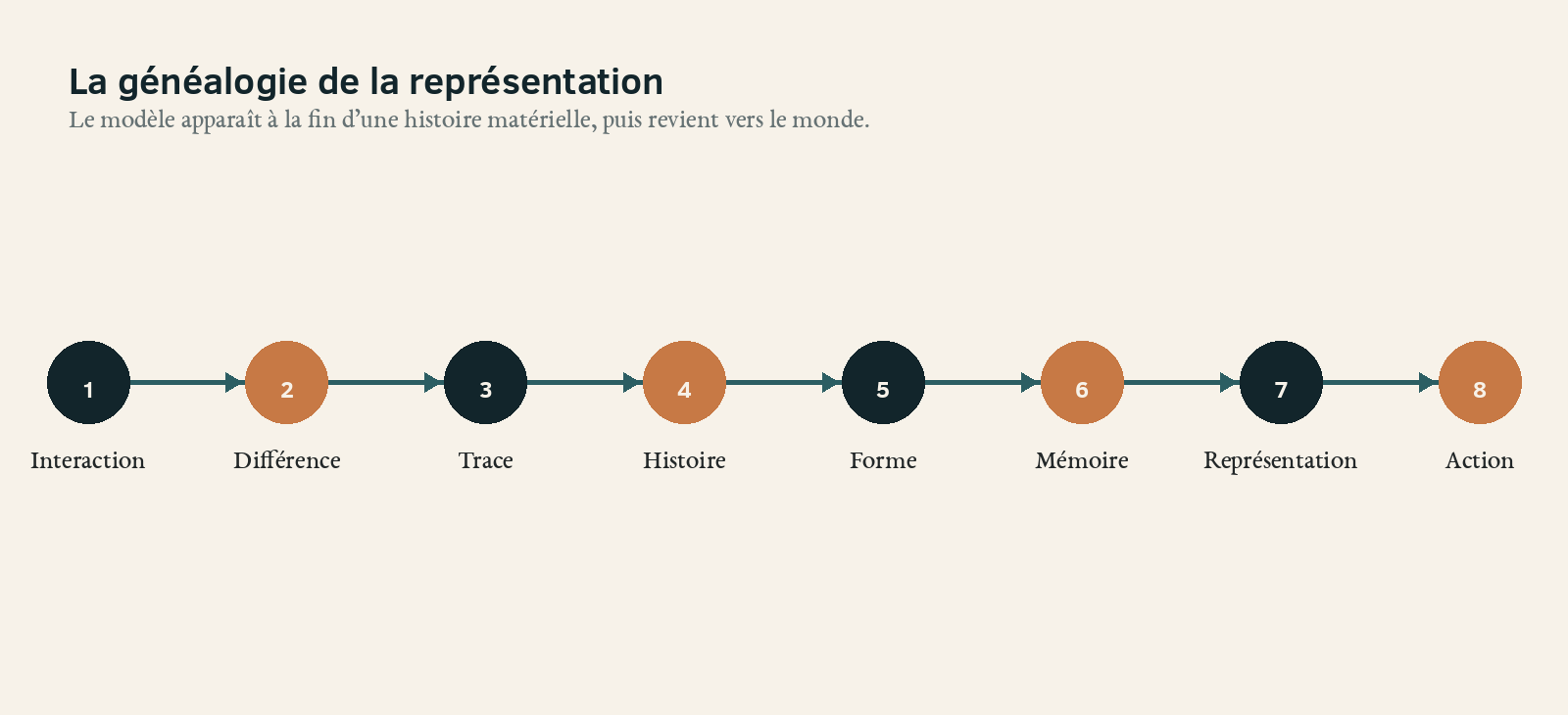
The general trajectory of the book, from phenomenon to action.
Contents
PART ONE · Reality has a history 01 When an interaction becomes a trace 02 The Universe as material and historical memory 03 QSO1, excess as archive 04 The archaeology of the void, absence as trace PART TWO · Constraints, forms and persistence 05 The habitability of constraints 06 Nothing is renewed for free 07 A series of transitions of persistence 08 Complexity, robustness and persistence PART THREE · When history becomes alive 09 When form preserves history |
10 LUCA and continuity become inheritance 11 Memories without humans 12 From organisational autonomy to reflexive autonomy 13 From exosomatisation to reflexive autonomy 14 Meeting your history from the other side PART FOUR · When the world becomes able to reread itself 15 The observer as memory of the world 16 Number as the trace of an operation 17 The geometric deformation of living systems PART FIVE · Knowledge returns towards the world 18 Learning from the unforeseen 19 Human civilisation, learning to become earthly |
|---|
Opening
We have inverted the order of dependence
Numbers, forms and models come from a material history. Their power becomes destructive when they forget that origin and claim to command reality on their own.
We live among representations that have become so familiar that they sometimes seem more real than what they represent. Numbers organise exchanges, maps divide territories, models describe phenomena, equations link quantities and technologies transform the world from data. Their effectiveness has ended up masking their origin.
No number appears before a difference can be recognised, preserved and reproduced. No geometry precedes the experience of a space, the perception of forms and the establishment of relations between them. Every representation is born of an encounter with reality, and then of a work of selection, stabilisation and translation. It preserves some relations and abandons others.
The inversion begins when that origin disappears. Forms extracted from reality become the architectures supposed to command it. Numbers issuing from operations of distinction take on the appearance of autonomous properties. Models built to make a phenomenon intelligible end up defining what the phenomenon ought to be.
This inversion affects our understanding of living systems in particular. An organism can be described by its form, its mass, its chemical composition, its genome or the functions of its organs. Its continuity nevertheless plays out in the renewal of constituents, the opening of boundaries, the circulation of flows, the repair of structures and the relation to its milieu. Identity runs through transformations without being reducible to a motionless state.
From interaction to action: the general path of the book.
The same difficulty runs through our reading of the Universe. Its history is often told as a succession of ever more complex objects. Particles appear, then atoms, stars, planets, molecules, organisms and consciousnesses. That chronology leaves the deeper mechanism of the transitions in shadow. The Universe produces new ways of lasting.
A stable particle, an atomic nucleus, a star, a cell and a civilisation do not persist in the same way. Each depends on a particular regime of interactions, constraints and exchanges. The guiding thread of this history lies in the appearance of mechanisms able to prolong certain configurations, preserve the effects of the past and open new possibilities.
Matter first carries the effects of what has happened to it. A collision modifies a trajectory, a reaction transforms a composition, a pressure deforms a structure. When those changes are preserved, the present becomes the bearer of a past. Living systems make certain inscriptions active in repair, learning, transmission and the transformation of environments.
Long before human beings, memory already exceeds the individual. Organisms modify their niches, animal groups transmit routes, techniques and vocalisations, ecosystems preserve the effects of earlier successions. With human beings, this externalisation changes scale. It becomes fixed in signs, narratives, archives, maps, numbers, institutions and machines. Human singularity lies in the symbolic and reflexive power of that memory, not in its absolute appearance.
This capacity creates an unprecedented power. A representation can return towards reality and transform it. An equation makes it possible to build a machine. A map makes it possible to organise a territory. An economic model orients the circulation of resources. Knowledge re-enters the world and changes the future conditions of its development.
The problem arises when that return loses contact with its origin. Whatever escapes the model becomes an anomaly to be eliminated, even when that anomaly reveals a limit of the framework. Margins shrink, redundancies disappear and living constraints are treated as technical obstacles.
This book follows the genealogy that links interaction, trace, history, form, memory, autonomy, representation and action. It shows how two long-separated errors come from the same inversion. We deform living systems by reducing them to forms detached from their history. We misunderstand the evolution of the Universe by describing it as an abstract progression towards complexity.
Reality reaches us in the form of a world already transformed by what preceded it. Every structure carries a history, every organisation depends on relations and every continuity has a cost. Memory begins when the past stops disappearing entirely.
Conceptual landmarks
A common grammar for the whole book
The same words often change meaning when we move from physics to living systems, and then from living systems to knowledge. The following distinctions fix their use in this book and prevent analogies from becoming equivalences.
The path rests on a simple difference. Everything that preserves an effect of the past carries a history, but not every historical inscription constitutes a memory in the same sense. The levels are distinguished by the way the past remains available and by the function it receives within the present organisation.
Interaction. A relation in the course of which several elements, processes or fields modify their respective states. Interaction produces a difference between a before and an after.
Trace. A durable difference left by a transformation. It preserves an effect of the event without containing the event itself.
Inscription. The physical, biological, ecological or symbolic support in which a trace remains accessible. An inscription can cross time without being used by the system that carries it.
History. A chain of transformations of which the present state preserves part of the consequences. History becomes reconstructible when several traces can be linked to a trajectory.
Memory. The capacity of an organisation to mobilise a past inscription in its present functioning. Immunity, learning and a social tradition belong to this regime. A biogeochemical cycle carries a historical dependence, but on its own it does not constitute a cognitive memory.
Persistence. The continuity of an organisation across the renewal of its constituents, perturbations and changes of context. What persists preserves certain relations by rebuilding their conditions.
Habitability. The relative compatibility between a regime of constraints and the continuation of an organisation. The same condition can sustain one form, weaken another or become destructive when its duration exceeds the capacities for recovery.
Autonomy. The capacity to regulate some of the dependencies required for one's own continuity. Autonomy increases when an organisation can select its exchanges, maintain its functions and preserve its transformability.
Reflexivity. The capacity to integrate a representation of oneself, of one's history or of the consequences of one's actions into the modification of one's own functioning.
Two complementary chains
The first follows the material construction of organisations. The second follows the way a history gradually becomes legible, mobilisable and then representable. They cross without merging.
MATERIAL CHAIN Flows → constraints → organisation → persistence → history → possibilities |
MEMORY CHAIN Trace → inscription → functional memory → transmission → representation → reflexivity |
|---|
These landmarks remain open to changes of scale. A trace can become a memory when an organisation learns to use it. A memory can become a culture when it circulates socially. A representation becomes reflexive when it turns back on the rules that produced it.
Reality has a history
PART ONE Reality has a history From change to trace, and from trace to a reconstructible history. |
|---|
CHAPTER 01
When an interaction becomes a trace
An interaction becomes historical only when a difference crosses time. The trace is that minimal passage between event, inscription and possible future.
Everything begins with a transformation. Two particles interact, a wave meets an obstacle, a material changes phase, a star modifies its environment, a cell receives a signal. In each of these cases, reality passes from one configuration to another. The event creates a difference between an earlier and a later state.
That difference may disappear quickly. A deformation fades, an excitation dissipates, information blends into noise. It may also be preserved in a trajectory, a structure, a distribution of energy, a chemical composition or an organisation. The present then carries a durable effect of what took place.
A trace appears when a transformation remains inscribed in an accessible configuration. It is not the event itself. A footprint is not the step that produced it. The light received from a star is not the star at the moment it emitted that light. A scar is not the wound. Each preserves a difference that links the present state to an absent history.
The trace introduces a temporal asymmetry. Two situations may look similar while carrying different histories. An intact glass and a mended glass have comparable shapes, but the fracture lines inscribe a past in the material. An organism returned to a stable state after an illness retains part of the episode it went through.
The historical sciences depend on this preservation. Cosmology observes radiation emitted billions of years ago. Geology reads ancient pressures and displacements in the Earth's layers. Biology compares genomes to recover common lineages. Archaeology links objects to vanished human activities.
A trace selects certain effects and loses others. A photograph preserves a distribution of light from a particular point of view. It retains neither the sounds, nor the temperatures, nor all the relations present at the moment it was taken. The reach of a trace depends on its support and on the transformations it has undergone.
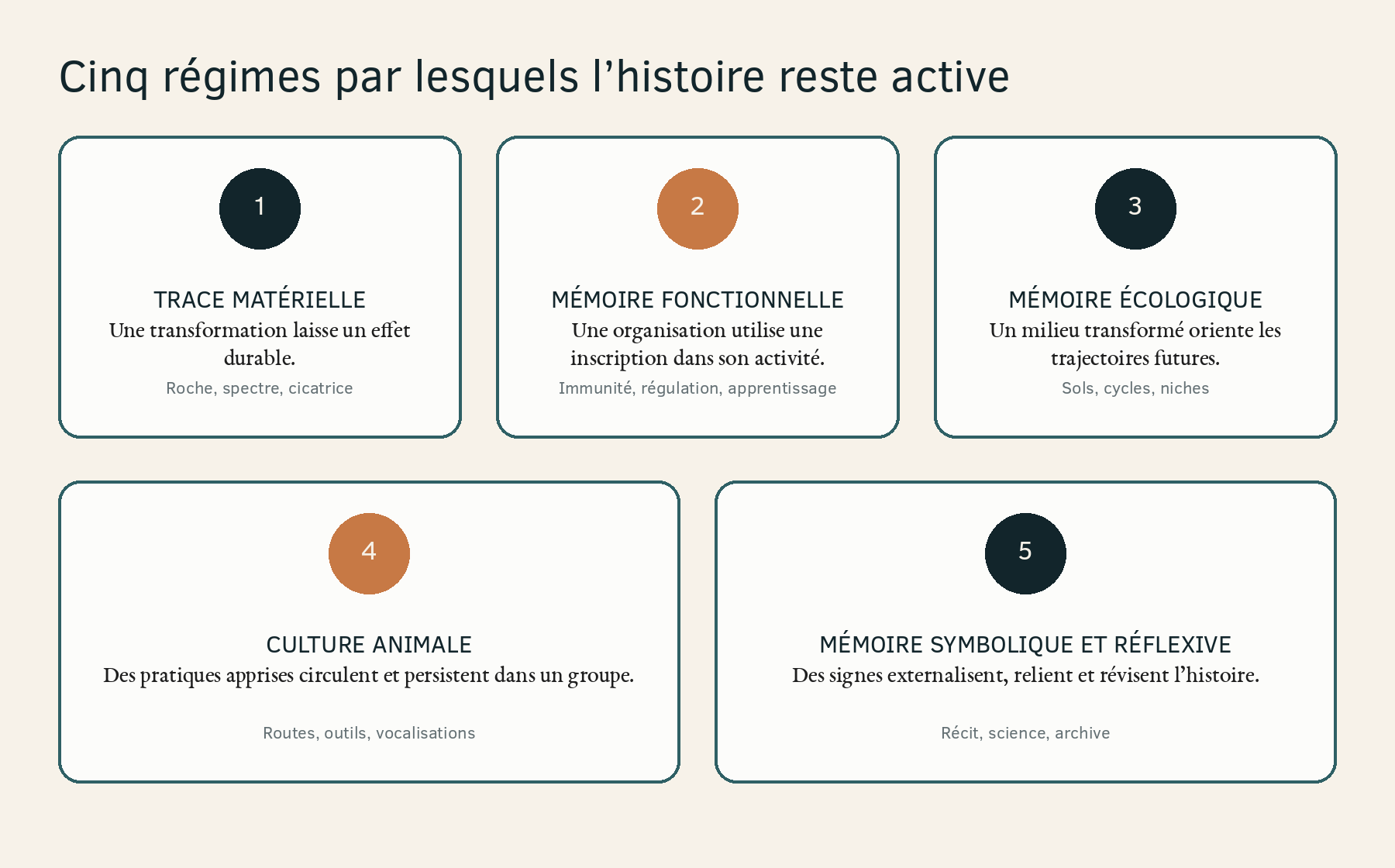
From the material trace to ecological, social and reflexive memories.
From effect to material document
A durable difference does not yet constitute a document. The word document presupposes that an inscription can be linked to what produced it. Matter, for its part, preserves effects without classifying them. A layer of ash, an isotopic variation, a fracture or a distribution of particles become documents when a system of observation establishes a correspondence between their present state and an earlier event. The trace exists physically before its interpretation, but its explanatory power depends on an operation of reading.
This distinction makes it possible to separate three levels that are often confused. The causal imprint designates a modification produced by an interaction. The record corresponds to a relatively stable, accessible and discriminable imprint. Functional memory appears when an organisation uses that record in its own activity. An exposed photographic plate preserves a distribution of light. An organism that modifies its conduct on the basis of a past experience mobilises a memory. Both belong to the material world, but they do not fulfil the same function.
The stability of the support plays a central role here. A trace requires a medium able to preserve a difference for longer than the event that produced it. Paper, DNA, sediments, synaptic connections and magnetic states offer different durations and fidelities. Each support selects what it can record. Its structure imposes a filter between the world that acts and the inscription that persists.
Reading adds a second filter. A light spectrum never delivers the history of a star on its own. It becomes informative thanks to theories, calibrated instruments, comparisons and computations. The reconstructed history results from the meeting between a resistance of reality and a framework of interpretation. The trace limits the possible narratives, while the framework decides which relations will be tested. This tension protects knowledge against two opposite drifts: believing that facts speak without mediation, or believing that every reading is as good as another.
The arrow of time as a modification of possibilities
The arrow of time appears concretely when transformations change the space of future possibilities. A broken glass can still be mended, but the return path calls on new operations, leaves joints and consumes energy. The final state does not erase the history of the passage. Configurations can be close without becoming equivalent.
This irreversibility does not require a fundamental law forbidding every microscopic return. It appears at the scale of organisations, where an immense number of relations would have to be rebuilt simultaneously. The more a structure depends on a history of couplings, the more improbable its exact return becomes. Historical time is formed in this gap between the abstract possibility of a reversal and the material reality of a reconstruction.
A trace then acts as a new condition. A scar modifies the resistance of a tissue. The bed of a river guides future flows. A transmitted mutation changes the range of variations accessible to a lineage. An institution inscribes procedures that orient subsequent decisions. The past does not exert a mysterious force from some elsewhere. It acts through the structures it has left in the present.
Causality then takes on a cumulative form. Each event depends on a state already charged with history, and then adds or removes possibilities. The transformation of reality resembles less a series of independent images than a construction of successive constraints. Traces make up the thickness of the present. They render some paths more probable, others more costly, and sometimes definitively inaccessible.
Time acts on traces. Some are erased, others deformed, superimposed or fragmented. Accessible history depends on what has resisted. An absence of inscription indicates that no legible consequence crossed the subsequent transformations, or that our means of observation cannot yet recognise it.
The material trace becomes functional memory when an organisation can use it. A cell modifies the expression of certain genes after a perturbation. An immune system retains a particular sensitivity to an agent already encountered. An organism learns to associate a signal with a danger or a resource.
The past then becomes a component of present action. It sometimes increases the capacity to respond, and it can also lock the system into a reaction that has become ill-adapted. An institution may preserve valuable knowledge or repeat rules devised for a vanished world.
Memory opens a tension between continuity and transformation. Without preservation, each event would disappear without durably modifying what follows. Without forgetting, reorganisation or reinterpretation, accumulated history would make the system rigid. Continuity requires a memory that is both stable and transformable.
The arrow of time becomes inseparable from the production of traces. The world changes in a way that modifies the conditions of subsequent transformations. An interaction closes some paths, makes others accessible, stabilises a structure or prepares a new organisation.
The Universe becomes legible because not all of its transformations disappear. Part of what happens remains inscribed in what comes next. Before a being could remember the world, the world already had to preserve the effects of its past.
CHAPTER 02
The Universe as material and historical memory
The cosmic present contains physical legacies that make history reconstructible, long before the appearance of any living memory.
Speaking of memory at the scale of the Universe calls for a precise distinction. A functional memory presupposes an organisation able to preserve an inscription, access it and use it. The Universe taken as a whole does not necessarily possess such an operative unity. It nevertheless carries a history. Its present states depend on earlier transformations and preserve measurable effects of them.
The cosmic microwave background offers a major example of this preservation. It carries information about the state of the plasma when light was able to circulate freely. Its minuscule variations testify to ancient differences that took part in the formation of later structures.
The abundances of the light elements likewise preserve a history. Hydrogen, helium and certain traces of lithium tell us about the conditions of primordial nucleosynthesis. The heavier elements recount another phase, that of stars, supernovae and mergers of compact objects.
This historical depth runs through every level of matter. The available atomic nuclei limit the possible chemical bonds. The molecules present open certain metabolic pathways. The geology of a planet conditions its cycles, its atmosphere and its environments. Living forms inherit an already transformed environment.
The present world resembles a reworked archive. The old pages have been partly erased, rewritten and incorporated into new structures. Reading this archive requires recognising the supports, the transformations and the losses.
A law expresses a regularity or a relation between quantities. It does not replace the concrete trajectory followed by matter. Two systems subject to the same laws can produce different histories depending on their conditions, their interactions and their bifurcations.
The physical archives of the cosmos
The cosmic microwave background, the abundances of the light elements, the distribution of galaxies and stellar spectra form archives of different kinds. Each preserves part of an ancient state within a present structure. The background carries the signature of an epoch when matter and radiation ceased to be tightly coupled. The proportions of hydrogen, helium and lithium retain the constraints of primordial nucleosynthesis. The large-scale structures reveal the growth of faint inhomogeneities under the action of gravitation.
These archives were not deposited in order to be read. They result from physical processes that left regularities stable enough to cross cosmic time. Reading them requires linking several scales. A spectral line depends on local quantum transitions, yet it makes it possible to estimate the composition, temperature and motion of an object billions of light-years away. A microscopic property thus becomes the instrument of a historical reconstruction.
The observable Universe presents a stratification of ages. Looking far often means receiving older light, without thereby gaining access to an intact past. The signal has crossed media, undergone expansion, met gravitational lenses and been selected by the limits of our instruments. Cosmological observation assembles heterogeneous temporal information within a single terrestrial present.
This situation reveals an essential property of knowledge: the past is never met directly. It becomes accessible through chains of transformation linking the event to the inscription, the inscription to the signal, the signal to the instrument and the instrument to the interpretation. The soundness of a reconstruction depends on the coherence of that entire chain.
A memory without a centre
Cosmic memory is not gathered in a single place. It is distributed across the relations between structures, radiations, compositions and motions. No centre contains the complete history. Each portion of the world preserves local effects of a vaster history, and relating them produces a partial image of cosmic evolution.
This distributed memory avoids personifying the Universe. The cosmos does not remember as an organism or a consciousness does. It remains marked by its transformations. The term memory here designates a capacity for material preservation, not an inner experience. This precision opens a conceptual continuity without erasing the differences of regime.
Matter can carry a history without using it. Living systems make certain inscriptions functional, then distribute them among organisms, generations and environments. Symbolic representation later adds explicit reconstruction, language and the archive. These regimes extend one another without merging.
The image of a historical Universe transforms the way we think about laws. A law expresses a regularity or a general constraint, but the current state of the world also depends on the trajectories actually followed. The same laws allow several histories. The structures observed result from what was possible, from what occurred and from what managed to persist. The law opens a space; history selects a path within it.
Constraints occupy a central place. A constraint limits the accessible transformations and channels trajectories. It may come from a conservation law, a spatial configuration, an environment or accumulated history. It organises a space of possibilities.
The Universe preserves its history by several routes. Some traces are spectral, others structural, chemical, topological or statistical. Some persist for a fraction of a second, others cross billions of years.
The human observer belongs to this history. Their organs, cognitive capacities, instruments and concepts come from a long material chain. When they observe the sky, one part of the Universe reconstructs other parts of its history.
The term memory becomes graded. At the first level, a transformation leaves an effect. At the second, that effect is preserved in a structure. At the third, an organisation uses the inscription in its functioning. At the fourth, it can represent that inscription, transmit it and confront it with other traces.
This continuity gives reality a depth that geometry alone cannot express. A geometry describes relations of position, form and transformation. History indicates how those relations became possible, which constraints selected them and what they make it possible to preserve.
Present forms become the provisional condensations of a transformed past. Their stability depends on mechanisms that reproduce certain relations. Their evolution depends on the margins they retain. Their reading depends on observers who themselves issue from this history.
CHAPTER 03
QSO1, excess as archive
A2744-QSO1 reveals the past through a disproportionate presence. The visible object acts as a positive archive and forces the formation scenarios to recover the history they had simplified.
Scientific models become particularly visible when an object resists the place they had prepared for it. QSO1 belongs to that category. Observed in the very young Universe, this system combines an already massive black hole with a compact and little-developed host galaxy.
The interest of QSO1 goes beyond the singularity of a distant object. Its light carries the state of an ancient system all the way to us. The observation imposes strong constraints on the trajectories able to produce it. The mass of the black hole, the size of the host, the composition of its environment and the cosmic epoch reduce the space of plausible scenarios.
A massive black hole in a Universe a few hundred million years old requires rapid growth. That growth may come from a more massive initial seed, from sustained episodes of accretion or from a combination of mechanisms. Each hypothesis has a cost in time, in available matter and in stability of the flow.
The small size of the host galaxy adds a tension. The relations observed in the more recent Universe often associate the mass of the black hole with the properties of the galaxy. QSO1 shows that such a relation may not always have existed in its present form.
This situation illustrates the difference between a law, a correlation and a history. A correlation that is stable across a large set of objects does not necessarily describe the causal order of each trajectory. It may be the late result of accumulated interactions, regulations and convergences.
QSO1 becomes an archive of a cosmic regime. Its disproportion preserves the effect of conditions different from those that dominate later. Its present structure carries the constraints of its formation and the margins it exploited.
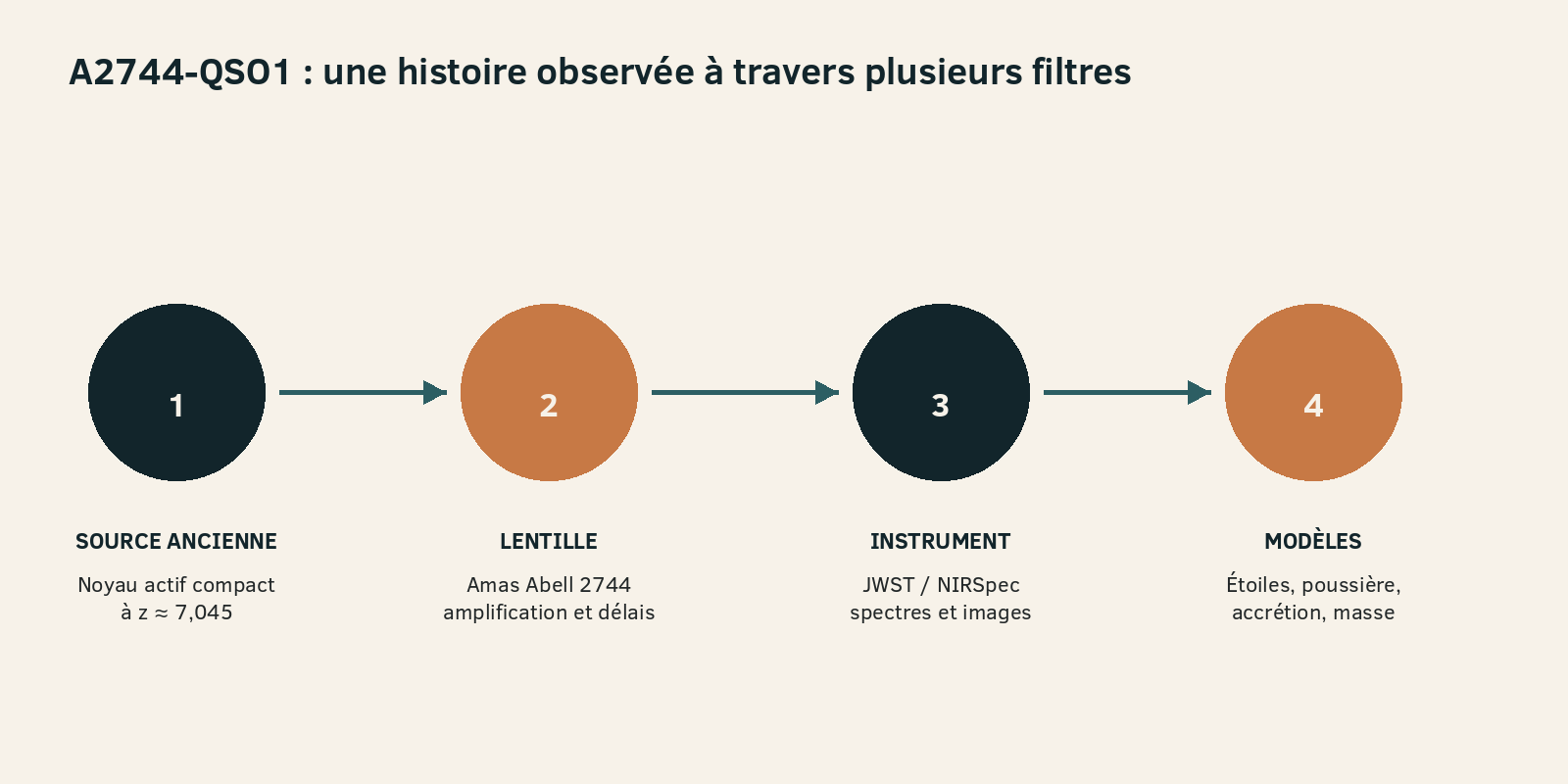
The ancient source becomes accessible through a chain of mediations.
An observation constructed by the lens
A2744-QSO1 is observed behind the galaxy cluster Abell 2744. The gravitation of the cluster deforms and amplifies the light of the distant source, producing several images of the same object. This natural lens increases our access to a very ancient world, while adding a layer of reconstruction. The source never appears separately from the gravitational structure that makes its observation possible.
The multiplication of images offers a rare advantage. Each light path has a different length and delay. The images therefore show the same source at slightly distinct moments of its history. This configuration turns the lens into a temporal device. Spectral variations can be compared without waiting for several years of terrestrial observation.
The first analyses identified a strongly reddened active nucleus at a redshift close to 7, with a black hole estimated at several tens of millions of solar masses. The ratio between the mass of the black hole and that of the host galaxy appeared far higher than the ratios measured in the local Universe. The object seemed to present an already massive black hole within a still limited stellar structure.
Subsequent work reinforced the interest of the source while making its interpretation more complex. Variable broad lines support the presence of an active nucleus. The continuum, the strong Balmer break, the absence of certain signatures and the extreme compactness resist simple models based solely on a stellar galaxy or on a classic active nucleus. A2744-QSO1 remains an object in which several possible histories overlap.
When an anomaly becomes productive
A scientific anomaly is valuable when it constrains the explanations without being turned too quickly into proof of a preferred theory. A2744-QSO1 does not by itself demonstrate a single scenario of black hole formation. It imposes a more precise historical question: which trajectories make it possible to obtain, so early, a source this compact, this red and this difficult to decompose?
Ancient reality reaches us in a form already filtered by cosmic expansion, dust, the gravitational lens and instrumental limits. The inferred properties depend on models of stellar population, accretion, extinction and magnification. A variation in any one of those models can strongly shift the estimated mass of the host galaxy. Uncertainty belongs to the very structure of the observation.
This difficulty does not diminish the reach of the object. It shows how a present structure preserves several layers of history: the formation of the black hole, the evolution of its environment, the path of its light and the configuration of the cluster that amplifies it. The observed object is also a relation between those histories.
QSO1 becomes a methodological example for the book as a whole. Knowledge advances when a model meets a resistance it cannot absorb without modifying itself. An anomaly is not a failure external to science. It marks the place where representation must recover the historical depth of the phenomenon.
A scientific anomaly has this value when it resists several checks. A distant object requires corrections related to distance, spectral shift, the gravitational lens and the separation between the light of the host and that of the active nucleus.
The anomaly indicates where the framework becomes too narrow. A useful theory preserves its achievements while integrating new trajectories, specifying its domains of validity or revising the relative importance of its mechanisms.
QSO1 also acts as a reminder about the arrow of time. We observe the system in an ancient state, but from a much later present. Our knowledge links several temporalities: that of the emission, that of the observation and that of the models built today.
The disproportion reveals several superimposed memories. The light retains the trace of the state of the system. The galaxy preserves a history of formation. The black hole condenses a trajectory of growth. The human model assembles these traces into a provisional narrative.
The case shows the limits of our geometric intuition. An image represents a size and a distribution of light, but the real dynamics depend on masses, flows, velocities, densities, compositions and growth times.
The Universe does not follow a single tempo. Different processes advance at different speeds. A trajectory can become extreme before its environment reaches a comparable level of organisation. The anomaly shows what was possible. Persistence indicates what can continue.
From excess to absence
QSO1 concentrates a trajectory in an object whose proportions resist the available scenarios. Its excessive presence makes an ancient history visible. The archaeology of the void starts from the complementary movement. It looks for the past in what has been displaced, thinned out or made absent. These two cases form a single method: reconstructing an inaccessible trajectory from an incomplete present, by reading both what remains and the distribution of what is missing.
CHAPTER 04
The archaeology of the void, absence as trace
After the excess concentrated in QSO1, the void reveals the inverse movement. History can also be read in the distributions, the gaps and the absences produced by cosmic transformations.
The void spontaneously evokes absence. An empty region seems to contain nothing, show nothing and tell nothing. That impression comes from our preference for visible objects. We recognise a presence more easily than a distribution, a structure more easily than a lack, a full form more easily than a gap.
At the cosmic scale, the great voids emerge from the growth of density differences. Matter gathers in filaments, clusters and galaxies, leaving vast, less dense regions between them. The present shape of a void depends on the motion of what surrounds it. Its relative absence preserves the trace of a redistribution.
Reading a void means observing what is missing, the way it is missing and the relations produced by that absence. The size of a cavity, the curvature of a boundary, the distribution of matter around a region or the trajectories that cross it all inform us about earlier processes.
This logic goes beyond cosmology. In biology, an available niche influences the forms able to occupy it. In a tissue, a cavity organises mechanical constraints. In a network, a missing link modifies circulation. In a memory, a forgetting sometimes structures the narrative as much as a recollection does.
The void has a relational efficacy. An opening allows a passage. A distance prevents an immediate interaction. A margin offers a capacity for movement. An unused reserve protects against a perturbation. An absence can become the condition of a future transformation.
The archaeology of the void looks for processes in the gaps. An extinction can be read in the interruption of a fossil continuity. An ancient river appears in a dry valley. A vanished star remains accessible through the elements it dispersed.
Reading what is missing
Absence becomes informative when it stands out against a justified expectation. A region poor in matter, a missing spectral line, a radio silence or a gap in a geological series take on meaning by contrast with a model of what should have appeared. The observed void is never a simple blank square. It is inscribed in a network of relations that makes its absence measurable.
This logic brings cosmic archaeology close to human archaeology. A post-hole, a break in a wall or a difference in soil density can reveal a vanished structure. The evidence lies in the way absence organises what remains. Lack has a relational form.
Cosmic voids offer a spectacular example. They occupy vast regions where the density of matter is low, while belonging to the same architecture as the filaments and clusters. Their development depends on initial contrasts and on gravitational redistribution. Less dense zones empty further as matter joins the neighbouring structures. The void thus preserves the history of the transfer that reinforced its boundaries.
An archaeology of the void observes edges, gradients and indirect effects. It does not look for a hidden object at the centre of every absence. It reconstructs the processes that produced a distribution. This method becomes precious as soon as reality manifests itself more through its consequences than through a directly isolable presence.
The void as a condition of relation
The space between structures is not a passive backdrop. It allows propagations, exchanges, separations and encounters. A distance makes possible trajectories that would disappear in uniformly compact matter. A boundary creates a gap through which flows can be regulated. The void takes part in organisation by opening intervals.
In living systems, cavities, membranes, extracellular spaces and gradients show the same importance of intervals. A cell does not function as a solid block. Its compartments maintain differences of concentration, charge and composition. Separating space becomes a condition of circulation and transformation.
Geometry tends to represent the void as a homogeneous expanse placed between objects. Material history reveals spaces differentiated by what crosses them, borders them or has deserted them. An interval carries the effects of the relations it makes possible. It has a dynamic and sometimes a memory.
This reading prepares an important reversal. Organisation is not reducible to the presence of components. It also depends on separations, delays, reserves and unoccupied zones. An empty margin can protect a future capacity. A saturated system loses the spaces from which it could reorganise itself.
An available space is never entirely free. Its shape, its boundaries, its energy and its environment define what can happen there. A cosmic void channels large-scale motions. A biological cavity imposes certain geometries on tissues.
The quantum vacuum adds another depth. It does not resemble philosophical nothingness. Fields and their ground states have properties, fluctuations and relations. The absence of an object does not remove the framework of interaction.
What we call void depends on the detection threshold, the scale chosen and the property measured. An empty room contains air, fields, radiation, dust and micro-organisms. A cosmic void still contains matter.
Voids keep the memory of circulations. They show where matter withdrew, where an interaction did not take place, where a continuity was broken and where a margin was preserved. They widen our idea of the trace.
A structure that is entirely filled, optimised and without margin loses its capacity to absorb the unexpected. A living form maintains spaces of circulation, times of recovery, variations and unrealised possibilities. The void takes part in what can still happen.
Reading the history of reality requires observing objects, relations and absences. QSO1 shows the archive concentrated in a disproportionate presence. Voids show the archive distributed across gaps and boundaries. The cosmic past is preserved in what remains, in what has changed and in the way absences still organise the present.
| The cosmic past can be read as much in what accumulates as in what is missing. |
|---|
FIRST REVERSAL From time that passes to time that inscribes itself The first movement of the book displaced time out of the image of a mere backdrop across which events follow one another. Time becomes material when transformations leave differences that modify what follows. A trace is a fragment of past made present by the stability of a support. History begins in that minimal preservation. The cosmos becomes legible without becoming conscious. QSO1 concentrates history in a disproportionate presence. The archaeology of the void recovers it in distributions, gaps and absences. Together, these two cases show that the present preserves the past in objects as much as in the relations that separate them. The rest of the book concentrates on what allows certain configurations to cross that history. A trace can persist passively. An organisation must rebuild the relations that make its continuity possible. The passage from inscription to persistence introduces constraints, flows, costs and thresholds. |
|---|
Constraints, forms and persistence
PART TWO Constraints, forms and persistence Organisations last by inhabiting constraints and rebuilding their conditions. |
|---|
CHAPTER 05
The habitability of constraints
A constraint can close a path and make an organisation possible. Viability is born in the precise interval where limitation becomes habitable.
The word constraint evokes hindrance, pressure and a reduction of freedom. That reading captures part of its effect and forgets its organising function. Every form depends on constraints that limit the accessible transformations and stabilise certain relations.
An atom exists in a regime where interactions and energy levels make certain configurations possible. A star maintains itself in a dynamic where gravity compresses matter while pressure and internal reactions oppose collapse. A cell preserves its organisation thanks to a membrane that separates without isolating.
A constraint creates a structured space of possibilities. It closes some paths and makes others practicable. A river is constrained by the relief, but that relief also gives it a course. A joint limits the movements of a limb while allowing their coordination.
Habitability designates the compatibility between a set of constraints and the continuity of an organisation. A temperature, a pressure or a composition may be compatible with some forms and destructive for others. The effect depends on the system, its history, its scale and its capacities of response.
An organisation inhabits its constraints when it can maintain a continuity within them, mobilise flows and preserve a margin of transformation. The milieu changes, resources vary, perturbations occur and the organisation itself transforms its environment.
Living systems illustrate this dynamic. A cell keeps a distinct internal medium without cutting off exchanges. It uses gradients, repairs structures, eliminates certain wastes and modifies its activity. The boundary selects, filters, recognises and regulates.
Living form comes from this activity. A membrane keeps a curvature because molecules assemble, move and interact. A tissue maintains an architecture thanks to forces, signals and cellular renewal. Visible geometry expresses a regulation.
Constraint as an architecture of possibilities
A constraint does not count by its intensity alone. It counts by what it channels, by the duration of its action and by the capacity of the system to respond to it. A membrane, a chemical bond and a relief do not have the same function, but each closes certain possibilities in order to make others practicable.
This compatibility remains relative. A temperature can sustain one species and become lethal for another. A change that is bearable for a few hours becomes destructive when it is prolonged. The effect depends on capacities for transformation, on reserves and on the history of the organisation.
This relation produces a window of viability. Below a certain level of stimulation, some functions atrophy or disappear. Above a threshold, the mechanisms of compensation are overwhelmed. Between the two, the system can learn, strengthen itself and diversify its responses. The window shifts with history, state and available resources.
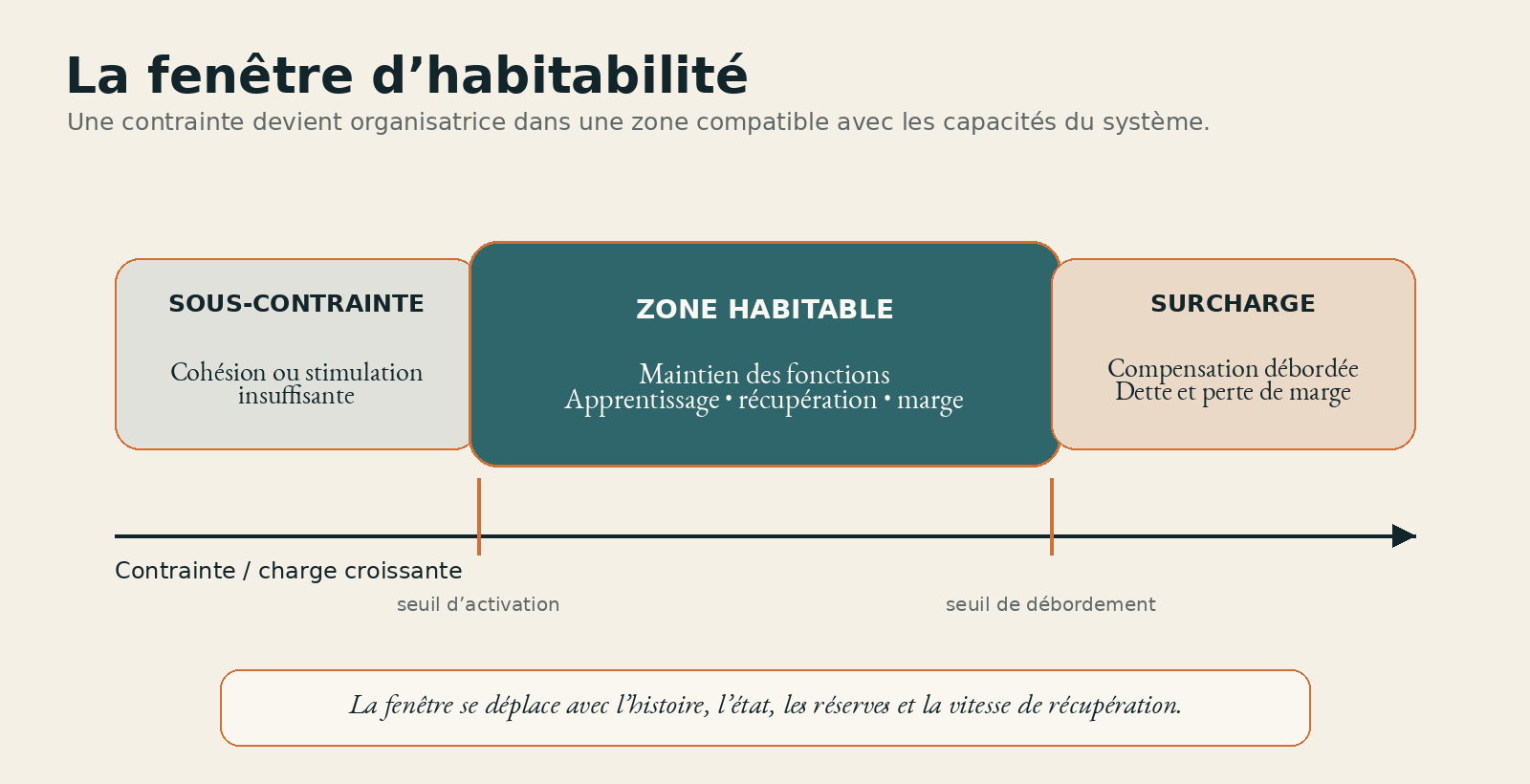
Viability occupies a mobile zone between under-constraint and overload.
Inhabiting a transformation
A changing environment demands more than a one-off adaptation. The organisation must retain enough continuity to cross the modification, while transforming whatever would become incompatible with the new conditions. Inhabiting a constraint means building a durable relation with what cannot be removed.
Living systems carry out this operation through multiple regulations. They shift flows, modify behaviours, repair structures and redistribute their resources. A response that is effective today can create a debt that reduces tomorrow's capacities. Viability then depends on the ratio between the load encountered, the reserves mobilised and the speed of recovery.
Societies too have windows of viability. An infrastructure withstands certain levels of traffic, wear and climatic variation. An institution absorbs a limited quantity of conflicts, delays and exceptions. When margins disappear, the slightest perturbation becomes able to trigger a cascade.
The habitability of constraints invites us to look at capacities before performance. A system can display a high yield while consuming the resources that allow it to maintain itself. Instantaneous power then masks a growing fragility. Duration is prepared in the reserves, the redundancies and the quality of the relations that remain available when a regime changes.
Constraints become uninhabitable when they exceed the capacity of response or reduce the margins too sharply. Too little constraint leaves some structures without cohesion; too much constraint blocks their renewal. Between the two, a mobile zone makes it possible to preserve functions and transform responses.
Cosmic evolution can be reread through these windows. Particles, atoms, molecules and organisms appear when certain combinations of temperature, density, energy and composition open a space of stability. Matter explores these configurations: some dissipate, others stabilise and prepare new organisations.
Industrial civilisation often acts as if every constraint were a limit to be overcome. It extracts faster, transports further, accelerates flows and replaces slow regulations with technical devices. The immediate gains displace the costs onto environments, organisms and the future.
Inhabiting terrestrial constraints orients power towards continuity. This orientation seeks transformations compatible with cycles, thresholds and capacities for renewal. It preserves margins instead of saturating every available space.
Habitability thus links physics, living systems and politics. An organisation persists in a world that constrains it and that it transforms. Its freedom is measured by its capacity to compose with those constraints, to understand their functions and to modify its responses without losing its conditions.
CHAPTER 06
Nothing is renewed for free
Every continuity mobilises a support, a regime of interaction and an environment. Duration always has an architecture and a cost.
What lasts often gives the impression of remaining identical. A mountain seems motionless, a star stable, a species continuous, an institution permanent. That impression comes from the scale of observation. Every continuity depends on processes that renew, sustain or protect an organisation.
A structure persists through its composition, its configuration, its regime of interaction and its environment. Constituents alone are not enough. The same elements can form very different organisations depending on their arrangement, their energy and the relations that unite them.
The stability of particles depends on the permitted transformations, the conservation laws and the accessible states. Quarks persist within hadrons thanks to the regime of interaction that confines them. Nuclei exist according to their composition and their binding energy. Atoms depend on the relations between nucleus and electrons.
A star maintains a recognisable form for millions or billions of years thanks to intense activity. Gravity, pressure, energy transport and nuclear reactions produce a dynamic organisation. The fuel is transformed and the equilibria shift.
Living systems make this cost more visible. A cell consumes energy to maintain its gradients, repair its molecules, renew its components and control its exchanges. An organism replaces a large part of its matter while preserving a functional continuity.
Duration has an energetic, material, informational and relational cost. An organisation must access resources, evacuate certain products, preserve differences and coordinate its processes. When the cost durably exceeds the capacities, continuity degrades.
The cost can remain invisible. A structure compensates for a perturbation by drawing on its reserves, an organism increases its physiological load, an infrastructure postpones its maintenance. Continuity remains, but the reserve used is missing at the next perturbation and fragility increases.
Continuity as reconstruction
A living organisation continually replaces part of its constituents. Molecules are degraded, cells die, tissues renew themselves and internal equilibria are re-established. Identity crosses this renewal because the relations required for function are rebuilt. Continuity lies in the organisation of replacement.
This idea holds beyond living systems. A flame persists by renewing the fuel and the gases that compose it. A river keeps a course despite the ceaseless passage of water. A city maintains functions through the replacement of its inhabitants, its buildings and its networks. The stable name masks a permanent activity of renewal.
Four dimensions make it possible to follow this reconstruction: composition, configuration, the regime of interaction and the environment. An adequate composition produces no continuity if the elements are badly configured. An isolated configuration loses its function if the interactions cease. A coherent internal regime collapses when the environment withdraws the indispensable flows.
These dimensions form a system of dependencies. Composition offers properties, configuration puts them into relation, interactions maintain or transform the structure, and the environment provides conditions of possibility. Persistence appears in their dynamic adjustment.
The hidden cost of duration
A bridge can stay open while water penetrates its joints, corrosion progresses and inspections are postponed. Nothing seems to change until the day an ordinary load meets a structure that has become unable to absorb it. The collapse seems sudden; the loss of capacity, however, built up slowly.
The same mechanism runs through living systems and organisations. Tissues repair more slowly, a soil loses its organic matter, a team stops passing on its skills. Appearances can be maintained while the maintenance debt silently reduces the margins.
The phrase « nothing is renewed for free » describes this reality without reducing every duration to a simple expenditure of energy. Some systems benefit from very stable physical regularities, others require an active reconstruction. The cost changes in nature according to the regime. It may take the form of a conservation forbidden by the laws, a confinement, an input of flows, a repair, a reproduction or a cultural transmission.
Information requires a material support. An archive requires upkeep and a possibility of reading. A tradition depends on people, gestures, narratives and institutions. A currency circulates thanks to rules, beliefs and infrastructures.
Even a mathematical form transmitted across the centuries depends on inscriptions, languages, schools and practices. Its abstract invariance crosses variable supports. The continuity of the concept rests on a material and cultural chain.
A chain breaks when transmission is interrupted. A language disappears, a technique is lost, an institution keeps its name while losing its function, and a species reaches a point where its populations can no longer ensure their continuity. The visible threshold often arrives after a long erosion.
Understanding persistence requires following the loops that sustain it. A loop brings in a resource, transforms a load, produces a repair or adjusts a response. Continuity depends on the speed, the quality and the coordination of those loops.
Redundancies, reserves and diversity look costly in a stable environment. They become essential when the situation changes. Efficiency often measures an immediate result. Viability integrates the capacity to continue, to recover and to absorb future perturbations.
A forest keeps a global identity while its trees are born and die. A soil stays fertile thanks to exchanges between organisms, organic matter, water and minerals. A body maintains its temperature through constant adjustments. Permanence emerges from coordinated transformations.
An organisation can remain itself while replacing its matter, modifying its form and changing certain rules. Its identity lies in a continuity of relations and functions. Transformability becomes a component of duration.
Every duration demands work from the system or from the world that carries it. Recognising this cost makes it possible to see debts before the rupture, dependencies behind autonomy and mechanisms behind stability.
| Visible continuity is a reconstruction whose cost often remains hidden. |
|---|
CHAPTER 07
A series of transitions of persistence
Cosmic history can be reread as a succession of new mechanisms of duration, without reducing it to a uniform march towards complexity.
The history of the Universe can be told as a series of transitions in the course of which new ways of lasting appear. Each stage opens a regime of organisation without forming a simple ladder in which every level would automatically be superior to the previous one.
Particles appear as excitations of quantum fields. Their stability depends on conservation laws, on their energy and on the available transformations. With confinement, quarks and gluons enter a regime in which the constituents no longer appear durably in free form: organisation modifies their way of existing.
Atomic nuclei add another combination of stability and fragility. Atoms then open chemistry: their electronic configurations allow bonds and exchanges while preserving relatively stable units.
Molecules multiply the accessible forms, charges and reactions. Stars build a dynamic continuity on a large scale, produce elements and transform their environment. Planets add cycles, gradients and geological histories able to sustain a prolonged chemistry.
Living systems cross a new threshold: an organisation uses flows to maintain internal differences, repair its structures, produce its components and transmit a continuity. Matter then enters loops that actively sustain form.
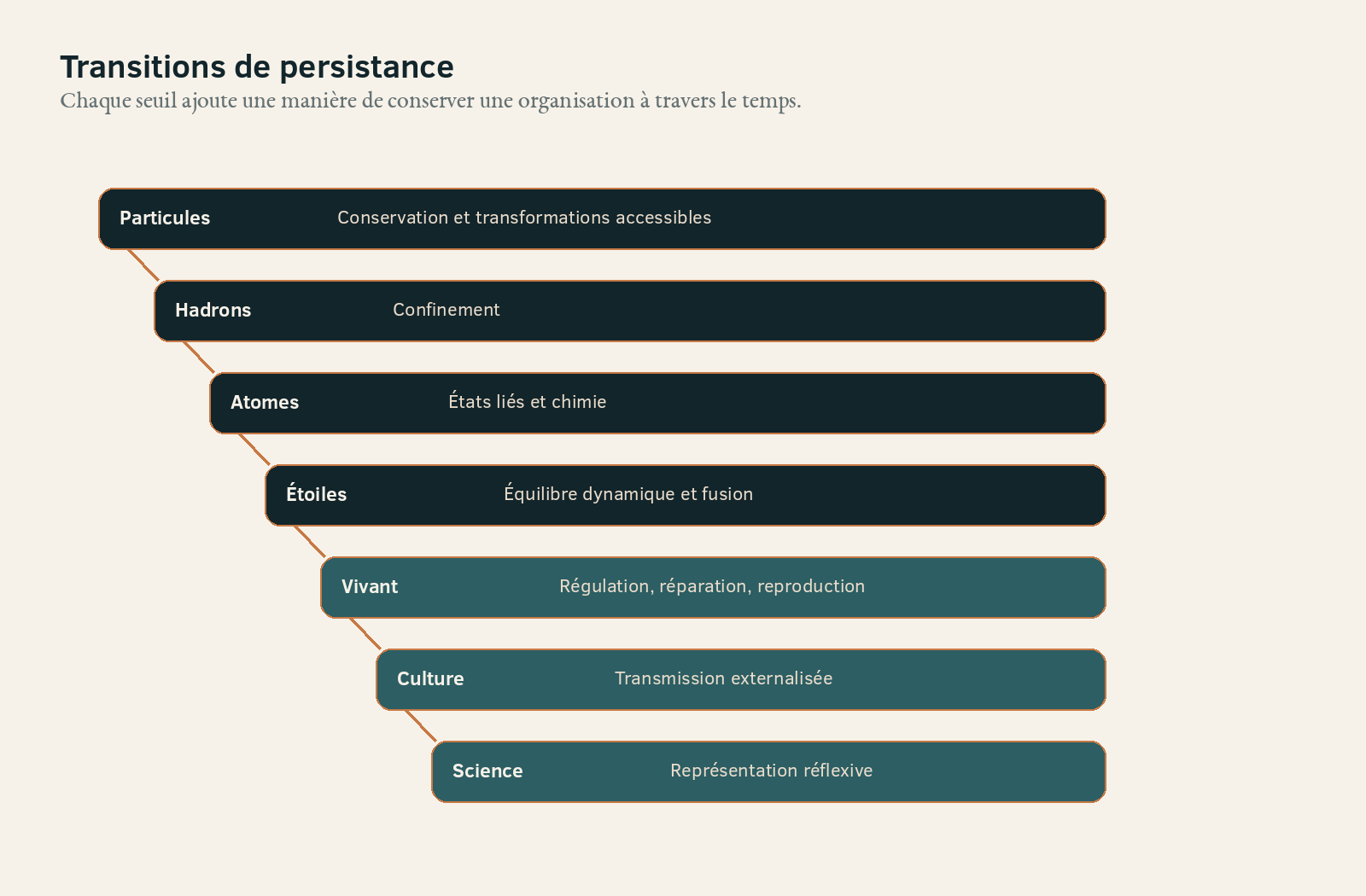
Seven regimes of persistence nested within one another.
Thresholds rather than a ladder
Telling the history of matter as a ladder produces the image of a summit towards which everything would converge. The transitions of persistence follow a branching structure instead. Many trajectories stop, others remain simple and robust, some compose deeper architectures. The appearance of a new regime does not replace the previous ones. It uses them as conditions.
At each threshold, the previous regime remains active and becomes a condition of the next. Quantum physics does not disappear into chemistry; chemistry remains present in the cell; organisms and their environments sustain culture. The passage adds a way of preserving and transforming history without abolishing the older dependencies.
Chemistry multiplies the forms of bonding, the cycles and the catalyses. Living systems cross another threshold by integrating a boundary, a metabolism, a repair and a transmission. Culture externalises traces beyond organisms. Science organises those traces into testable representations. Each passage adds a way of preserving and transforming history.
Organisational depth
The depth of an organisation depends on the number of levels it integrates and on the way those levels constrain one another. An organism contains chemical reactions, membranes, cells, tissues, organs, nervous regulations and ecological relations. A local perturbation can be compensated at another level, while a breakdown of coordination can propagate the effect through the whole architecture.
This depth is not the same thing as the quantity of components. A disordered heap may contain more elements than an organised system. Relevant complexity appears in the differentiation of functions, the density of feedbacks, the preservation of history and the capacity to modify responses without losing continuity.
Each level inherits earlier constraints and produces new possibilities. Chemistry does not suspend quantum physics. Biology does not leave chemistry behind. Culture remains dependent on organisms and environments. Autonomy increases within deeper dependencies.
This reading forbids placing the human outside cosmic history. Human reflexivity is a local organisation built by older levels. It can represent those dependencies, forget them or transform them. Its power comes from integration, not from an absolute separation.
With the cell, persistence becomes genealogical. An active boundary, a metabolism, a repair capacity and a reproduction maintain a functional continuity despite the replacement of constituents. Evolution then distributes that memory across lineages, where present forms preserve ancient compromises and solutions.
Nervous systems make individual history directly mobilisable: an experience modifies future responses. Culture extends this movement outside bodies; gestures, tools, signs and narratives outlive individuals and stabilise transmissible operations.
Reflexivity adds the capacity to represent the rules of one's own transformation. A person, an institution or a society can compare its conduct with its effects and modify certain structures, while remaining dependent on the organisms, environments and resources that make it possible.
Each capacity creates a new vulnerability. A cell can be infected because it possesses exploitable mechanisms. A society dependent on its infrastructures can be paralysed by their failure. A civilisation able to transform the planet can destroy its own conditions.
Cosmic progression resembles a diversification of regimes of persistence. Some are passive at our scale, others dynamic, restorative, transmissible or reflexive. No level guarantees duration.
The series of transitions leads from the preservation of a state to the preservation of an organisation, and then to the preservation of a history able to act. Living systems turn duration into inheritance. Consciousness turns part of that inheritance into representation. Civilisation turns representation into a power to act.
CHAPTER 08
Complexity, robustness and persistence
Complexity increases the capacities of a system as much as it multiplies its dependencies. Robustness is built through compromises, margins and redundancies.
Complexity fascinates because it seems to sum up the history of the Universe. Particles form atoms, atoms molecules, molecules cells, cells organisms and organisms societies. This succession masks the permanent disappearance of countless structures and the fragility of many complex organisations.
A complex structure brings together several components, levels and relations. This richness allows specialisation, coordination and a diversity of responses. It also creates dependencies. The more precise the relations a system requires, the more points there are at which its functioning can be interrupted.
Robustness describes the capacity to preserve a functional identity despite perturbations. It may come from resistance, redundancy, repair, adaptation or transformation. A distributed network routes around a break. An organism repairs a tissue. An institution modifies its rules.
Complexity contributes to robustness when it multiplies pathways, regulatory loops and capacities of response. It becomes fragile when it increases the coordination required, reduces margins or creates invisible dependencies.
A simple organisation can last a long time in a stable environment. A more complex organisation becomes advantageous when perturbations are varied and its mechanisms make it possible to absorb them. Complexity is a local strategy whose effectiveness depends on the context.
Living systems combine several forms of robustness. Barriers protect, loops regulate, reserves cushion, repairs restore and learning modifies responses. Genetic diversity offers possibilities to the lineage.
These mechanisms require energy and time. A repair mobilises resources. A redundancy maintains capacities that seem useless as long as nothing breaks. Optimisation often seeks to remove those costs and weakens the robustness that depends on them.
A tightly run supply chain reduces stocks and improves certain indicators. A local perturbation can then propagate rapidly. A homogeneous agriculture facilitates production and increases exposure to a pathogen. A centralised platform simplifies exchanges and concentrates risk.
Robustness has a temporal dimension. A system may withstand a brief perturbation and exhaust itself under a prolonged pressure. It may cross several shocks and then suddenly lose its capacity for recovery. The visible state does not always reveal the accumulated debt.
The trade-offs of robustness
A robust system maintains certain functions despite perturbations. That capacity always depends on what must be preserved, on the perturbation considered and on the timescale. A bacterium resistant to an antibiotic may grow more slowly in the absence of treatment. A rigid structure supports a stable load and breaks under an unforeseen torsion. An organisation optimised for a precise environment becomes fragile when that environment changes.
Robustness often relies on redundancy, modularity, feedback loops and a diversity of responses. Two metabolic pathways can ensure the same function. Compartments limit the propagation of damage. Reserves absorb a peak of load. A diversity of behaviours prevents a single perturbation from reaching all members of a population in the same way.
These mechanisms have a cost. Redundancy consumes resources, modularity sometimes limits overall efficiency and reserves look useless as long as nothing calls on them. Systems oriented towards immediate performance naturally seek to remove those margins. They gain in yield and lose in transformability.
Robustness is not a single property added to an architecture. It results from the distribution of capacities of response. A system may be robust to a frequent perturbation and vulnerable to a rare combination. The analysis requires mapping thresholds, dependencies and possible cascades.
Complexity and synchronised fragility
Complexity becomes dangerous when dependencies multiply without mechanisms of decoupling. A highly connected network transmits information rapidly and also propagates errors. A global supply chain reduces local costs and exposes entire regions to the failure of a distant node. A centralised organisation coordinates repetitive actions efficiently and slows down when a situation calls for local responses.
Synchronised fragility appears when numerous elements depend on the same rhythm, the same resource or the same information. Visible diversity then masks a common vulnerability. Several distinct companies may rely on the same supplier, several institutions on the same digital system, several agricultural crops on the same seasonal climate.
True robustness can be read in the capacity to continue under several regimes. It demands alternative pathways, times of recovery, degraded modes and a distribution of decisions. A robust architecture accepts a share of inefficiency in order to preserve the possibility of responding to the unexpected.
Complexity is neither automatic progress nor an error. It becomes a resource when it allows a richer coordination and a fragility when it increases dependencies beyond the capacities of regulation. The decisive question concerns integration: does the system have loops able to perceive, interpret and correct the effects produced by its own depth?
Resilience makes it possible to recover an organisation after a perturbation. Transformability makes it possible to change regime when a return to the earlier state becomes impossible or undesirable. A forest after a fire, a person after a break-up or a society after a crisis all recompose themselves.
Deep robustness includes several options: maintaining, repairing, circumventing, learning, transmitting and transforming. A system that knows only one response may seem powerful as long as the context remains compatible.
Autonomy increases with the diversity of the options genuinely accessible and with knowledge of their consequences. An autonomous organisation regulates part of the exchanges required for its continuity. It does not abolish its dependencies.
Reflexive complexity adds the possibility of modifying the criteria themselves. An institution can review its way of assessing success. A science can change its model. A person can recognise that an old strategy is now sustaining the problem.
Representations can lock the system in. A single indicator simplifies decision-making and reduces perception. A hierarchical architecture speeds up execution and blocks signals coming from the periphery.
The unforeseen reveals blind spots. An unknown perturbation reaches a neglected dependency, combines several weaknesses or crosses a threshold. The system discovers that its stability rested on conditions it was not tracking.
A robust civilisation maintains infrastructures, knowledge, ecosystems, local capacities and spaces of decision. It accepts certain present costs in order to preserve future possibilities.
Complexity counts through the relations it makes possible, the perturbations it absorbs and the transformations it permits. A very complex structure that consumes its supports moves towards rupture. A more frugal organisation that maintains its capacities can last longer.
Living systems add repair and transmission. Reflexivity adds the possibility of understanding the mechanisms of one's own fragility. That capacity places a new responsibility at the heart of persistence.
SECOND REVERSAL From stability to reconstruction Stability ceases to be an absence of change. A star, a cell or a society lasts by transforming matter, energy and information. Their continuity results from an activity of reconstruction. Visible states hide the operations that sustain them. This reading replaces the fascination with complexity by an analysis of the mechanisms of duration. Each cosmic transition opens a new regime of persistence. Robustness depends on the margins and alternative pathways that make it possible to preserve a function under several constraints. Living systems will deepen this logic. They turn continuity into inheritance, the trace into functional memory and constraint into regulation. Their history becomes an active component of their organisation. |
|---|
When history becomes alive
PART THREE When history becomes alive The trace becomes function, ecological inheritance, social learning and regulation of transformability. |
|---|
CHAPTER 09
When form preserves history
A present form condenses constraints, bifurcations and trajectories. Its visible geometry remains the surface of a deeper history.
A form seems to belong to space. It has a limit, a curvature, a symmetry, an orientation and proportions. That reading gives a useful description and leaves aside the path by which the form was constituted. A real form carries a history of forces, constraints, materials and transformations.
A crystal reveals the relations between its components and the conditions of its growth. A folded rock preserves ancient pressures and movements. The shape of a dune depends on the wind, the grain size and obstacles. The silhouette of a tree carries the available light, the winds, the wounds and the competition.
In living systems this condensation becomes particularly rich. The development of an organism transforms an initial cell into a multicellular architecture. Forms appear through division, migration, differentiation, tension, adhesion and signalling. Organisation is formed through coordinated local interactions.
Biological form channels flows, distributes constraints, protects structures, allows movements and organises exchanges. Its stability depends on the processes that maintain it. A form deprived of those processes degrades.
Geometry describes stabilised relations, whereas morphogenesis follows their production. A circle can represent a cell in a diagram. The real cell has an active membrane, irregularities, gradients, tensions and a history.
Simplification becomes useful when it stays aware of its limits. It makes it possible to compare, to compute and to identify invariants. It becomes distorting when it imposes its categories on the phenomenon and ignores everything they do not contain.
An already constituted structure influences its future transformations. A bone remodelled after a fracture does not behave exactly as it did before. A city organised around old axes preserves their effects in its movements. An institution built on an old hierarchy reproduces certain circulations of power.
Form as a historical solution
A biological form results from physical constraints, developmental programmes, cellular interactions and selective pressures. It is never chosen among all possible geometries by an external calculation. It emerges from a path in which each step depends on the previous one. The final form preserves the compromises of that trajectory.
Bones respond to the forces they undergo, tissues develop according to gradients, vascular networks compose with diffusion, pressure and available space. Symmetries are broken in the course of development to produce orientations, axes and differentiated organs. A living architecture is built in time.
This historicity explains why imperfect structures can persist. Evolution works from existing forms. It modifies, diverts and reuses. A new solution must remain compatible with development, reproduction and the environment. Form carries inheritances that could have been different in another history.
Reading a form therefore means looking for the constraints it has integrated. A curvature, a branching or a proportion indicates relations between growth, resistance and exchange. Geometry becomes a means of recovering a dynamic, not an autonomous explanation.
From morphology to memory
A form can preserve a history at several depths. A scar records a singular event. An anatomical structure transmits an evolutionary inheritance. An acquired posture carries learning and compensations. Morphology gathers different temporalities within a single body.
This superposition prevents us from reading living systems as an ideal figure. Two organisms of similar shape may have different capacities, histories and fragilities. External measurement captures a configuration, whereas viability depends on invisible relations between flows, repairs and reserves.
Form also preserves possibilities. A joint permits certain movements, a membrane certain exchanges, a root architecture certain explorations of the soil. The present structure delimits the range of future transformations. It acts as a material memory of what the organisation has learned to make possible.
This approach brings morphogenesis and persistence together. Form does not simply come to complete the organisation. It takes part in maintenance, redistributes constraints and prepares what follows. Its stability remains active, since it must continually be sustained by the processes that made it habitable.
History produces a path dependence. Several trajectories could lead to a comparable function, but the trajectory actually followed limits the accessible modifications. A new solution composes with what already exists.
This dependence explains certain imperfections of living systems. Organisms inherit ancient structures and modify them. An architecture can fulfil several functions, preserve compromises and present fragilities linked to its history.
The numbers associated with natural forms also carry this history. A number of branches, petals, faces or connections results from constraints of growth, symmetry, packing or topology. The observed number preserves a trace of the process.
A hexagonal structure in a tiling, a spiral organisation in a growth process or a symmetry in an organism show that certain constraints produce recurrent solutions. Similar operations can lead to similar numbers without sharing their whole history.
Form then acts on what maintains it. A membrane influences the flows that modify its tension. A branch changes its exposure to wind and light. An urban architecture orients the movements that reinforce certain axes.
This circular causality moves form away from the image of a finished object. It becomes a stable moment within a dynamic in which interactions produce an organisation that modifies the subsequent interactions.
Reading a form requires several levels. Its geometry indicates present relations. Its matter tells us about the supports. Its function shows what it makes possible. Its genesis reveals the operations. Its environment explains the constraints.
Form becomes an interface between past and possible. It condenses what has resisted and organises what can still happen. It carries a memory without always being able to read it.
CHAPTER 10
LUCA and continuity become inheritance
LUCA designates a continuity reconstructed from present-day living systems. Its importance lies in the functional inheritance that all cells still preserve.
All known cellular life shares a common depth. Bacteria, archaea, plants, animals and fungi use related fundamental mechanisms. This unity points to a genealogical history and to a common ancestor, LUCA, the last universal common ancestor.
LUCA is not the first form of life. It represents the most recent point of convergence of present-day cellular lineages. Other forms may have existed before it or alongside it without leaving still identifiable descendants.
The mechanisms shared by present-day living systems already suggest an elaborate organisation. A translation of genetic information, a largely common code, membranes, metabolic reactions and systems of maintenance existed in an ancestral form.
Biological continuity differs from the stability of an object. An organism dies, but part of its organisation is prolonged in its descendants. The matter changes, individuals disappear and the lineage preserves certain mechanisms.
This continuity rests on reproduction with variation. A perfectly identical copy would preserve an organisation in a stable environment and would limit adaptation. Too strong a variation would destroy the inherited functions. Living systems inhabit a zone in which information remains faithful and transformable.
The structures that allowed LUCA to transmit an organisation have crossed billions of years of modification. They persist today in diverse forms. Their continuity comes from a chain of reconstructions.
Each generation renews an organisation from new resources. Molecules are produced, assembled, repaired and replaced. Genetic information is expressed within an inherited cellular context. An isolated sequence is not enough to create an organism.
Heredity belongs to the living system as a whole. DNA plays a central role, but its reading depends on structures and conditions transmitted with the cell. Biological continuity combines inscriptions, molecular machines and an environment.
An ancestor reconstructed from the living
LUCA is not a fossil found in a rock. It is a node reconstructed from the characteristics shared by present-day lineages. The almost universal genetic code, ribosomes, the use of ATP, protein translation and several metabolic pathways indicate a common history prior to the separation of bacteria and archaea.
This reconstruction works as a distributed archaeology. Each organism preserves part of the inheritance, transformed by billions of years of evolution. The most universal characters have a higher probability of having been present in the common ancestor, but horizontal transfers and losses complicate the inference. LUCA appears at the crossing of phylogeny, biochemistry and ancient geology.
Recent estimates describe an organism already complex on the prokaryotic scale, integrated into an ecosystem and living very early in Earth's history. This image moves LUCA away from an isolated first cell. A long chemical and biological evolution precedes it. Communities, exchanges and forms that have now disappeared probably prepared the continuity from which present-day life descends.
LUCA marks less a beginning than a success of transmission. Among many ancient trajectories, one lineage or a network of lineages preserved an organisation fertile enough to cross planetary changes and give rise to all known cellular diversity.
Continuity without identity of constituents
Not one molecule of LUCA is still to be found in present-day cells. Continuity lies in reproduced relations: the correspondence between nucleic acids and proteins, mechanisms of replication, energetic coupling, compartmentation and transmission. The inheritance crosses the total replacement of the constituents.
This continuity shows the power of an organisation able to rebuild itself in other matter. A genetic sequence produces components that take part in the reading, repair and copying of that sequence. The system transmits a set of operative constraints rather than a motionless object.
Reproduction introduces a persistence distributed across generations. The individual disappears, while part of its organisation and its history continues elsewhere. Variation prevents perfect copying and opens an exploration of possibilities. Selection preserves certain compatibilities with the environments encountered.
Living systems thus combine fidelity and transformation. Too many errors destroy continuity, too much rigidity reduces adaptation. LUCA represents the antiquity of that compromise. Every present-day cell carries an active memory of solutions that have continued to work across countless environments, catastrophes and bifurcations.
The cell transforms the trace into function. A sequence preserves the effect of an evolutionary history. Cellular mechanisms use it to produce components, regulate activities and respond to conditions.
This memory has several layers. Some are genetic, others epigenetic, structural, metabolic or ecological. An organism also inherits a milieu modified by earlier generations.
The continuity of living systems exceeds individual boundaries. It circulates between lineages, environments and relations. A species depends on other species. A multicellular organism depends on microbial communities. A population depends on cycles that outlast it.
The visible differences between living forms rest on a common base of processes. The history of life resembles a branching issuing from an ancient continuity.
Natural selection preserves certain variations through their differential success in a context. Present-day forms result from a history of constraints, accidents, relations and bifurcations. Their adaptation remains local and provisional.
Living systems rebuild, vary and explore. The lineage preserves a general identity by producing differences. It transforms the inheritance without entirely breaking the chain.
Reducing living systems to their geometry erases this genealogy. Reducing heredity to a string of symbols erases the system that makes those symbols active. Life inhabits the articulation between inscription, matter, function and milieu.
LUCA constitutes a major piece of evidence for the thesis of this book. A material history can become a functional memory, be transmitted and produce a growing diversity without losing all continuity. We are temporary forms of a memory that crosses the generations.
| LUCA is less the first living thing than the ancient continuity whose trace all present-day living beings still carry. |
|---|
CHAPTER 11
Memories without humans
Living systems preserve and transmit a history long before writing, archives and science. Cellular, ecological and animal memories distribute the past among organisms, groups and environments.
Long before any human being gathered traces into a narrative, living systems were already using their past. A cell adjusts its activity according to earlier states, an animal modifies its conduct after an experience, a population inherits a transformed environment and a group transmits learned practices. History becomes active at several scales without waiting for an observer able to recount it.
The word memory here calls for precision. A rock preserves a trace, but it does not mobilise it. A soil enriched by generations of organisms modifies future conditions without possessing a centre that remembers. An animal uses a past experience in its behaviour. These situations belong to a single historical depth while involving different mechanisms.
Speaking of non-human memories means following this diversity. Functional memory appears when an inscription intervenes in the regulation of an organisation. Ecological memory describes inheritances distributed within a milieu. Animal culture adds a social transmission of practices that depends neither on an immediate genetic modification nor on a human symbolic language.
The history inscribed in environments
Organisms never encounter a nature left intact since the origin. They live in environments worked by other living beings. Soils concentrate organic matter, fungal networks and structures produced over generations. Reefs, peat bogs, forests and burrows durably modify the circulation of water, energy and nutrients.
These transformations create an ecological inheritance. A beaver dam slows a watercourse, retains sediments, forms wetlands and changes the species able to settle there. The structure sometimes persists after its builders have disappeared. Subsequent organisms do not inherit only genes; they inherit a space already organised by a living history.
Biogeochemical cycles also carry this depth. Carbon, nitrogen, phosphorus and oxygen circulate through reservoirs shaped by biological and geological activity. Their present state depends on earlier trajectories. The term memory remains analogical here when no organisation reads or mobilises the inscription. It becomes precise as soon as inherited states actively orient the regulation of a living system.
This distinction protects the book against two opposite reductions. The first would reserve all memory for human consciousness and would make biological inheritances invisible. The second would attribute a complete memory to every material persistence. Between the two, several regimes appear, from dependence on the path travelled to learning and explicit representation.
An ecosystem does not form a single organism endowed with a central intention. It nevertheless preserves effects distributed across its soils, its populations, its trophic networks and its cycles. An ancient perturbation can modify for decades the composition of a forest, the availability of resources or the sensitivity to a new event. The milieu becomes an active archive for the living beings that inhabit it.
Learning and transmitting without language
Animal memory shows another degree of historical activity. An individual recognises a place, anticipates a danger, finds a migratory route again or adjusts a technique after several attempts. Its nervous system preserves differences that modify future conduct. Experience transforms the space of accessible responses.
Some of these acquisitions circulate socially. Chimpanzees learn tool-use techniques specific to their group. Cetaceans transmit vocalisations and hunting strategies. Birds maintain local dialects. Elephants follow routes and waterholes known to the most experienced individuals. The continuity of behaviour then exceeds the memory of a single organism.
An animal culture exists when a socially learned practice is maintained within a group and helps to differentiate its habits from those of other groups. This definition does not erase the differences between species. It recognises a historical transmission that precedes human archives and that can disappear when experienced bearers are eliminated.
The loss of a group therefore does not only remove a number of individuals. It can erase routes, techniques, relations and accumulated ecological knowledge. Biodiversity has a historical and cultural dimension. Two genetically close populations may no longer have the same capacities once a chain of transmission has been broken.
Imitation is not enough to explain all transmission. Attention to the behaviour of others, social tolerance, repetition, the structure of the group and the stability of the milieu all take part in preservation. A practice persists because a set of relations makes its learning possible.
A distributed memory
Non-human memories displace the centre of the demonstration. Active history does not always reside in an isolated brain. It circulates between cells, organisms, generations, ecological infrastructures and social groups. A system can preserve an orientation without possessing a unified narrative of its past.
This distribution illuminates autonomy. An organism regulates its dependencies from resources and information it did not produce alone. A population relies on collective learning. A species transforms a milieu that then becomes a condition of its own continuity. Autonomy is built inside a relational memory.
Human beings extend these capacities rather than inaugurating them. Symbolic language, writing, instruments and institutions radically increase the reach of transmission. They make it possible to reconstruct absent events, to compare hypotheses and deliberately to revise archives. This bifurcation remains rooted in older biological, social and ecological memories.
The passage towards the human observer must therefore be read as a change of regime. Memory becomes explicitly represented, discussed and organised on a large scale. It acquires a reflexivity able to examine its own categories. This power does not place humanity outside living systems. It increases its responsibility towards the memories it can now interrupt, preserve or transform.
CHAPTER 12
From organisational autonomy to reflexive autonomy
Autonomy grows when an organisation regulates its dependencies and its own capacity for transformation. Reflexivity introduces the history of the system into its future choices.
Autonomy often evokes independence. Living systems show a different reality. A cell, an organism or a society depends on an environment, on resources and on relations. Their autonomy comes from the capacity to regulate part of those dependencies.
An elementary organisation preserves certain relations. It has a boundary, a structure or a regime of interaction that distinguishes it from its environment. That distinction remains active. Without exchanges it is exhausted. Without regulation it dissolves.
Organisational autonomy appears when a system takes part in maintaining the conditions that constitute it. A cell produces components of its membrane, controls certain flows and repairs structures. Its activity sustains the boundary that makes that activity possible.
The cell depends on molecules, energy, temperature and a milieu. It transforms a raw dependence into a regulated relation. Autonomy is measured by the capacity to modulate exchanges and to preserve continuity in a variable environment.
Several dimensions enrich this capacity: preserving an organisation, maintaining a viability, integrating signals, producing new responses, transmitting what has been acquired and representing a situation. A system may be effective in one dimension and fragile in another.
A system may be effective in one dimension and limited in another. An institution transmits its rules efficiently and integrates the signals of change badly. An organism learns quickly and has a weak capacity for recovery.
Transformability describes the capacity to modify part of one's organisation while preserving a continuity. Too weak a transformation leaves the system prisoner of an inadequate regime. Too strong a transformation destroys the functions that made action possible.
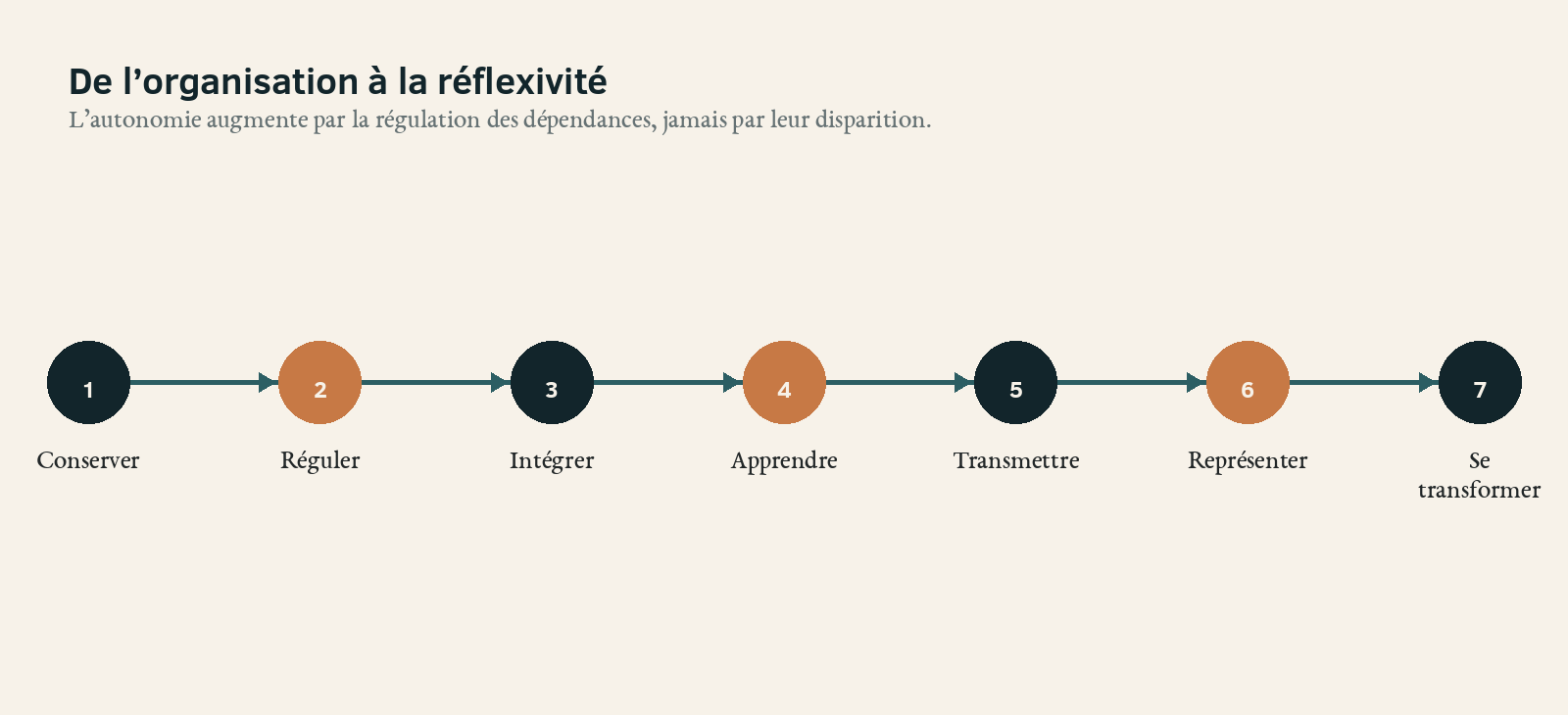
Reflexivity extends the regulation of dependencies.
Regulating one's dependencies
In living systems, the regulation of dependencies becomes a permanent activity. An organism selects exchanges, maintains internal differences and modifies its conduct in order to preserve a continuity. Energy, matter, information and ecological relations remain indispensable, but access to them is partly organised by the system itself.
A living boundary illustrates this logic. The membrane separates without isolating. It controls the inputs, the outputs and the gradients that make metabolism possible. Its functioning depends on internal processes which, in return, ensure its upkeep. Constraint and organisation produce one another.
Regulation compares the present state with thresholds and modifies flows or behaviours. Learning adds a temporal depth: certain differences are preserved, linked to their consequences and then reinvested in the future response. History thus takes a growing place in present activity.
Dependence becomes problematic when it escapes perception or regulation. An organisation may believe it acts freely while its resources, its information or its decisions come from an infrastructure it does not control. Autonomy requires a realistic mapping of the relations that make action possible.
Regulating transformability
Reflexivity adds a singular capacity: the system can represent part of its own functioning and intervene on the rules that orient its transformations. An individual can recognise a habit, an institution can modify a procedure, a society can revise a norm. The organisation becomes partly able to choose how it will change.
This capacity remains limited. Every self-representation selects certain aspects and ignores others. A reflexive system can be mistaken about its dependencies, rationalise its reactions or protect an identity that has become incompatible with its environment. Reflexivity opens a possibility of correction without guaranteeing its use.
Transformability therefore deserves to be regulated as a capacity. Changing too quickly can dissolve the necessary continuities. Changing too slowly lets incompatibilities accumulate. A viable organisation preserves several rhythms: rapid reaction to an emergency, gradual learning, deep revision when the whole regime is transformed.
Reflexive autonomy reaches maturity when it integrates the deferred consequences of action. The system no longer merely attains an immediate objective. It observes how that objective modifies its resources, its relations and its possible futures. Freedom takes the form of a responsibility towards the conditions that make it durable.
Memory intervenes at every stage. It preserves the results of earlier transformations, provides landmarks and limits the space of responses. An organisation without memory repeats every piece of learning. An organisation saturated by its past loses its capacity for innovation.
The reflexive threshold is crossed when the system builds a representation of itself, of its relations and of its possible transformations. A person recognises a pattern of behaviour, an institution observes the effects of its rules, a science examines the presuppositions of its model. The present is then linked to a history and to several conceivable futures.
This capacity depends on the quality of the traces, the models and the criteria. A partial representation can steer a decision in the wrong direction; a measure that has become an objective can divert activity. A reflexive organisation therefore keeps a margin between the model and the world and corrects its categories when consequences resist.
A mature autonomy recognises its dependencies. It identifies the vital relations, the limits of its capacities and the consequences of its choices. It turns some constraints into functions and composes with those it cannot modify.
Human civilisation has powerful forms of technical autonomy. It moves matter, captures energy, stores information and modifies environments. Its collective reflexivity remains fragmented. The knowledge exists, but the institutions that decide do not always integrate its consequences.
Autonomy becomes the capacity to take a conscious part in one's own transformability. It opens the possibility of recognising a trajectory, measuring its costs and modifying the rules before constraints do so brutally.
CHAPTER 13
From exosomatisation to reflexive autonomy
Human beings extend their organs outside their bodies. Tools and institutions amplify their capacities while displacing their dependencies.
Human beings displace part of their capacities outside their bodies. A tool extends the hand, clothing regulates temperature, a dwelling protects, writing preserves memory, a machine amplifies force, an instrument extends perception and a computer externalises operations of calculation.
This exosomatisation profoundly modifies human persistence. An individual capacity becomes shareable, transmissible and cumulative. Knowledge no longer disappears entirely with the person who acquired it.
Externalisation increases the reach of action and creates new dependencies. A society depends on its tools, its networks, its energy sources and the skills required to maintain them. The loss of an infrastructure affects functions that individuals no longer know how to ensure on their own.
This dependence remains invisible as long as the devices work. Water arrives, electricity flows, data are accessible and food is distributed. Everyday continuity rests on extended material, human and institutional chains.
An archive stabilises a trace and removes it from living memory. It can cross time with great precision, but it requires a code, a support and a capacity for reading. Data without context persist physically and lose their function.
Culture ensures the link through education, practices and institutions. It teaches how to recognise signs, reproduce operations and interpret archives.
Digital systems accelerate this movement. They store, classify, combine and reproduce traces on an immense scale. They allow an almost instantly accessible memory and introduce fragilities linked to formats, platforms, energy and architectures of selection.
A distributed cognition
Reading a map, jotting down an idea or solving a problem together shows that competence does not reside entirely in a brain. It circulates between the body, signs, objects, procedures and people. The tool is not merely added to the action: it becomes a component of it.
Each extension modifies body and thought in return. Writing transforms memory by making it possible to compare epochs, to reread and to transmit over great distances. Scientific instruments open sensory domains that are otherwise inaccessible. Digital networks accelerate the circulation of signs and reconfigure attention. The outside becomes a component of cognitive organisation.
The boundary of the individual then becomes less obvious. A task carried out with a notebook, a database or a coordinated group depends on a distributed system. Competence does not reside entirely in a brain. It circulates between people, procedures, tools and environments.
This distribution increases power and produces new vulnerabilities. Losing a tool can make a capacity disappear that is no longer maintained internally. A network failure interrupts activities that no individual could rebuild alone. Apparent autonomy rests on a collective infrastructure.
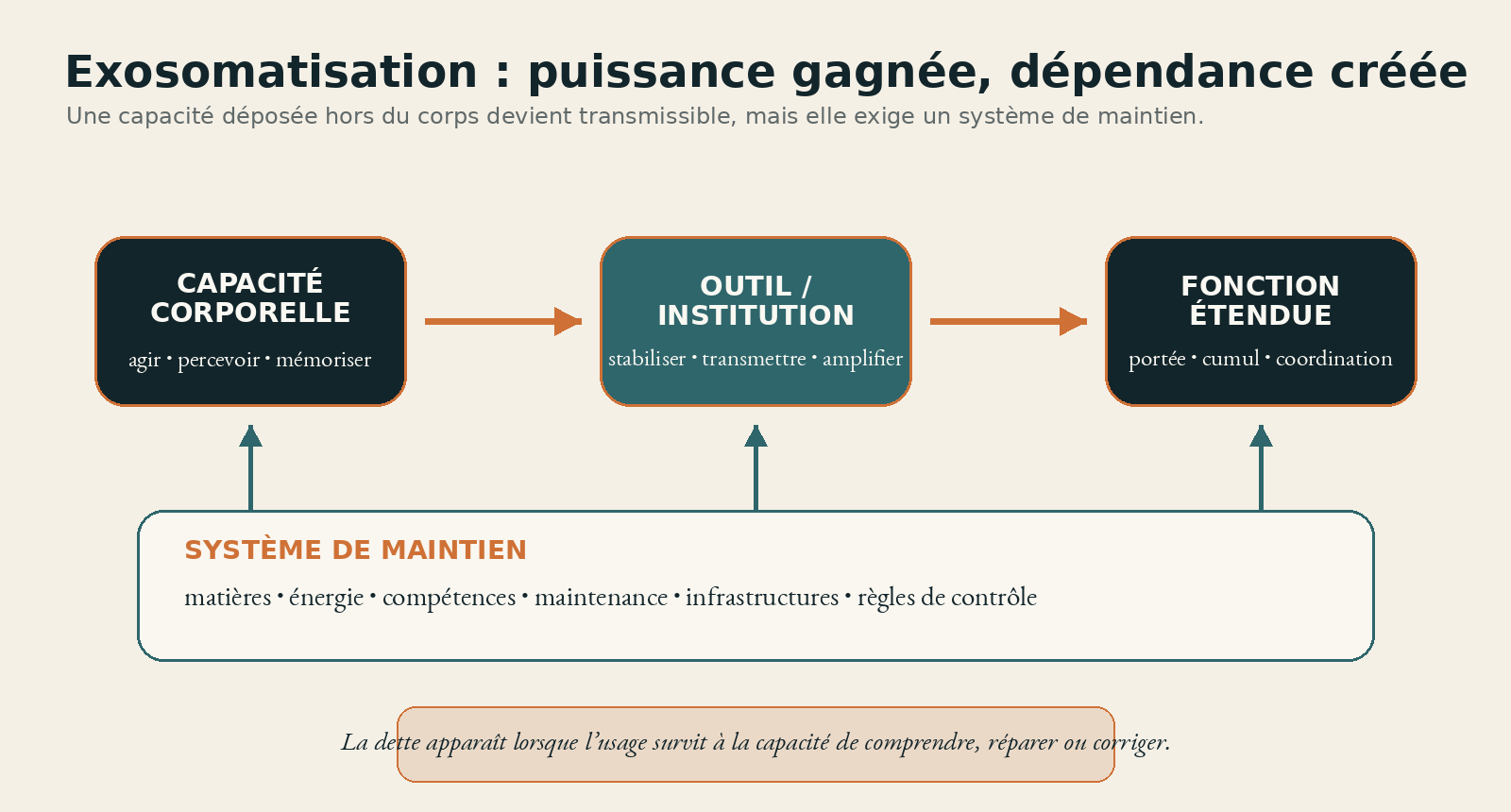
Extending a capacity creates a system of maintenance and a possible debt.
The exosomatic debt
A technology requires materials, energy, maintenance, skills and institutions. Its visible use shows only part of that system. The more functions are externalised, the more continuity depends on long and often opaque chains. The power acquired comes with a debt of upkeep.
This debt becomes dangerous when a society retains the uses while losing the capacity to repair or to understand. Essential systems then rest on a few suppliers, rare components or closed software. Dependence increases faster than collective mastery.
Exosomatisation can also displace consequences. A machine reduces local effort while increasing extraction elsewhere. A digital memory facilitates access while demanding data centres, metals and electricity consumption. Efficiency at one level masks the load transferred to another.
A reflexive autonomy applied to technology maps these displacements. It examines the function made possible, the dependence created, the cost of upkeep, the deferred consequences and the modes of degradation. Technology then joins the general question of this book: a capacity counts through the way it inscribes itself within a habitable continuity.
When memory becomes opaque
An abundant memory can produce a loss of orientation. Access to many traces does not guarantee their integration. Information circulates faster than the capacities for verification and for putting things into relation.
Algorithms recommend, classify, detect and orient. A datum comes from a measurement, a category from a distinction and an objective from a choice. When those origins disappear, historical decisions take on the appearance of a neutral necessity and are repeated on a large scale.
Technical autonomy can then be opposed to human autonomy: the device increases the power to act while reducing the capacity to understand, modify or refuse the rules that organise it.
A reflexive exosomatisation preserves the possibility of rereading its own architectures. It documents the criteria, makes the effects visible, distributes the capacities of control and allows correction.
Telescopes, detectors and computers make accessible phenomena beyond our senses. They transform signals into images, spectra and numbers. Scientific observation becomes a hybrid chain in which the world, the instrument and the model together produce a representation.
Human beings become an extended organism. Their capacities circulate between the body, objects, groups and institutions. Their functional identity depends on that network.
Exosomatisation recounts a new transition of persistence. Memory partly leaves the body, function is stabilised in the object and knowledge becomes cumulative. Reflexivity re-establishes the relation between external power and the internal conditions of its continuity.
CHAPTER 14
Meeting your history from the other side
The past changes in reach when a system can reread it from a new organisation. Continuity then becomes a capacity for reinterpretation.
A lived history never exists for us in the same form as the original event. Time transforms the person, the context and the capacities of understanding. Returning towards one's past means meeting old traces from an organisation that has become different.
This distance sometimes makes it possible to recognise what remained invisible at the time of the events. An experience lived in fear, dependence or incomprehension can be reread from a more stable position. The events remain the same, while their place in the present organisation changes.
Personal memory illustrates the difference between trace and reconstruction. A recollection preserves sensory, emotional and narrative elements. Each recall reactivates them in a new context. Memory takes part in present identity and is transformed along with it.
Meeting your history from the other side means reaching a point where the experience no longer entirely organises perception. The person can observe certain mechanisms, recognise old adaptations and distinguish what once protected from what now confines.
A response acquired in a difficult context can become a competence. Vigilance, anticipation or resistance sometimes make it possible to get through a situation. They may then remain active once the context has changed.
Reflexivity opens a space between the trace and the response. It makes it possible to recognise the origin of an automatism and to explore other forms of conduct. That space modifies the way history takes part in action.
The same process exists in institutions and societies. A rule born of a crisis can become permanent. An architecture created to protect a system can go on functioning after the threat has disappeared.
The past reconstructed from another state
An ancient event was lived through by an organisation that no longer exists in exactly the same form. Present knowledge, resources and relations modify access to that history. Returning to the past means meeting it from another side, with capacities one did not possess at the moment it occurred.
This reconstruction does not change the event. It transforms the place it occupies in the present organisation. An experience that automatically commanded a reaction can become an element that is understood, situated and related to others. Memory ceases to be only an implicit constraint and becomes an object of reflection.
The process requires enough continuity to recognise that this history is one's own, and enough distance not to repeat it identically. Reflexivity creates that interval. It makes it possible to distinguish the past inscription from the present situation.
Societies carry out a comparable operation when they revisit their institutions, their violence or their technical choices. An archive takes on a new reach when the moral and political framework changes. Collective history becomes active in the revision of present rules.
Memory, forgetting and reorganisation
A perfectly exhaustive memory would be unusable. Every organisation selects, condenses and reorganises. Forgetting frees capacities, reduces noise and makes generalisation possible. It becomes destructive when it erases the traces required to understand a repetition or a debt.
The health of a memory depends less on its quantity than on its plasticity. A trace must be able to be linked to new information without losing all continuity. The past becomes a resource when it illuminates the present, not when it occupies it entirely.
This plasticity converges with robustness. A system able to reinterpret its history has more responses than a system locked into a single reading. It can preserve the experience without preserving the reaction. It turns an inherited constraint into knowledge of its own thresholds.
Meeting your history from the other side therefore describes a transition of persistence. The organisation no longer survives only by repeating what protected it. It preserves continuity by modifying the meaning and the function of its traces. Memory becomes an instrument of transformation.
Rereading history from another regime requires accessible traces. Archives, testimonies, bodies, landscapes and institutions preserve different elements. Confronting them builds a richer image and also reveals gaps.
Every reconstruction depends on a framework, a language and a present position. That dependence calls for vigilance about the way we relate traces and about the effects of that relation.
A useful reconstruction meets the resistance of the traces, accepts contradictions and keeps a place for uncertainty. A history that is too perfect risks protecting the present identity instead of illuminating its formation.
Personal transformation resembles a reorganisation of memory. Some traces remain painful, but they cease to command every response. Other resources, previously invisible, become accessible.
Society faces the same challenge. It inherits borders, inequalities, techniques, beliefs and debts. These structures orient present decisions. A reform limited to the surface often preserves the historical architecture that produces the effects.
Cosmic history too is met from the other side. We observe the first galaxies from a late Universe. We reconstruct LUCA from the organisms that survived. We read the past through its descendants.
The present contains more consequences than the past could know. It makes it possible to see completed trajectories. It has also lost part of the details and projects its own categories onto the traces.
Meeting your history from the other side becomes a form of reflexive autonomy. An organisation recognises that its present carries a past, that its responses have a genealogy and that this genealogy does not impose an exact repetition.
THIRD REVERSAL From inheritance to reflexivity Living systems preserve a history by reproducing it, repairing it and transforming it. LUCA represents the antiquity of that capacity. Environments and animal cultures then show that memory is distributed among organisms, groups and ecological infrastructures. Autonomy develops within this relational memory, and exosomatisation then displaces part of the functions into tools and institutions. Human beings can reread their history from a new state without ceasing to belong to the non-human continuities that make it possible. The next movement follows this memory when it becomes explicit knowledge. The observer gathers traces, number preserves operations and geometry stabilises relations. Representation then acquires the capacity to return towards the world. |
|---|
When the world becomes able to reread itself
PART FOUR When the world becomes able to reread itself After biological, ecological and animal memories, number and geometry extend history into symbolic representation. |
|---|
CHAPTER 15
The observer as memory of the world
After biological, ecological and animal memories, the symbolic observer gathers scattered traces and reconstructs absent events. Its singularity lies in making history explicit and revisable.
The human observer often appears as an external point looking at an object. That representation erases the material continuity between the one who observes, the non-human memories that preceded them, their instruments and the phenomenon observed. The observer belongs to the world they seek to understand and extends capacities of perception, learning and transmission already present in living systems.
Their perceptual capacities come from a biological history. Their categories come from a culture. Their instruments extend their senses. Their models stabilise operations of comparison. Observation forms a chain in which each stage selects, transforms and preserves part of the signal.
A photon reaches a detector, a device produces a measurement, software transforms data and a person interprets the result. Knowledge is built through a succession of interactions and traces.
The symbolic observer becomes a reflexive memory of the world when they link scattered inscriptions to an explicit history. They reconstruct a vanished star from its light, an ancestral species from genomes, a civilisation from ruins and a personal trajectory from recollections. The novelty lies in the conscious putting into relation, the discussion and the possibility of revising the narrative.
This extension depends on transmission. Observations are inscribed in texts, images, databases and objects. Other people can verify them, contest them and integrate them. A collective memory is formed through supports and practices.
A capacity for explicit return thus appears in the world. Organisations issuing from cosmic evolution gather traces of that evolution and build verifiable narratives. Matter does not suddenly begin to observe with humanity, but certain living forms become able to represent the history from which they come.
This formulation remains material. It describes a continuity of processes. The same laws and the same material history have produced stars, planets, cells, nervous systems and instruments able to observe.
The observer also transforms what they observe. Every measurement implies an interaction. In the human sciences, categories and institutions directly influence conduct. In physics, the instrument selects certain properties and has limits of its own.
Observing, relating, reconstructing
An observer never receives the world as a totality. They select signals, compare them with earlier states and produce distinctions. Their perception is already an operation of memory, since a difference cannot be recognised without a minimal preservation of what has just been perceived.
Scientific observation amplifies this structure. Instruments record phenomena beyond sensory capacities. Archives allow comparisons across generations. Theories link scattered traces. The observer becomes a network of people, devices, conventions and external memories.
Knowledge of an ancient black hole, an extinction or a common ancestor resides in no direct witness. It emerges from a collective reconstruction. The world produces traces, and then part of the living organises devices able to read them. Material history becomes represented history.
This capacity does not place the observer outside reality. Their instruments, their concepts and their institutions belong to the same history. Observation sometimes modifies the phenomenon, always the situation of knowledge, and often future actions. The world rereads itself from within.
The collective memory of the world
Animal cultures already show that an experience can outlast the individual. In human beings, narratives, images, practices and archives extend that transmission on a new scale. Science organises this externalisation through procedures of preservation, verification and correction that cross the generations.
This collective memory has fragilities of its own. Formats become unreadable, institutions lose skills, archives are destroyed or drowned in an overabundance of information. Preserving a datum guarantees neither its context nor its future comprehension.
The quality of a memory depends on the chain linking inscription, access, interpretation and use. An archive without an index becomes almost invisible. A model without explicit hypotheses becomes difficult to re-evaluate. A measurement without its conditions of production loses its reach.
The observer as memory of the world carries a particular responsibility. They choose what will be recorded, transmitted and transformed. That selection shapes the possibilities of future understanding. The memory of the world is not neutral, since it depends on the structures that decide which traces deserve to last.
Objectivity rests on documenting the conditions of observation, multiplying viewpoints, comparing methods and looking for what resists variations among observers.
Knowledge gains solidity when traces converge. A reproducible result, a confirmed prediction and a measurement obtained by several methods reduce dependence on a particular viewpoint. Objectivity becomes a collective organisation of correction.
That correction depends on memory. A science without archives would repeat the same errors. An institution without a record would forget the consequences of its decisions. A person without access to their past would lose part of their continuity.
An abundance of traces does not automatically produce understanding. A useful memory requires a structure of access, criteria and a capacity for integration. Classification can reinforce a bias. An archive can preserve information and erase the voices that had no access to inscription.
The observer therefore examines their own instruments of memory. They look at what is measured, what remains out of frame and the way categories orient perception.
Science widens the reach of this loop. It builds instruments that detect invisible phenomena, mathematics that links scales and institutions that preserve results. The individual observer becomes a node in a distributed memory.
This distribution creates a responsibility. Collective representations orient techniques, policies and ways of inhabiting the world. An error amplified by an infrastructure produces far greater effects than an individual perception.
Through the symbolic observer, part of the memory of living systems becomes reflexive. The past can be represented, discussed and used to orient the future. This capacity extends non-human memories and gives humanity the power to modify the conditions of their continuity.
CHAPTER 16
Number as the trace of an operation
Number emerges from operations of distinction, equivalence and repetition. It retains the trace of a cognitive gesture before becoming an abstract object.
Number seems independent of matter. Two remains two, whatever objects are counted. That stability explains the power of mathematics and can make us forget the path that leads from reality to number.
Before counting, a difference must be recognised. Elements must be distinguished, grouped according to a criterion and considered equivalent for the operation. Counting three trees requires ignoring their differences of size, age and shape.
Number stabilises this operation. It preserves the quantity of elements recognised as units within a given framework. Its generality comes from the possibility of repeating the operation on different contents.
Numeral systems, symbols and methods of calculation have been developed, transmitted and transformed. Mathematical abstraction can become independent of its immediate origin while still being carried by practices and supports.
Number acts as an operative trace. It keeps the result of a distinction, a repetition, a measurement, a ratio or a transformation. A length expressed by a number preserves the relation between an object, a unit and a procedure of measurement.
That relation becomes invisible when the result circulates on its own. A datum then seems to describe the world directly. It nevertheless contains choices of threshold, category, instrument and scale.
Numerical precision sometimes reinforces the illusion. Several decimals give an impression of certainty while the uncertainty comes from the model, the sample or the definition. A figure cannot carry more reality than the operation that produced it.
The numbers observed in natural architectures often result from geometric, topological, energetic or developmental constraints. A number of faces, branches, petals or connections expresses a stabilised solution.
The same constraint can produce several numbers depending on conditions. The same number can appear through different mechanisms. The correspondence invites us to reconstruct the operation.
Before number, distinction
Counting first requires cutting a flow into units. Two stones can be considered as two objects despite their differences of shape, mass and colour. The operation retains an equivalence and suspends other properties. Number is born of that selection.
A unit is never given without a rule. Counting trees requires deciding what constitutes a distinct tree, counting waves requires identifying a beginning and an end, measuring a length requires choosing a standard and a procedure. The stability of the result depends on the reproducibility of the operation.
Number preserves that operation while partly erasing it. The symbol « three » can apply to sounds, people or galaxies. Its power comes from that independence with respect to content. The same abstraction that permits comparison removes the phenomenon from its context.
This extraction does not make number arbitrary. Reality resists inadequate operations. An unstable measurement, a badly defined unit or an incoherent classification produce contradictions. Abstraction remains bound to the conditions that make the operation possible.
From number to architecture
Geometry stabilises relations of position, proportion and transformation. It builds ideal objects that undergo neither wear, nor growth, nor history. This idealisation makes it possible to isolate invariants and to demonstrate relations with exceptional precision.
The passage becomes problematic when the geometric object returns towards reality as a sufficient cause. A spiral observed in several systems does not prove that a single programme produces all those forms. Different constraints can lead to similar ratios. Geometric convergence calls for an analysis of the operations that generated it.
Number and form function as condensed archives. They preserve the results of long practices of distinction, comparison and construction. Their cultural history fades in ordinary use, just as material history sometimes fades within a stable form.
Recovering that genealogy does not diminish mathematics. It illuminates their power. An abstraction becomes universal when an operation can be repeated in very different contexts while preserving a relation. Universality belongs to the fecundity of the operation, not to a magical separation from the world.
Geometry extracts spatial relations, defines invariants and studies transformations. Its ideal forms allow a rigour inaccessible to material objects. A mathematical circle has neither thickness, nor defect, nor history.
The return towards reality requires a translation. A physical structure approaches a model in certain dimensions and departs from it in others. Success depends on the property studied, on the scale and on the precision required.
The inversion appears when the phenomenon is forced into the categories of the model. Whatever resists becomes noise, a defect or an exception to be removed.
Living systems suffer particularly from this inversion. Indicators of health, performance or productivity isolate variables. They modify conduct when they become objectives. The real organisation begins to adapt to the number that was meant to describe it.
A school teaches for the score, a company works for the indicator, a hospital optimises the measured duration and a platform organises attention according to a metric. The number returns towards the world and creates a new constraint.
Every value refers back to an act of distinction, to a unit, to a support and to an intention. Making those choices transparent makes the measurement debatable and improvable.
Mathematics meets reality when it preserves operative invariants. A relation remains stable across several observations, transformations or scales. That resistance gives the model its fecundity.
Number becomes a bridge between history and abstraction. It is born of a situated operation, emancipates itself in a formal space and returns towards the world through measurement, prediction and technology.
When number forgets the operation, it becomes an authority without genealogy. When the operation remains visible, number remains a powerful tool in the service of an open understanding.
| Number preserves an operation while erasing the gesture that produced it. |
|---|
CHAPTER 17
The geometric deformation of living systems
Geometry reveals invariants, but it easily flattens the flows, temporalities and dependencies that constitute living systems.
The previous chapter isolated the inversion in its simplest form. The visible order of a few signs could stand in for physical mechanisms. The same operation becomes deeper when geometry detaches living forms from the flows and histories that produce them. Our perception spontaneously cuts the world into forms. We recognise a limit, a silhouette, a symmetry and a movement. This capacity allows rapid action and prepares geometry. It also simplifies living systems into separate objects.
An organism has a recognisable form, but its boundary remains crossed by exchanges. It breathes, absorbs, eliminates, radiates, perceives and acts. Its continuity depends on a milieu that no outline can entirely separate from it.
Geometric representation privileges states. It captures a position, a size and a spatial relation. Living systems develop in time, renew their matter and modify their functions. A fixed image preserves an appearance and erases a large part of the activity.
This reduction produces practical categories. The body becomes an assembly of organs, the cell a bag containing components, the ecosystem a set of species and society a pyramid of functions. Each diagram makes certain relations visible and eliminates others.
The deformation begins when simplification dictates intervention. A defective part calls for a replacement. An abnormal variable calls for an isolated correction. A population becomes a stock. A territory becomes a surface.
Living systems organise flows. A function depends on several levels, loops and temporalities. Modifying one element changes the relations around it. A local intervention can displace a load, reduce a capacity for compensation or produce a deferred effect.
Classical geometry retains an immense usefulness. It describes structures, computes surfaces, models forces and makes construction possible. Its extension to historical, adaptive and open systems requires a translation.
Living boundaries resemble interfaces. They filter, recognise and modulate. Their effectiveness depends on a regulated porosity. An entirely closed boundary cuts off resources. A boundary without selection dissolves the organisation.
Living forms possess several simultaneous scales. A cell belongs to a tissue, an organism to an ecosystem and a person to social and technical networks. A decision favourable at one scale can produce a debt at another.
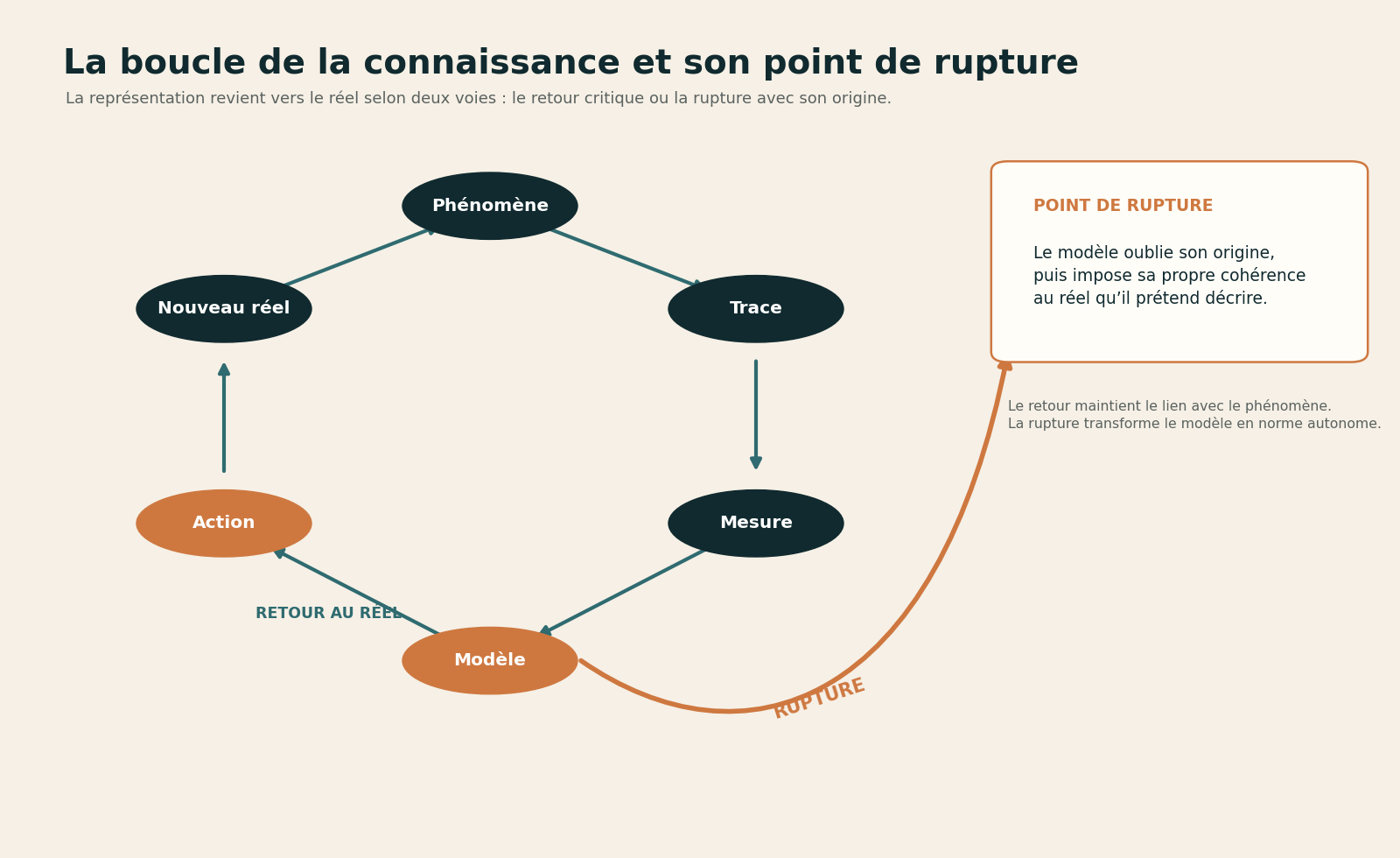
Representation returns towards reality and can break the link with its origin.
Living systems flattened into a state
A geometric figure presents its points, its edges and its proportions simultaneously. An organism exists within nested temporalities. Its cells renew themselves, its flows vary, its tissues carry delays and its behaviours anticipate. Spatial projection gathers these processes into a visible state and loses part of their rhythm.
This loss becomes important when form is used to define normality. A bodily average, an urban architecture or an ecological indicator can ignore the trajectories that lead to the same apparent result. Two systems placed at the same point of a measurement may have opposite reserves and fragilities.
Living systems require geometries enriched by time, flows and transformations. Networks describe relations, topology follows continuities beyond distances, phase spaces represent dynamic regimes, adaptive landscapes show possible transitions. No single tool exhausts the organisation.
The deformation begins with forgetting the selection that has been made. An anatomical section, a map or a graph remain powerful instruments when they clearly indicate what they preserve and what they abandon. Their danger appears when they become the supposed totality of the phenomenon.
Architecture against genesis
Modern societies like to design structures from a plan. That logic works for objects whose components and functions can be stabilised. It meets limits when applied to living, historical and adaptive systems.
A forest is not built like a building. It develops through interactions, successions, perturbations and inheritances. An institution does not function by organisation chart alone. It depends on practices, trust, tacit knowledge and accumulated relations. A person is not reducible to the sum of administrative categories.
The plan tends to privilege coherence seen from above. Genesis reveals local adjustments, detours and solutions that appeared without central design. Living architectures often preserve redundancies and irregularities because they result from a history of viability.
Reintroducing genesis changes design. The objective is no longer to impose a perfect form, but to create constraints able to sustain a transformation. A good living architecture protects the loops of regulation, the margins and the possibility of learning. It accompanies the organisation instead of freezing it.
Our understanding of the Universe undergoes a comparable deformation. We draw a succession of objects and look for the architecture that would organise them. The real transitions pass through changes of regime, constraints and instabilities.
A spiral observed in a galaxy, a shell and a plant does not prove a complete common mechanism. It shows that a family of constraints can produce related forms.
The comparison becomes fruitful when it specifies the status of the relation. A homology comes from a common history. A convergence produces a similar form by different paths. An analogy links functions or partial structures. A coincidence shares an appearance without any established mechanism.
Living systems bring another conception of architecture. An organisation can preserve its identity while changing form. It can shift its resources, reassign its functions and rebuild its boundaries.
A geometry of living systems would integrate history, flows and margins. It would follow the admissible transformations, the active boundaries and the relations between scales. It would describe a domain of viability.
Geometry keeps the spatial relations, dynamics follows the trajectories, thermodynamics describes the flows and biology reveals the inherited functions. Each tool retains its status.
Re-establishing the order of dependence means starting from the phenomenon, extracting an operation, formalising a relation and returning towards reality to verify what the representation preserves.
Living systems then recover their depth. Their form becomes the active trace of a history, their boundary a relation, their identity a transformable continuity and their geometry one dimension among others.
The Universe too recovers its historical character. Its architectures appear as the results of constrained trajectories rather than as copies of a prior design.
FOURTH REVERSAL From representation to inversion Number and geometry amplify thought by isolating reproducible relations. The inversion begins when the order of representation stands in for the physical order and when form is detached from the mechanisms that produced it. The inversion continues when living forms are detached from their flows, their reserves and their trajectories. The partial representation then returns towards the organisation and imposes its own coherence on it. The final part examines how to correct this loop. The unforeseen forces a model to rediscover its limits. Earthly civilisation appears as an organisation able to reintegrate its abstractions within the material and living dependencies they transform. |
|---|
Two possible directions for knowledge
| ORDER OF GENESIS | INVERTED ORDER |
|---|---|
| The phenomenon precedes the operation that isolates it. | The model defines in advance what must be seen. |
| Form condenses a history of constraints. | Form is treated as a plan independent of its genesis. |
| Number preserves a measured relation. | The indicator replaces the capacity it was meant to make visible. |
| Knowledge returns towards reality in order to correct itself. | Reality is corrected in order to stay conformable to the representation. |
The rupture appears when abstraction forgets the material chain that made it possible.
Knowledge returns towards the world
PART FIVE Knowledge returns towards the world Representations transform their own conditions and engage a responsibility of civilisation. |
|---|
CHAPTER 18
Learning from the unforeseen
The unforeseen exposes the hidden hypotheses of a model. A politics of margin protects the capacity to change when prediction ceases to guide action.
Simulation extends our capacity for anticipation. It makes it possible to explore several scenarios, estimate risks and test decisions without immediately producing their consequences in the world. Its power depends on the framework, the data and the relations it contains.
The unforeseen appears when reality combines elements absent from the model, crosses a threshold or follows a neglected trajectory. It indicates a limit in the represented space.
A system organised solely around prediction becomes fragile in the face of what has not been simulated. It optimises its resources for the expected scenarios, reduces redundancies and brings its activities closer to their thresholds.
Learning from the unforeseen requires a politics of margin. Margin takes several forms: a material reserve, a delay, a redundancy, a diversity of skills, an unprogrammed space or a possibility of local decision.
In a stable environment, margin looks like a cost. A stock ties up resources, an extra team reduces measured productivity and a recovery time limits immediate output. During a perturbation, those capacities prevent rupture.
Living systems maintain many margins. Organisms have reserves, alternative pathways and repair mechanisms. Populations preserve a diversity. Ecosystems distribute functions.
Simulation can integrate this logic. It explores the zones of rupture, the rare combinations and the dependencies. It measures the capacity of the system to remain functional when several hypotheses fail.
A politics of margin values recovery, the continuity of services, reversibility and the possibility of changing strategy. It accepts a lower average efficiency in order to reduce the risk of an irreversible loss.
The unforeseen becomes a source of knowledge. It reveals the ignored variables, the invisible links and the badly estimated thresholds. A learning organisation keeps a record of the discrepancies and modifies its models.
The unforeseen as a test of the framework
A simulation explores a space defined by variables, rules and scenarios. It can reveal consequences impossible to follow intuitively. It remains enclosed within the dimensions that have been represented. The unforeseen often appears at the point where the world mobilises a relation absent from the model.
The discrepancy does not condemn the simulation. It informs us about its domain of validity. A model becomes dangerous when it turns its limits into certainties and pushes an organisation to remove every margin that does not serve the central scenario.
Major accidents often combine events that are bearable separately. A breakdown meets a delay, incomplete information and a rigid procedure. Linear analysis looks for a single cause, whereas the real dynamic depends on a chain. Preparing for the unforeseen requires working on transversal capacities: communication, reserves, degraded modes and local decision-making.
Learning is measured by the modification of the framework after the surprise. An organisation that merely adds a rule after each incident accumulates complexity without understanding the structure of its fragilities. A reflexive organisation looks for common dependencies and restores margins.
A politics of margin
Margin represents a capacity not engaged in normal functioning. It may take the form of a stock, free time, a redundancy, a diversity or an available skill. In a logic of optimisation, it looks like waste. In a logic of persistence, it constitutes a space of transformation.
A politics of margin refuses to measure all value by maximal use. It protects unexploited soils, hospital capacities, alternative logistical routes, time for learning and institutions able to experiment. These reserves make possible a response that has not been programmed.
Margin does not replace prevention. It recognises that some combinations will remain unknown. Prudence does not consist in imagining every catastrophe, but in preventing a single shock from reaching all essential functions at once.
This politics links knowledge and operational humility. A model guides action as long as it remains open to its own correction. The unforeseen ceases to be an external fault. It becomes a signal about the relation between representation and world.
The culture of performance often produces the opposite effect. It turns a discrepancy into an individual fault, protects the framework and erases weak signals. Members of the system learn to hide problems in order to preserve the indicators.
A reflexive architecture examines the conditions, the incentives, the communications and the margins. It makes responsibilities more precise and avoids reducing a systemic dynamic to a single person.
The unforeseen has several temporalities. A sudden shock attracts attention. A slow drift can produce an equally strong rupture. Soils are depleted, infrastructures age, organisms accumulate a load and institutions lose their trust.
A politics of margin follows capacities, not only results. It observes reserves, recovery times, the diversity of responses and accumulated debts. It seeks to see before the break.
QSO1 forces us to widen the scenarios of formation. A mutation, a perturbation or a change of milieu opens an unexpected trajectory in living systems. Civilisation meets both logics in climate, technologies and interdependencies.
Simulation becomes dangerous when it replaces observation, closes decisions and gives a certainty its hypotheses do not contain. Its best use prepares several responses and makes dependencies visible.
A well-designed margin has a function of transformability. It allows the system to slow down, reallocate resources, experiment and repair. It creates a space in which history can bifurcate without destroying all continuity.
Whatever is not occupied, used or programmed can become the condition of what will have to emerge. An organisation saturated with procedures and loads can no longer learn.
Learning from the unforeseen means turning surprise into a trace, the trace into a revision and the revision into a capacity. Knowledge gains depth when it accepts that reality always exceeds representation.
CHAPTER 19
Human civilisation, learning to become earthly
A civilisation becomes earthly when it reintegrates its abstractions within the physical, biological and historical conditions on which they depend.
Human civilisation is terrestrial before being industrial, digital or spatial. Its bodies, its materials, its energy, its food and its infrastructures depend on planetary dynamics. This obvious fact disappears behind economic and technical abstractions.
An accounting system can record the growth of an activity while leaving out of frame the erosion of soils, the loss of biodiversity, the depletion of an aquifer or the load imposed on organisms. Number preserves the chosen operation and makes the excluded dimensions invisible.
Civilisation then acts according to an incomplete map. It increases the flows of matter and energy, accelerates exchanges and concentrates functions. The local gains are real. The displaced costs reappear in the form of disruptions, dependencies and fragilities.
Becoming earthly begins with the recognition of the order of dependence. Institutions depend on societies, societies on people, people on living environments and environments on terrestrial dynamics.
This recognition modifies the idea of progress. An innovation increases capacities without destroying their supports. A technology that solves an immediate problem while creating a larger debt merely displaces the constraint.
Technical power is linked to viability through concrete criteria: the consumption of resources, repairability, deferred effects, dependence on infrastructures and the capacity to reverse course.
An earthly civilisation preserves margins. It maintains soils, water reserves, local skills, infrastructures and times of recovery. It avoids confusing every unused capacity with waste.
It recognises the diversity of scales. A decision that is profitable for a company can weaken a territory. A production that is efficient in the short term can reduce ecological capacity. A high-performing global system can create an extreme local dependence.
Collective reflexivity links these scales. It makes displaced costs visible and gives a place to the traces produced by environments and populations. Indicators remain tied to the functions they serve.
Democracy can be understood as an architecture of correction. It distributes the capacity to produce signals, to contest a representation and to modify a decision. It loses that function when the real choices are locked inside opaque structures.
Science describes relations, estimates consequences and reveals constraints. Politics organises the trade-offs. A reflexive civilisation makes that articulation explicit and preserves the possibility of revising its priorities.
Living systems offer a source of principles. They show the importance of cycles, active boundaries, diversity, repairs and interdependencies. They also show extinctions, competitions and dead ends. The lesson concerns the mechanisms.
An earthly economy follows the real flows. It measures what enters, what is transformed, what accumulates and what can be reincorporated. It distinguishes renewable resources according to their speed of regeneration.
An earthly technology remains repairable, understandable and compatible with environments. It uses power where it increases continuity and accepts sobriety when acceleration destroys future capacities.
An earthly culture transforms the relation to autonomy. Absolute independence gives way to the mastery of dependencies. Freedom becomes the capacity to take part in the rules that organise essential exchanges.
Humanity has instruments able to observe the planet as a system. It tracks temperatures, flows, populations, forests and oceans. That capacity for representation takes on its value when it returns into action.
The gap between knowledge and decision reveals an incomplete reflexive autonomy. We know how to describe many risks and continue to reinforce the structures that produce them. Collective memory remains separated from the mechanisms of power.
Becoming earthly requires an architecture in which knowledge of consequences genuinely modifies choices. Ecological thresholds, capacities for recovery and effects on living systems become constraints of design.
The Earth changes, societies evolve and needs shift. Continuity comes from the capacity to follow those transformations without destroying the fundamental cycles.
Having externalised its memory and its power, human civilisation can learn to regulate their return upon the world. It links abstractions to supports, decisions to consequences and freedom to the conditions that make it possible.
We are a form of living system able to represent the Universe, to transform the planet and to anticipate part of its own effects. That capacity makes us responsible for the relation between what we know, what we do and what will still be able to last.
The history travelled in this book begins when an interaction produces a difference and part of that difference crosses time. The trace gives the present a depth. Present structures become the heirs of ancient transformations.
The Universe carries this history in its radiations, its compositions, its distributions and its forms. QSO1 reveals an ancient growth that resists overly simple scenarios. Voids preserve the effects of redistributions. Stars transform matter and prepare new possibilities.
Persistence links these levels. A structure lasts because certain relations are renewed. That continuity requires conditions, interactions and sometimes permanent flows. Visible stability often masks an activity or a support.
The transitions of persistence give another reading of cosmic evolution. Particles, nuclei, atoms, stars, molecules, cells and cultures develop different mechanisms. History diversifies the ways of preserving an organisation.
Living systems turn this continuity into an active inheritance. The cell maintains differences, uses flows, repairs and transmits. LUCA reminds us that all present-day cellular forms extend a common history.
Memory becomes functional when the trace modifies the response. It gains depth with learning, culture and archives. Human beings externalise their capacities and build a collective memory.
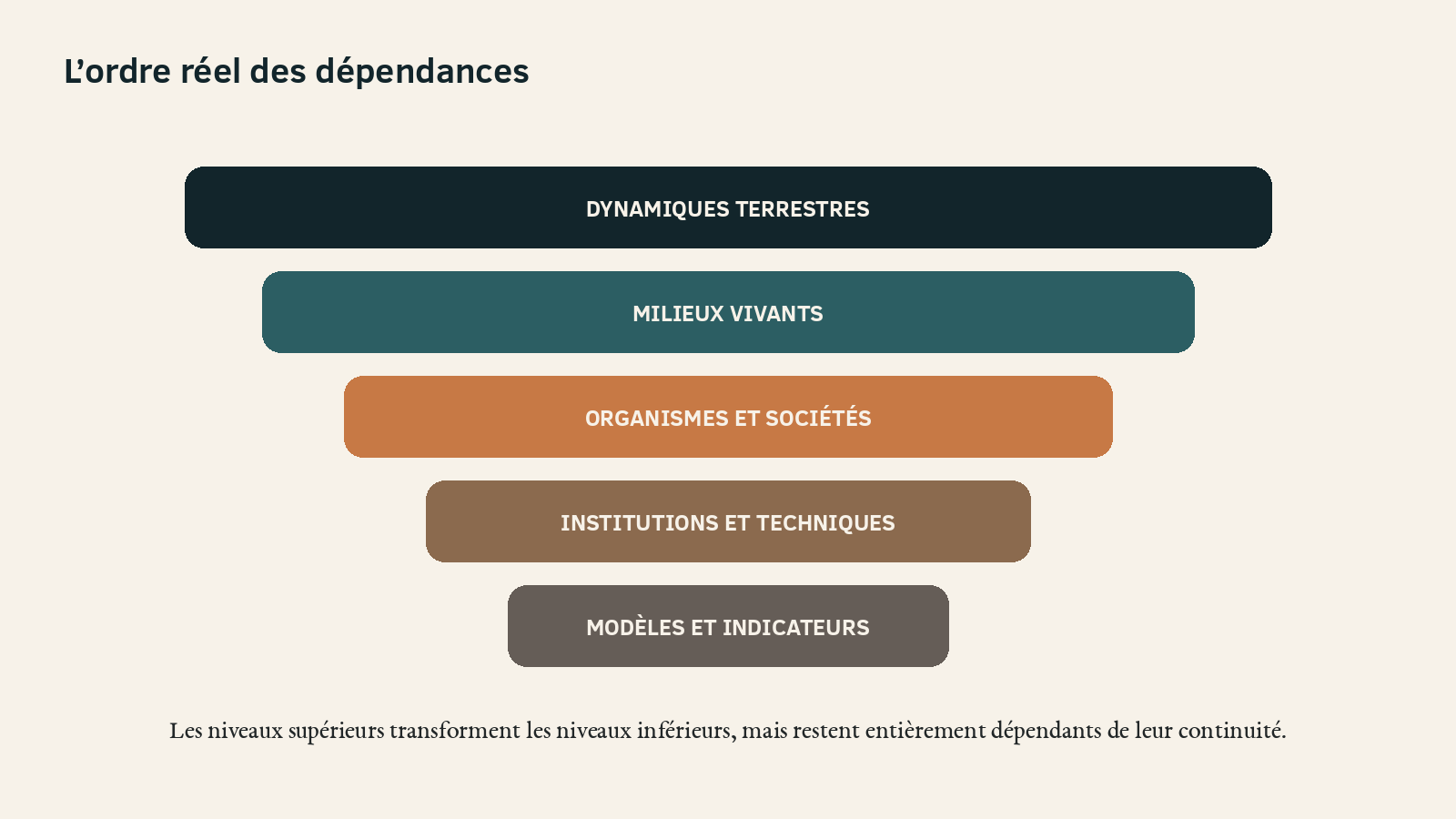
Human abstractions remain internal to terrestrial dynamics.
Recovering the order of dependencies
An earthly civilisation begins by recognising the nesting of its conditions. Institutions depend on populations able to act and cooperate. Populations depend on infrastructures, resources and environments. Environments depend on physical and biological cycles that human decision can modify without replacing.
The economy often inverts this order by treating living conditions as adjustment variables. A forest becomes a stock, a soil a productive surface, a person a unit of labour and a river an available volume. Representation facilitates exchange, but it cuts the measured value off from the processes that regenerate it.
Technical power accentuates this inversion. A local constraint can be displaced to another region, another population or a future generation. The system seems liberated because the cost leaves its field of vision. The debt accumulates in soils, climate, infrastructures, bodies and social relations.
Recovering the order of dependencies means reintegrating those effects into decision-making. An activity becomes viable when it contributes to maintaining the capacities on which it depends. Wealth is also measured in the quality of environments, the solidity of ties and the margins left to the future.
From power to maturity
The maturity of a civilisation cannot be read solely in the quantity of energy it mobilises or in the precision of its machines. It appears in its capacity to orient that power without destroying the conditions that make it possible.
A reflexive civilisation observes the deferred effects of its choices, keeps archives of its errors and modifies its rules when indicators cease to represent reality. It distinguishes development from mere acceleration. It protects capacities for recovery and accepts limits when crossing them reduces possible futures.
Becoming earthly does not require a return to an idealised past. Sciences, techniques and institutions remain indispensable. Their orientation changes. They serve the understanding of dependencies, the reduction of invisible debts and the widening of habitable possibilities.
Living systems offer a principle here, not a model to be copied literally. They endure through regulated exchanges, repairs, variations and transmissions. A civilisation able to learn from that logic would seek less to immobilise the world than to preserve its own transformability within a universe that keeps changing.
Numbers, maps and models stabilise operations able to cross the generations. Their power opens a breaking point when representation forgets the operation that produced it.
Re-establishing the genealogy of representations makes their power safer. A measurement refers back to an operation. A form refers back to a history. A model refers back to a domain. A decision refers back to consequences.
Reflexivity is the capacity to travel that path. An organisation observes its effects, rereads its history and modifies its rules. It preserves a continuity by transforming what threatens its viability.
Our civilisation possesses an immense memory and an unprecedented exosomatic power. It nevertheless depends on models that fragment consequences and displace costs. Its future is at stake in the reunion of knowledge and regulation.
An earthly civilisation places science and technology back within the order of dependence. Living supports, cycles, margins and capacities for recovery enter into design.
The world has produced a form able to recognise the traces of its history and to anticipate part of its transformations. That form can use its knowledge to accelerate the rupture or to modify its trajectory.
Responsibility comes from our belonging to a history that has become partly conscious of itself. We carry in our bodies, our techniques and our concepts a continuity older than our species.
Every decision adds a trace to the world. Some will disappear quickly. Others will modify conditions for centuries. Understanding persistence means recognising that temporal depth within present action.
Reality becomes memory when the past remains active in what comes next. It becomes knowledge when an organisation can relate the traces. It becomes responsibility when that knowledge takes part in the choices that transform the future.
We come from a history of constraints, bifurcations and reconstructed continuities. Our singularity lies in the possibility of reading that history and of choosing how our power will take its place within it.
The next transition of persistence will not be guaranteed by more complexity. It will depend on our capacity to link memory, knowledge and transformability before constraints alone impose what follows.
| A civilisation becomes mature when it protects the conditions that make its power possible. |
|---|
Conclusion
From memory to responsibility
Reality becomes memory when a history remains active in what comes next. With reflexivity, that memory can choose what it will transmit.
The history of reality is not a uniform march towards a final form. It resembles a succession of bifurcations in which certain configurations find a way of lasting. Interactions produce differences, differences become traces, traces modify future possibilities. Matter acquires a historical depth before any organism can remember it.
Living systems turn that depth into function. They mobilise inscriptions, repair their structures, transmit an organisation and explore variations. Environments preserve the effects of earlier generations, while animal groups transmit practices and routes. Active history is distributed among organisms, populations and ecosystems long before becoming narrative.
Human beings extend this movement by massively externalising memory. Number, geometry, models and institutions condense operations, make relations comparable and transmit knowledge beyond individuals. Their singularity lies in symbolic representation and reflexive revision, not in a separation from the memories of living systems.
The inversion appears when this partial preservation forgets its origin. The map is substituted for the territory, the indicator for the capacity, form for genesis and performance for viability. Living systems are then reorganised according to abstractions that nevertheless depend on them.
Reflexivity offers a possible way out. An organisation able to represent its own dependencies can modify its rules before the rupture. It can learn from the unforeseen, restore margins, reinterpret its history and orient its power towards the continuity of the conditions that make it possible.
Becoming earthly means consciously inhabiting that dependence. Humanity remains a local construction of the Universe, issuing from a planet where living systems, environments and non-human cultures have preserved continuities for billions of years. Its responsibility begins when it recognises that possible futures also depend on the ecological and social memories it chooses to preserve, transform or erase.
| The memory of reality becomes responsibility when it can act on the conditions of what will come after it. |
|---|
Scientific landmarks and selected bibliography
These references frame the scientific facts drawn upon and situate the proposed extensions within the ORI-C framework.
Furtak, L. J. et al. A high black-hole-to-host mass ratio in a lensed AGN in the early Universe. Astrophysical Journal Letters, 2024. Preprint arXiv:2308.05735.
Ma, Y. et al. UNCOVER: 404 Error, Models Not Found for the Triply Imaged Little Red Dot A2744-QSO1. Preprint arXiv:2410.06257, 2024.
Furtak, L. J. et al. Investigating photometric and spectroscopic variability in the multiply-imaged Little Red Dot A2744-QSO1. Preprint arXiv:2502.07875, 2025.
Moody, E. R. R. et al. The nature of the last universal common ancestor and its impact on the early Earth system. Nature Ecology & Evolution, 8, 1654-1666, 2024.
Kitano, H. Towards a theory of biological robustness. Molecular Systems Biology, 3, 137, 2007.
Whitacre, J. M. Biological robustness: paradigms, mechanisms, and systems principles. Frontiers in Genetics, 3, 67, 2012.
Artime, O., Grassia, M., De Domenico, M. et al. Robustness and resilience of complex networks. Nature Reviews Physics, 6, 114-131, 2024.
Maturana, H. R. and Varela, F. J. Autopoiesis and Cognition: The Realization of the Living. Reidel, 1980.
Moreno, A. and Mossio, M. Biological Autonomy: A Philosophical and Theoretical Enquiry. Springer, 2015.
Bich, L. and Bechtel, W. Mechanism, autonomy and biological explanation. Biology & Philosophy, 36, 53, 2021.
Mossio, M. (ed.). Organization in Biology. Springer, 2024.
Di Paolo, E. A., Buhrmann, T. and Barandiaran, X. E. Sensorimotor Life. Oxford University Press, 2017.
Prigogine, I. and Stengers, I. Order Out of Chaos. Bantam, 1984.
Holling, C. S. Resilience and stability of ecological systems. Annual Review of Ecology and Systematics, 4, 1-23, 1973.
Scheffer, M. Critical Transitions in Nature and Society. Princeton University Press, 2009.
Landauer, R. Irreversibility and heat generation in the computing process. IBM Journal of Research and Development, 5, 183-191, 1961.
Maynard Smith, J. and Szathmáry, E. The Major Transitions in Evolution. Oxford University Press, 1995.
Thompson, D'Arcy W. On Growth and Form. Cambridge University Press, 1917.
Dehaene, S. The Number Sense. Oxford University Press, 1997.
Hutchins, E. Cognition in the Wild. MIT Press, 1995.
Stiegler, B. La technique et le temps, vol. 1: La faute d'Épiméthée. Galilée, 1994.
Georgescu-Roegen, N. The Entropy Law and the Economic Process. Harvard University Press, 1971.
Frigg, R. and Hartmann, S. Models in Science. Stanford Encyclopedia of Philosophy, revised edition.
Kauffman, S. A. The Origins of Order. Oxford University Press, 1993.
Odling-Smee, F. J., Laland, K. N. and Feldman, M. W. Niche Construction: The Neglected Process in Evolution. Princeton University Press, 2003.
Trappes, R. et al. How Individualized Niches Arise: Defining Mechanisms of Niche Construction, Niche Choice, and Niche Conformance. BioScience, 72(6), 538-548, 2022.
Whiten, A. et al. Cultures in chimpanzees. Nature, 399, 682-685, 1999.
Rendell, L. and Whitehead, H. Culture in whales and dolphins. Behavioral and Brain Sciences, 24, 309-382, 2001.
Jablonka, E. and Lamb, M. J. Evolution in Four Dimensions. MIT Press, 2005.
BIPM. The International System of Units (SI), 9th edition. Bureau international des poids et mesures, 2019, updated 2022.
NIST. CODATA Recommended Values of the Fundamental Physical Constants. National Institute of Standards and Technology.