The formula Σ (6 − n) fₙ = 12 is neither an autonomous law nor a mysterious property of the number 12. It follows from Euler's formula applied to a cell decomposition of a closed surface, without boundary, of spherical topology, under a second decisive condition: the network is trivalent, that is, three edges meet at every vertex. Each edge belongs to exactly two faces. These assumptions exclude free boundaries, edges shared by more than two faces, and singularities incompatible with a surface.
The proof shows that the 12 is produced by the conjunction of three facts: the Euler characteristic of the sphere, the trivalence of the vertices, and the double incidence of each edge with the faces. It changes as soon as the topology or the valence changes.
1. Setting the notation
We write V : the total number of vertices. E : the total number of edges. F : the total number of faces. fₙ : the number of faces having exactly n sides.
F = Σₙ fₙ The total number of faces is the sum of the faces of each type. |
|---|
2. Counting edges through the faces
A face with n sides has n edges. Adding up the sides of all the faces gives Σₙ n fₙ. Since each edge belongs to exactly two faces, this count meets it twice.
| Σₙ n fₙ = 2E |
|---|
| E = ½ Σₙ n fₙ |
|---|
3. Counting edges through the vertices
Trivalence means that three edges meet at every vertex. The total number of edge endpoints is therefore 3V. But each edge has two endpoints, so the same count also equals 2E.
| 3V = 2E |
|---|
| V = ⅔ E |
|---|
4. Applying Euler's formula
For a closed surface of spherical topology, the Euler characteristic equals 2. The cell decomposition therefore satisfies:
| V − E + F = 2 |
|---|
5. Substituting V and F
We replace V by 2E/3 and F by Σₙ fₙ:
| ⅔E − E + Σₙ fₙ = 2 |
|---|
| −⅓E + Σₙ fₙ = 2 |
|---|
| −E + 3Σₙ fₙ = 6 |
|---|
6. Substituting E
The relation obtained by counting the faces gives E = ½Σₙ n fₙ. Substituting it into the previous equation:
| −½Σₙ n fₙ + 3Σₙ fₙ = 6 |
|---|
| −Σₙ n fₙ + 6Σₙ fₙ = 12 |
|---|
7. Grouping the sums term by term
The last step is not a simple factoring out of Σₙ fₙ. The two sums are grouped term by term:
| 6Σₙ fₙ − Σₙ n fₙ = Σₙ 6fₙ − Σₙ nfₙ |
|---|
| Σₙ 6fₙ − Σₙ nfₙ = Σₙ (6 − n)fₙ |
|---|
Σₙ (6 − n)fₙ = 12 An identity valid for a trivalent network of spherical topology. |
|---|
Interpreting the number 12
Each face contributes to the balance an amount equal to 6 − n. A pentagonal face contributes +1, a hexagonal face 0 and a heptagonal face −1. This contribution is combinatorial. It does not on its own describe the full metric geometry of the surface.
Pentagons and hexagons
In a spherical trivalent network composed solely of pentagons and hexagons, the hexagons contribute nothing to the balance. The pentagons each supply one positive unit. Exactly twelve of them are therefore required, whatever the number of hexagons.
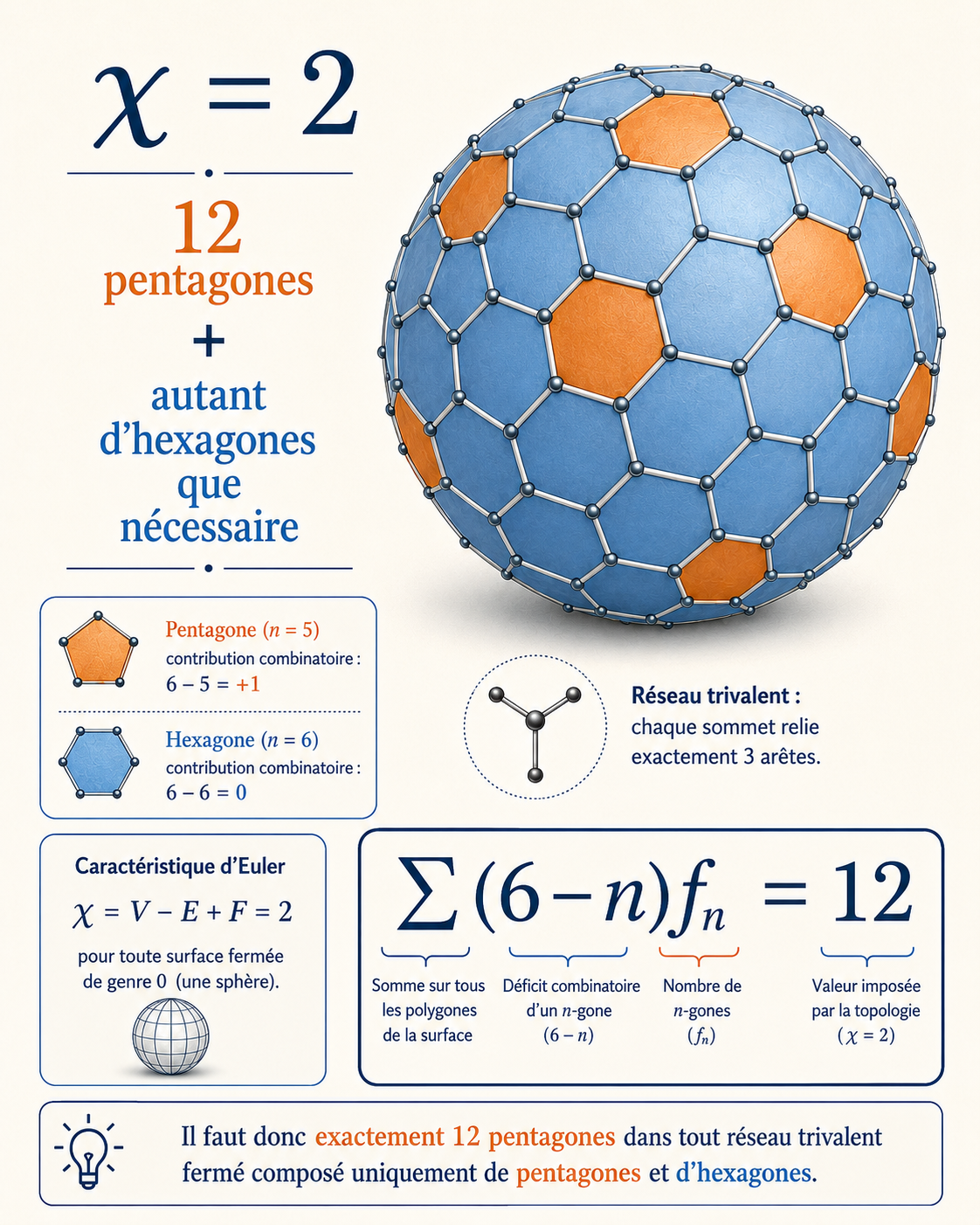
| f₅ = 12 |
|---|
Pentagons, hexagons and heptagons
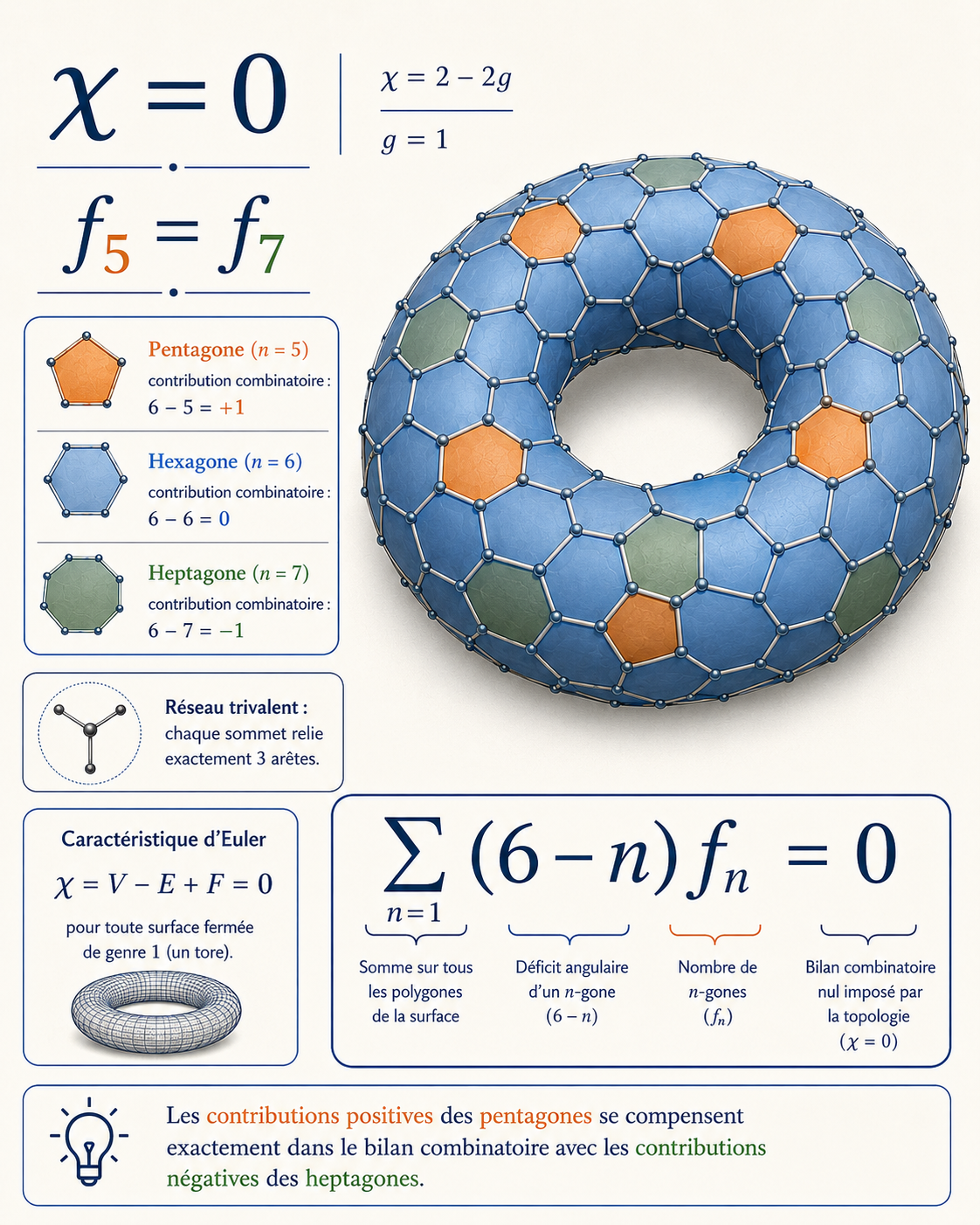
A heptagonal face contributes one negative unit. Each heptagon must therefore be compensated by an additional pentagon in order to preserve the same spherical topology.
| f₅ − f₇ = 12 |
|---|
The case of the hexagon
A hexagonal face contributes zero to the combinatorial balance. In the regular case, it is compatible with a trivalent plane tiling without concentrated intrinsic curvature. This does not mean that any assembly of hexagons is geometrically flat: deformed hexagons can be placed on a curved surface. The formula describes first of all the topology and the combinatorics of the network, not its whole metric.
The interpretation in degrees: a normalised combinatorial curvature
In the interpretation obtained from the triangulated dual network, each unit 6 − n corresponds to a normalised deficit of 60°. A vertex of the dual surrounded by six equilateral triangles is flat, whereas a vertex surrounded by five triangles shows a deficit of 60°. The total sum then equals:
| 12 × 60° = 720° = 4π |
|---|
This value agrees with the total curvature of a sphere given by the Gauss–Bonnet theorem. It is, however, a combinatorial curvature. It coincides with the real geometric angular deficit only under additional metric assumptions, for example when the elements of the dual are taken to be equilateral triangles.
Why trivalence is indispensable
The relation 3V = 2E enters directly into the proof. If every vertex has a different valence, this relation changes and the final identity changes with it. The number 12 is therefore not universal independently of the network. It is the particular value produced by a spherical topology and a valence equal to three.
Generalisation to a surface of genus g
For a closed orientable surface of genus g, the Euler characteristic equals χ = 2 − 2g. The same proof gives:
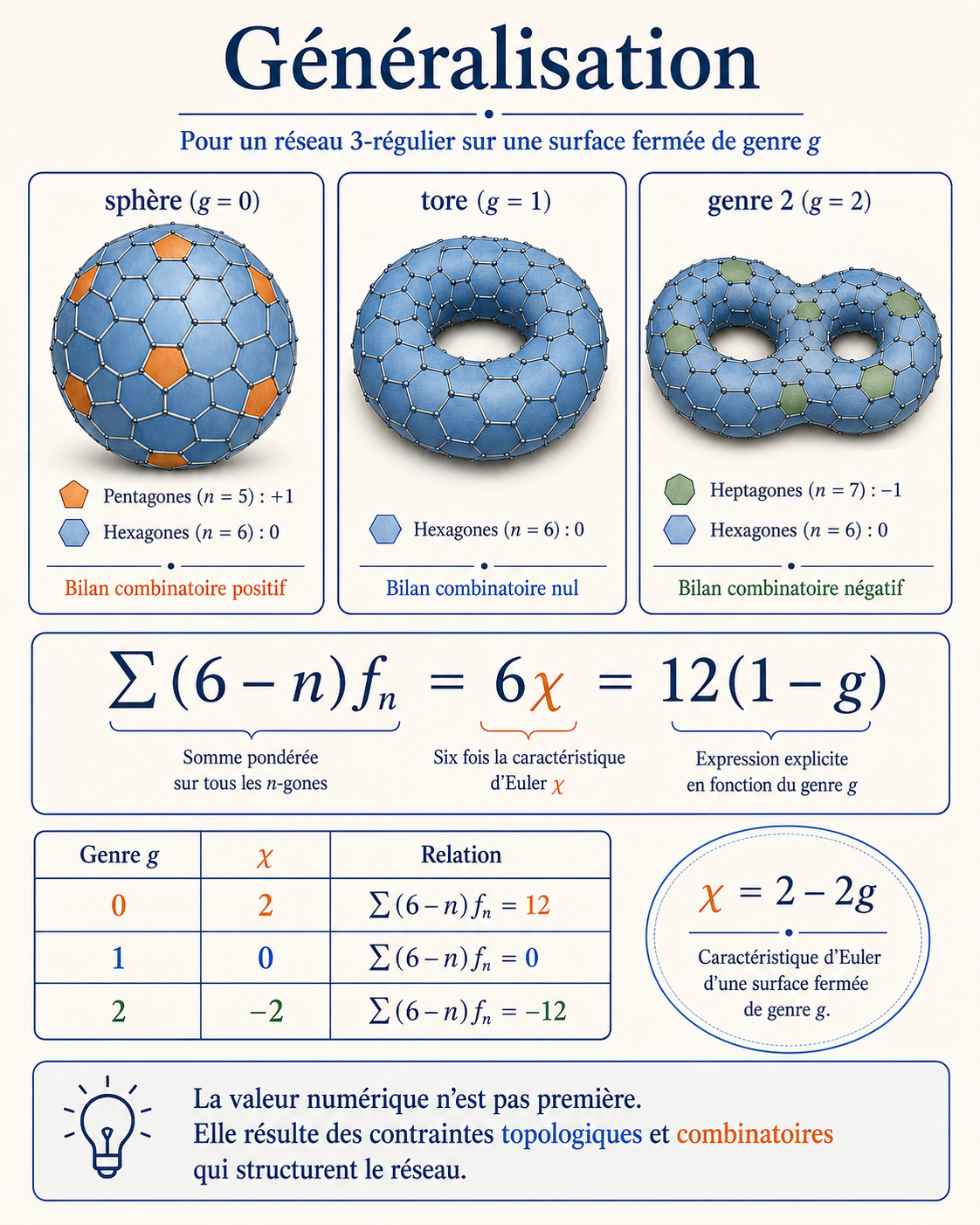
| Σₙ (6 − n)fₙ = 6χ = 12(1 − g) |
|---|
| Surface | Genus | Characteristic | Trivalent balance |
|---|---|---|---|
| Sphere | g = 0 | χ = 2 | Σ(6 − n)fₙ = 12 |
| Torus | g = 1 | χ = 0 | Σ(6 − n)fₙ = 0 |
| Genus-2 surface | g = 2 | χ = −2 | Σ(6 − n)fₙ = −12 |
Generalisation to a valence q
If every vertex has exactly q edges, then qV = 2E. Applying the same reasoning to a closed surface of Euler characteristic χ, we obtain:
| Σₙ [2q − (q − 2)n] fₙ = 2qχ |
|---|
On a sphere, χ = 2, hence:
| Σₙ [2q − (q − 2)n] fₙ = 4q |
|---|
Examples
For q = 3, the formula becomes Σₙ(6 − n)fₙ = 12 again. For q = 4, it becomes Σₙ(4 − n)fₙ = 8. The octahedron has eight triangular faces, and 8(4 − 3) = 8. For q = 5, it takes the form Σₙ(10 − 3n)fₙ = 20. The icosahedron has twenty triangular faces, and 20(10 − 9) = 20.
What changes when a network has a boundary
The proof above rests on one essential assumption: each edge belongs to exactly two faces. As soon as a boundary appears, the peripheral edges are incident to a single face only. The double-incidence relation Σₙ n fₙ = 2E is then no longer valid in that form, and the vertices of the boundary may also have a valence different from that of the interior vertices.
The formula therefore acquires additional contributions depending on the number of peripheral edges, the valence of the boundary vertices and the combinatorial geometry of the boundary. The substitution χ = 2 − 2g − b alone does not suffice. Surfaces with boundary fall under a distinct generalisation, analogous to the version of Gauss–Bonnet in which the interior curvature must be completed by a boundary contribution and, where applicable, by the angles of its corners.
One constraint, several numbers
The Euler characteristic does not always produce the same numerical value. It imposes a balance whose translation depends on the nature of the system, on the object counted and on the charge assigned to each defect. On a sphere, a trivalent polygonal network composed of pentagons and hexagons requires twelve pentagons. A nematic field tangent to that same sphere must, for its part, have a total topological charge equal to +2, often distributed among four defects of charge +1/2.
The sphere imposes neither the 12, nor the 4, nor the 2. It imposes a topological balance whose numerical translation depends on what is counted and on the way that balance is distributed among the elements of the system. One and the same value may arise from distinct mechanisms, and one and the same constraint may produce different values. In neither case does the number alone allow its cause to be reconstructed.
Visualising the balance: sphere and torus
| Surface | χ | Combinatorial balance | Consequence |
|---|---|---|---|
| Sphere | 2 | Σₙ(6 − n)fₙ = 12 | 12 pentagons |
| Torus | 0 | Σₙ(6 − n)fₙ = 0 | f₅ = f₇ |
On a torus, the Euler characteristic is zero. The hexagons contribute nothing to the combinatorial balance, while each pentagon must be compensated by a heptagon. The relation f₅ = f₇ expresses this global topological neutrality. This representation concerns the combinatorics of the network. It does not mean that an ordinary geometric torus can be tiled everywhere by regular Euclidean hexagons without deformation.
Topology imposes the balance. Local geometry determines how that balance is distributed.
Conclusion
The number 12 is neither arbitrary nor universal. Here it results from the Euler characteristic of the sphere, the trivalence of the vertices and the double incidence of the edges. Another topology, another valence or the presence of a boundary produces another balance. Numbers are measurable results of mechanisms, not their causes.
The numerical value is never the final explanation. Numbers are the visible traces of constraints, relations and histories that remain to be identified. Those constraints are not necessarily primary: they merely mark the level at which the inquiry provisionally stops, before it can be pushed further back.