Terrestrial life is perhaps not life, but a local realisation of a more general logic: that of organisations which produce the conditions of their own continuation.
Abstract
The organisational framework characterises living systems by a constitutive closure: a network of processes that produce, renew or reactivate the conditions of their own continuation, individuated by an operational boundary. That characterisation mentions neither carbon, nor water, nor DNA.
If it is genuinely substrate-neutral, two questions arise. What minimal conditions of density, coupling and reciprocity of constraints make a closure self-sustaining? And are there, outside carbon biology, other realisations of that logic in the universe — astrophysical plasmas, exotic solvent chemistries or structures at the galactic scale?
This article argues that the relevant object is not « exotic life » but a comparative physics of autonomy, of which terrestrial life is the only realisation confirmed today. It abstracts the physical conditions of closure, proposes a descriptive vector in which a term of externalisation plays the discriminating role, and distinguishes three regimes that resemblance conflates: the relaxation, the repair and the reproduction of a constraint. Three cases — dusty plasmas, the lakes of Titan and galactic structures — are treated not as candidates but as tests of a criterion that must exclude as much as it includes.
The proposal issues in a falsifiable research programme and in a discriminating prediction: constitutive closure should appear only where an exploitable flux, an integrated network of productive reciprocity, a sustained individuation and a limited externalisation of the organising functions coexist. It should not appear in plasma or gravitational configurations whose essential constraints and individuation remain mainly imposed by the environment. These conditions are not asserted to be sufficient: the thesis is that a candidate failing to satisfy them should fail.
The article finally proposes a multidimensional profile Γ = (K, R, I, P, X, V) and an experimental protocol founded on causal interventions, the estimation of externalisation and the temporal measurement of restoration after perturbation.
Status of the text A cosmological extension of the framework set out in « Viability, closure and memory ». It is a theoretical proposal and a testing programme, not a claim of existence. Carbon retains considerable chemical advantages. Substrate neutrality is a working hypothesis here, not an established thesis. |
|---|
I. The question and its discipline
The organisational framework does not define living systems by a substance. It characterises them by an architecture: a network of mutually necessary constraints and processes, producing the individuation that makes them attributable to a unit, and maintained far from equilibrium. None of these conditions names carbon.
This substrate neutrality is fruitful, but it is a double-edged blade. If the requirement of individuation or of reciprocity is relaxed, « everything organised » becomes alive and the framework empties out. Its value lies not in what it includes, but in what it continues to exclude. The extension to the cosmos must carry the safeguards, not abandon them.
The question posed splits in two. On one side, a question of conditions: what forms of coupling, productive reciprocity, persistence and individuation allow an organisation to take charge of part of the conditions of its own renewal? On the other, a question of extension: does that logic admit non-carbon realisations? The two are closely linked without being identical: the search for exotic realisations puts the proposed conditions to the test, while their formulation determines what we shall look for outside terrestrial biology.
They are treated here in the spirit of the original framework: through hypotheses and tests, not assertions. The three exotic scenarios are not candidates to be promoted, but test cases. Two of them, the plasma and the galaxy, are valuable because the criterion must rule them out; the third, Titan, is valuable because it forces us to separate what terrestrial biology has welded together: individuation and membrane.
A semantic precaution. The terms « autonomy », « memory » and « information » are used in an organisational and operational sense. They imply neither intention, nor cognition, nor subjective experience. The framework compares causal dependencies, capacities of renewal and effects of the system's history, not mental states.
II. The minimal physical conditions
1. Flux, constrained work and dissipation. Any active closure must be maintained far from thermodynamic equilibrium: it preserves its organisation by exploiting an available difference and dissipating energy. That does not, however, identify it with a dissipative structure in Prigogine's sense. Being far from equilibrium is necessary, not sufficient. The usual formula, « a high-quality source and a low-energy sink », is moreover too narrow: depending on the system, the relevant resource may be a chemical potential, an electrochemical gradient, non-equilibrium radiation, a thermal difference, a mechanical flux or a varying field.
The general condition is stated more prudently: the system must be coupled to fluxes allowing constrained work, and must have a pathway of dissipation compatible with the continuation of its organisation. This formulation makes it possible to introduce the hypothesis of a conserved closure, where the current flux can become very weak while the structures required for a possible reactivation persist. In the case of a spore, that closure must not be presupposed: it must be assessed relative to a defined class of compatible environments and to criteria of organisational resumption.
2. Processes, constraints and the Γ profile. A word of vocabulary, since it carries everything else. A process is a transformation; a constraint is a relatively persistent structure or relation that channels transformations without being consumed on the same timescale. It may be, for example, a membrane that modifies exchanges, a catalyst that selects a pathway or a field that orients charged particles. A constraint is constitutive only if it contributes to the continuation of the organisation and if its existence depends, directly or indirectly, on other processes of that same organisation. The mere presence of an interface, a catalyst or a field is not enough.
Nor is the raw density of relations enough: a dense network can remain entirely dependent on an external catalyst, feed or controller. The relevant properties are gathered not into a single degree, but into a pre-registered descriptive profile:
| Dimension | Operational question |
|---|---|
| K: connectivity | Do the constraints form a strongly connected sub-network? |
| R: productive reciprocity | Do they effectively renew their targets, rather than merely being correlated? |
| I: individuation | Does the boundary explain the fluxes and perturbations better than its alternatives? |
| P: persistence | Do the constraints last on the right scale while being renewed? |
| X: externalisation | What share of the organisation is supplied from outside? |
| V: viability | Is there a measurable domain of continuation and of loss? |
None of these numbers should be read as a « degree of life ». The vector serves to compare systems on distinct operational questions, not to rank them on a single scale. It thereby extends the refusal of the scalar adopted in the original framework.
Dimension P has a simple temporal reading: a constraint must last long enough to channel a faster process while remaining renewable by the network — that is, a hierarchy of characteristic scales, without a single hierarchy being imposed:
History and memory are not added here as a seventh dimension H. They are treated as transversal properties. P describes the renewed persistence of constraints. The dependence of G(p,t) on the earlier state and on the sequence of perturbations makes it possible to test a functional historicity. V can also depend on the path when past transformations modify the domain of states still accessible. In other words, an organisational memory emerges here as a natural consequence of closure, through the persistence of constraints and the historical dependence of states, rather than as an independent condition to be added to the Γ profile. A memory in the strong sense nevertheless requires internal traces whose causal effect on a later response can be demonstrated. It is deduced neither from persistence alone nor from a historical signature observed from outside.
This distinction separates minimal closure from its adaptive elaborations. A constitutive closure can exist without learning or open-ended evolution. In a variable environment, its long-term persistence may nevertheless depend on plastic regulations, functional memories or an evolutionary capacity. These properties can increase the robustness and transformability of the system, but they are not introduced as conditions of minimal closure.
Information is not added as a substance or as an autonomous dimension. Within this framework, a physical difference counts as organisational information only if it is produced or preserved by the system and if an intervention shows that it causally modifies a later response. In a non-carbon realisation, its support could be chemical, structural, topological, electromagnetic or otherwise: the physical encoding, the transmission and the causal use would have to be demonstrated, not assumed.
Of the six dimensions, X — externalisation — is the most discriminating, and it is X that the rest of the article places at the centre; I and V take up, as comparable dimensions, the individuation and viability treated elsewhere as conditions. Externalisation is read first constraint by constraint, as the external share of its renewal:
The vector E = (e₁, e₂, …, eₙ) is then kept rather than immediately averaged into a global figure: adding heterogeneous contributions — the synthesis of a membrane, the upkeep of a gradient, the repair of a catalyst — presupposes a comparability that must be justified before any aggregation. A single value X is introduced only afterwards, and subject to that reservation. The eᵢ are not mere declarations: they are estimated by causal perturbation, through the inhibition or targeted ablation of a component, a simulated knock-out or the controlled withdrawal of an input from the environment, and then by measuring the effect on the renewal of the constraint. The share restored internally is distinguished from the share coming from the wider arrangement; multi-scale modelling serves as a complement when direct intervention is impossible.
Since the distinction between inside and outside depends on the boundary adopted, I and X are partly co-determined during the analysis. The procedure must be comparative and iterative rather than circular: several candidate boundaries are pre-registered, I and E are estimated for each, and their capacity to explain the fluxes, the localisation of perturbations, the reciprocity and the persistence is then compared according to criteria fixed before observation. The boundary retained is not the one that arbitrarily maximises a Γ score, but the one that provides the most robust and most parsimonious causal delimitation across the interventions.
A system may freely import matter and energy: autonomy is not autarky. X does not measure general dependence on inputs from the environment, but the external share of the renewal of the organising constraints. A system can be entirely dependent on a supply of matter and energy while presenting a low externalisation of its constraints, if it itself produces the interfaces, catalysts, controls and renewal mechanisms that channel those inputs. But if the environment directly supplies all the interfaces, all the catalysts, the control and the repair, the closure belongs to the wider arrangement: to the surrounding plasma, to the designer or to the host. This is the proper formalisation of the central question of the original framework, from the engine to the erythrocyte: does this process belong to the system or to what surrounds it?
A closure does not appear when a single component crosses a threshold, but when a strongly connected sub-network renews several indispensable constraints, sustains an operational individuation, persists at the relevant scales and remains within a defined domain of viability, with a sufficiently limited externalisation.
3. An individuation without an obligatory membrane. Terrestrial biology has welded individuation to the lipid membrane. Nothing in the framework requires it. An active boundary can be topological, dynamic, chemical, electromagnetic or purely functional.
But a mere difference between an inside and an outside is not enough. To count as constitutive individuation, the boundary must satisfy four joint conditions: selectively modify exchanges, persist at the relevant scale, depend causally on processes attributable to the system, and in return contribute to the continuation of those same processes. It is above all the third and fourth conditions — the production and the reciprocity of the boundary — that separate a constitutive boundary from a mere physical interface.
4. Relaxation, repair, reproduction. The most deceptive resemblance is the one surrounding restoration. Three regimes must be distinguished, since they look identical to superficial observation.
Relaxation: after a perturbation, the system returns passively towards a state or a dynamic regime mainly determined by its physical conditions and its external forcing, without necessarily returning to thermodynamic equilibrium. This is the regime of the flame and of the plasma sheath.
La repair : the system restores an impaired function from its own dynamics, within a bounded domain.
La reproduction of a constraint : the network remanufactures the element removed from it, because it was already producing it normally.
The last two provide indications in favour of closure without demonstrating it in isolation: a closure can be real while remaining fragile and unable to repair certain losses. That is why the original framework carefully distinguishes closure, robustness and recoverability. The relevant test is not « what happens when the element disappears? ». That question measures only dependence. One must instead ask: « does the network take part in producing this element, and can it reconstitute its function after a limited loss? ». An engine deprived of its pump does not remake it; a cell regenerates its damaged membrane. It is that regenerative asymmetry, and not the propagation of an effect, that indicates closure — without the extent of the repair being an absolute condition of it.
III. The status of the closure threshold
It is tempting to imagine the appearance of closure as a phase transition in the space of organisations: beyond a critical density of coupling, the system locks all at once into a self-producing state. The image is powerful. It also carries a reservation that must be named before it is used.
The literature offers a foothold on one side. In certain models of random reaction networks, the probability of obtaining a reflexively autocatalytic and food-generated set increases as the level of catalysis grows, sometimes abruptly (Kauffman, 1986; Hordijk and Steel, 2010). The thresholds and their behaviour nevertheless depend on the model, the size of the system, the distribution of catalysts and the rules of attribution: there is no single universal threshold, but a qualitative candidate for a « critical density ».
But that percolation delivers a catalytic closure, not a constitutive one. An autocatalytic set in a well-mixed reactor produces its components without individuating itself: it has K and part of R, but neither a boundary of its own nor a guaranteed P, and often a high X. Two conceptual passages must be distinguished, not one: the emergence of an autocatalytic set, which has mathematical support, and the integration of individuation into the productive network, which remains an organisational hypothesis. The second might correspond to an abrupt transition rather than a gradual accumulation, but that remains to be demonstrated; the constitutive level in any case requires their conjunction: the boundary must be produced by the very network it encloses. The regimes can then be ordered:
| Regime | Central property | Limit |
|---|---|---|
| Self-assembly | Spontaneous formation of a structure | Does not necessarily produce its own conditions |
| Autocatalytic coupling | Mutually favoured production | Individuation can remain external |
| Feedback | Return effect on a process | The loop can be imposed or passive |
| Constitutive closure | Reciprocal production of the constraints and of the boundary | Must be demonstrated causally |
As for the term « phase transition », it must remain hypothetical as long as no order parameter has been defined and no reproducible critical behaviour has been observed in a family of systems. The search for a possible universality class would become relevant only in a second stage. The combination proposed below is not presented as an order parameter, but as an exploratory index of productive closure. It brings together the connectivity of the constitutive sub-network, productive reciprocity and low externalisation. Purely heuristically, and without claiming any derivation:
where ρ(K) denotes the fraction of the network belonging to the strongly connected component of the constraints, R the mean productive reciprocity and X the aggregated externalisation, once its comparability has been justified. Φ does not represent the complete profile of autonomy: it measures only the productive closure of the network from K, R and X, while I, P and V remain outside that combination. At this stage Φ is not an order parameter. It could be requalified as one only if it exhibited, within a family of models, a reproducible critical variation robust to the size of the system and to choices of parameterisation. Until that demonstration, its role is more modest: to test whether that combination usefully discriminates between autocatalytic networks, strongly externalised systems and organisations able to produce their own individuation.
Exploratory index Φ
The index Φ is not proposed as an established measure of autonomy. Its relevance will depend on its capacity to distinguish autocatalytic networks, strongly externalised systems and organisations able to produce their own individuation, without replacing the multidimensional profile Γ.
| Step | Test |
|---|---|
| 1. Build | Generate networks of different sizes N, with degradable constraints, external resources and a candidate boundary. |
| 2. Vary | Modify the density of catalysis, the reciprocity, the rate of degradation, the permeability and the externalisation. |
| 3. Measure | Compute K, R, I, P, X and V separately, then evaluate the exploratory index Φ. |
| 4. Compare | Test non-individuated autocatalytic networks, externally driven systems and organisations with a renewed boundary. |
| 5. Search | Study Φ(λ,N), possible hysteresis and relaxation times, without presupposing a phase transition. |
One fundamental question remains, which this framework makes precise without settling it: does constitutive closure emerge regularly in certain families of sufficiently coupled and driven systems, or is it a rare contingency ? Results in the thermodynamics of replication impose certain relations between growth, durability, internal entropy and dissipation, but they do not demonstrate that dissipation spontaneously generates self-replication or closure (England, 2013). Work on dissipative adaptation then proposed that a non-equilibrium forcing may favour certain forms of self-organisation through the dissipation of absorbed work, without thereby providing a theory of the emergence of constitutive closure (England, 2015). The question remains open, but empirically approachable — through laboratory prebiotic chemistry on one side and agnostic biosignatures on the other.
IV. Three test cases: what the criterion must exclude
5. Dusty plasmas: the failure case. Complex plasmas contain charged dust grains that self-organise into crystals, vortices and filaments. Each grain surrounds itself with a Debye sheath that differentially modifies the fluxes of charged particles and maintains a potential difference relative to the surrounding plasma, which is one of the indications of operational individuation.
The resemblance stops there. If the candidate unit is limited to the grain, the Debye sheath depends mainly on the collective response of the surrounding plasma, not on an internal network proper to the grain: its externalisation appears high. A wider delimitation, including a region of the plasma, should nevertheless be compared before concluding, in accordance with the principle of scale locality. Under the grain delimitation, restoring the potential after a pulse would demonstrate no closure: it would be a relaxation towards a regime mainly determined by the surrounding plasma, not the reproduction of a constraint by the candidate system. To speak of closure one would need a cycle of distinct constraints producing one another: a surface structure modifying local ionisation, that ionisation sustaining a current, that current rebuilding the structure, all within an individuated zone. The mere growth of a grain by ionic attraction remains insufficient.
The work of Tsytovich, Morfill and colleagues on helical structures in dusty plasmas invoked replication, bifurcation and memory (Tsytovich et al., 2007). It rests on simulations and does not demonstrate the existence of « inorganic living matter »; the expression belongs to speculative proposal and must be treated as such. Under the delimitation centred on the grain and its sheath, the candidate fails the closure criterion: a dissipative structure individuated from outside, with no self-produced boundary within a constitutive loop. A wider plasma-dust unit would require a distinct causal analysis; the result holds for the delimitation examined, not for every conceivable plasma organisation.
6. Titan: the productive case. On Titan, lakes of liquid methane and ethane replace water at some 90–95 K. The chemistry there is real and rich. The question of compartmentation has an instructive history there.
Molecular dynamics simulations proposed that acrylonitrile, detected in Titan's atmosphere (Palmer et al., 2017), could self-assemble into stable vesicles, the « azotosomes », inverted-membrane analogues in a non-polar solvent (Stevenson, Lunine and Clancy, 2015). A later thermodynamic study concluded the opposite: under Titan's conditions the crystalline form of acrylonitrile is favoured over the azotosome by some 8 to 17 kJ/mol, making such membranes improbable (Sandström and Rahm, 2020). The first experimental test, more recent still, points the same way: acrylonitrile forms a stable co-crystal with ethane rather than a membrane (Vu and Hodyss, 2026).
That trajectory — from simulation to thermodynamic difficulty, and then to the absence of membrane formation under the experimental conditions studied — is valuable for the framework rather than fatal. These results do not refute every conceivable membrane in every Titan environment. They put one particular architecture in difficulty. Even if an azotosome-type structure did manage to form spontaneously, it would belong first of all to self-assembly. A closure would become conceivable only if an internal network took part in producing or renewing that boundary. Above all, these results forbid us from privileging in advance an inverted lipid membrane and lead us to look for individuation elsewhere: interfaces between phases, mineral pores, droplets, gradients within solid matrices, selective adsorption or transient compartments sustained by fluxes.
Titan remains a good test bed, precisely because it separates individuation from the terrestrial membrane. It also points to a substrate-specific kinetic falsifier: at 90–95 K, can a catalytic cycle run fast enough to renew a compartment before it disperses? Even granting good compartmentation, the ratio between renewal time and dispersion time remains decisive. It indicates whether a dynamic organisation can persist long enough to become a candidate for closure. Closure itself still requires that the renewal of the boundary depend on the network it helps to maintain. That question will have to be pursued through cryogenic experiments, kinetic and thermodynamic models and, where possible, direct observations. Substrate neutrality cannot dissolve it.
Methodological box: time ratios in a cryogenic chemistry
The kinetic test must compare several characteristic times. A durable compartmentation is plausible only if its constraints are renewed before their dispersion or degradation. That condition is necessary for a candidacy to closure, but it does not demonstrate productive reciprocity.
| Quantity | Interpretation |
|---|---|
| τreaction | Characteristic time of the useful internal transformations. |
| τrenewal | Time required to produce or renew the boundary. |
| τdispersion | Time of loss of the compartment through diffusion, dissolution or fragmentation. |
| τdegradation | Time of functional loss of the constitutive constraints. |
| τobservation | Minimum duration required to distinguish persistence from a mere transient. |
Indicative kinetic condition: τrenewal < min(τdispersion, τdegradation). Complementary causal condition: a controlled variation in the activity of the internal network must modify the flux of production or renewal of the boundary. Without that dependence, one observes a persistent compartmentation, not yet a constitutive closure.
At this stage no general numerical value is proposed for these time ratios. The relevant orders of magnitude will depend on the solvent, the composition, the phase, the interfaces, any catalysts and the mechanism of renewal. The test must bear first on ranges of values and their uncertainties, obtained through cryogenic experiments and modelling, rather than on a single numerical threshold transposed from terrestrial biology.
7. Galaxies: a profile, not a level. Applying closure to a galaxy is the extreme test of scale locality. A spiral galaxy has an identifiable shape, presents feedbacks that modulate its star formation and preserves traces of its history in its metallicity gradients. The temptation to see an « autocatalytic network » there is real, but excessive.
Stellar feedback is not unequivocal: supernovae compress some clouds and favour their collapse, but they also heat, disperse and expel gas, inhibiting formation. The coupling is sometimes positive, sometimes negative. This is not autocatalysis. Moreover, stars do not produce most of their raw material, and the galaxy depends on its cosmological environment, on mergers and on accretion: its externalisation is substantial. Above all, it does not produce the boundary that individuates it: its edges are gravitational and diffuse, not integrated into a loop.
Rather than classifying it as « level 1 », it is better to assign it a profile, in the multidimensional sense of the framework:
gravitational individuation: moderate to strong,
internal feedbacks: strong,
mutual production of constraints: weak or not demonstrated,
production of the boundary: absent,
externalisation: substantial.
On the Γ profile, the failure does not bear on a single dimension. The galaxy does present a gravitational individuation, but it is not self-produced in the constitutive sense nor integrated into a demonstrated network of productive reciprocity: R remains weak, X substantial, and a proper domain of viability V is not established. It is that configuration, not a mere deficit of feedback, that disqualifies it from the constitutive level, while justifying that we assign it a multivariate profile of its own rather than a simple « level 1 ». The strongest thing the framework can say about a galaxy is not « it is alive », but « here is precisely why it is not, despite the resemblance ». That takes nothing from its majesty; it specifies its status.
8. The three cases on the Γ profile. Brought together across the six dimensions, with the minimal terrestrial cell as a positive reference, the three cases make visible what the criterion does and why it excludes without denying complexity. The values are qualitative and provisional; they indicate directions of testing, not measurements.
| Dimension | Minimal cell (ref.) | Plasma grain | Chemistry (Titan) | Galaxy |
|---|---|---|---|---|
| K: connectivity | high | medium | med. to high | high |
| R: productive reciprocity | high | low | to be established | low (±) |
| I: self-produced individuation | strong | external | to be sought | absent |
| P: renewed persistence | strong | weak | to be established | not applicable |
| X: externalisation | limited | high | to be measured | high |
| V: viability (proper domain) | established | not established | to be established | not established |
| Status | constitutive closure | dissip. structure | candidate to test | self-organised, not closed |
Note. The assessments are qualitative and provisional. They aim to illustrate the discriminating power of the framework rather than to establish a definitive ranking of the systems studied.
The table assigns no definitive verdict to Titan: it locates precisely the work that remains — measuring externalisation, establishing reciprocity and seeking an individuation that is not an inverted membrane. That is exactly what a discriminating framework must produce: not an answer, but a map of the tests.
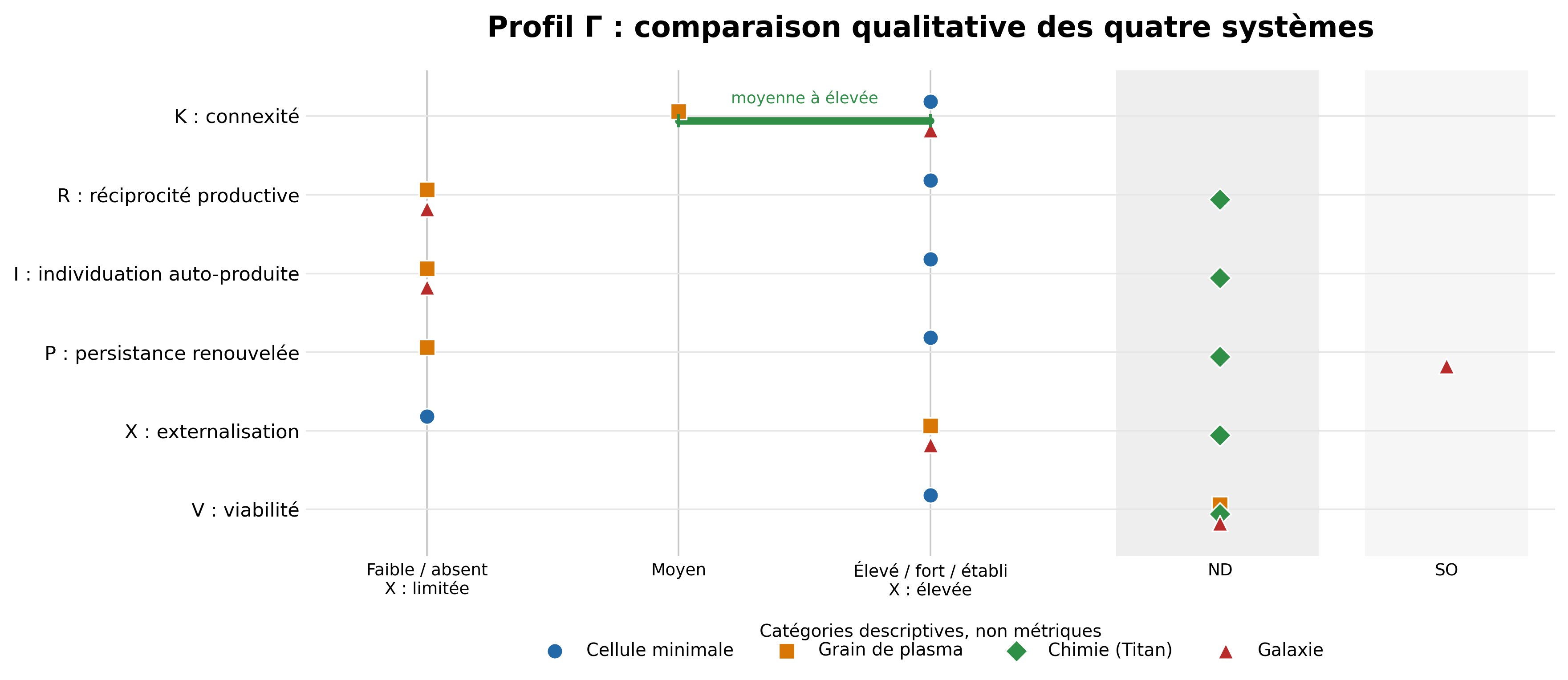
Figure 1. Γ profile: a qualitative representation without aggregation. The positions « low », « medium » and « high » reproduce the assessments of the table. ND covers states that are undetermined, not established, or still to be established, sought or measured; NA means « not applicable ». Dimension X keeps its definition as externalisation: a high position means a greater externalisation and is read in the opposite direction to the other dimensions as regards organisational autonomy. No non-established category is equated with a low value, and no position constitutes a quantitative measurement.
The three cases are not an exhaustive inventory. Later studies could apply the same procedure to molecular clouds, to coupled planetary systems or to feedback networks between active galactic nuclei and star formation. Their interest would lie less in widening the list of candidates than in testing the robustness of the criterion, its sensitivity to the scale chosen and its conditions of failure.
V. Positioning: lyfe, autonomy and closure
The approach has published neighbours that must be situated, if only to mark what it adds. The tradition of biological autonomy — notably closure to efficient causation in Rosen, closure of constraints in Montévil and Mossio, and autonomy in Moreno and Mossio — provides the conceptual base of constitutive closure and of its assumed circularity (Rosen, 1991; Montévil and Mossio, 2015; Moreno and Mossio, 2015). Prigogine's dissipative structures provide its thermodynamic precondition (Nicolis and Prigogine, 1977).
The closest neighbour for the cosmic question is Bartlett and Wong's concept of lyfe, which defines the living state by four substrate-independent pillars: dissipation, autocatalysis, homeostasis and learning. Terrestrial life is only one realisation of it (Bartlett and Wong, 2020). The kinship is real, but the two frameworks do not cut the problem along the same dimensions: the four pillars describe general capacities, whereas the Γ profile seeks first to characterise the causal architecture and the degree of internalisation of the organisation.
The difference is instructive and justifies the exercise. The four pillars of « lyfe » describe general processes or capacities: dissipation, autocatalysis, homeostasis and learning. They do not explicitly formulate the requirement of an individuation produced and renewed by the network. The organisational criterion does not replace the four pillars of « lyfe » with another list of capacities. It asks a different question: are the constraints and the individuation of the system produced or renewed by the organisation they make possible? That difference does not mean that the « lyfe » framework would necessarily class plasmas or galaxies among the living. Nothing shows that they would satisfy its four pillars. It indicates that the two frameworks do not place their discriminating power in the same place. ORI-C is thus more demanding about causal attribution, without claiming a wider substrate openness than the « lyfe » framework, which is likewise agnostic. Its own contribution is to make explicit that a relevant individuation can be non-membranous, provided it is produced or maintained by the network.
A synthetic comparison of the two frameworks
| Dimension | Concept of « lyfe » | Organisational closure |
|---|---|---|
| Dissipation | Explicit pillar | A necessary but not sufficient thermodynamic condition |
| Autocatalysis | Explicit pillar | Insufficient without production of the constraints and of individuation |
| Homeostasis | Explicit pillar | A possible regulatory capacity, not an obligatory base |
| Learning | Explicit pillar | A historical elaboration, not a requirement of minimal closure |
| Self-produced individuation | Not formulated as a central requirement | Central requirement of the diagnosis |
| Externalisation | Little made explicit | A discriminating dimension, assessed constraint by constraint |
| Viability | Present through homeostasis and persistence | A domain of states explicitly studied |
| Detection | Search for manifestations of the four pillars | Search for causal convergence and reduction of false positives |
Implication for biosignatures: the organisational profile does not necessarily provide signals that are easier to detect remotely. It rather imposes a more demanding interpretation. An isolated disequilibrium, gradient or feedback remains compatible with abiotic processes. The indication sought would be their convergence with a dynamic individuation, the localised renewal of an interface, a dependence on history and specific responses to perturbations.
The Γ profile must be distinguished from a remote observable. Some of its components may leave indirect clues accessible at a distance, but establishing closure ideally requires interventions or time series allowing a causal attribution. In observational astrobiology, the realistic use of Γ would be to structure a convergence of indications and to identify the abiotic explanations to be eliminated, not to provide a single signature.
VI. A falsifiable research programme
The working hypothesis, stated with the required prudence, becomes:
| In certain families of far-from-equilibrium systems, a constitutive closure could emerge when a differentiated set of persistent constraints forms a strongly connected causal network, ensures a sufficient share of its own renewal and produces or maintains the individuation required for its continuation. |
|---|
This formulation avoids four presuppositions: a universal threshold, an already demonstrated phase transition, an obligatory membrane and an equivalence between passive restoration and repair. The programme then comprises four research operations and one transversal rule of revision.
1. Define the constitutive graph. The nodes are not all molecules or all processes, but the candidate constraints. An edge is admitted only if an intervention on the first constraint causally modifies the production or renewal of the second. Several competing boundaries are delimited, fixed before the analysis, rather than one being presupposed. The comparison is iterative: each boundary is assessed by its explanatory power over the fluxes, the localisation of perturbations, the reciprocity and the persistence, without selecting after the fact the one that artificially maximises Γ.
2. Measure externalisation. For each constraint and for each candidate boundary, eᵢ — the external share of its renewal — is estimated, and the vector E is kept before any aggregation. A high externalisation across all essential functions indicates that the organisation belongs to the wider arrangement. X measures neither the total flux imported nor the energetic dependence of the system: it measures the origin of the renewal of the organising constraints. It is that distinction which rules the plasma sheath out of the autonomous candidate class and which situates the status of the erythrocyte.
3. Compare with passive controls. Each test includes, alongside the candidate, a self-assembled system, a non-compartmented autocatalytic network, an externally driven system and a system in which a constitutive relation has been broken. The perturbation rule is fixed before observation and applied identically. This comparison distinguishes relaxation, robustness, repair and organisational reconstruction.
4. Look for signatures without calling them biosignatures. A non-equilibrium spectrum or a persistent gradient is not an indication of closure: it is the signature of the flame as much as of the cell, and geological, photochemical and magnetohydrodynamic forcings produce them routinely. Thermodynamic disequilibrium is a sieve, not a signal: it tests the flux condition alone. The signal sought, if it is accessible remotely, would be a far more demanding combination: dynamic compartmentation, interdependent gradients, localised renewal of the interface, specific response to perturbations, dependence on history, repeated reconstruction of the constitutive relations. That difficulty must not be masked; it is precisely where the cosmic extension is genuinely hard.
A transversal rule of revision
A framework that claims falsificationist discipline must state what would put it at fault. This one will have to be revised, or explicitly restricted, in four situations:
if a recognised minimal cell systematically fails the closure criteria, after a thorough causal and multi-scale analysis,
if entirely externally driven systems obtain the same Γ profile as systems taken to be autonomous,
if productive relations cannot, in practice, be distinguished from mere correlations by intervention,
if the verdict depends on thresholds shifted after the observation rather than fixed in advance.
These conditions are not concessions: they are the price of the falsifiability the framework claims. A framework that no result could force to revise itself would say nothing about the world.
Conclusion: a comparative physics of autonomy
Such an approach does not reduce biology to physics. It looks for the physical conditions under which an organisational causality becomes possible. The fundamental laws determine what can happen; organised constraints locally select, among those possibilities, the transformations that contribute to their own continuation. It is that local selection, and not a particular substance, that defines autonomy. The perspective thus avoids two symmetrical excesses: declaring alive every persistent, complex or self-regulating system, and reserving life for the contingent list of terrestrial materials.
Organisational closure might not be an exclusively carbon-based property, but a general class of far-from-equilibrium organisation. Terrestrial life would then provide its only realisation confirmed today, not the obligatory paradigm. The object of research ceases to be immediately « exotic life » and becomes more fundamental: a comparative physics of autonomy, which asks under what conditions a network of constraints takes charge of producing its own boundary.
This reformulation does not relax the discipline of the article from which it proceeds; it extends it. Looking for other realisations requires demonstrating not merely a persistent structure, an autocatalysis or a feedback, but the reciprocal production of the constraints that make the individuation and the continuation of the system possible. It is that requirement which forbids attributing to the plasma or to the galaxy an autonomy they do not have.
Carried to the cosmos, the framework finally yields a discriminating and refutable prediction, as is required of it. Constitutive closure should be found only where several differentiated constraints ensure a measurable share of their mutual renewal, sustain an operational individuation and keep the organisation within a domain of viability, with a limited externalisation. In a chemical realisation, these organisational requirements have material correlates that astrobiology knows how to look for, notably a sustained exploitable gradient, a chemistry rich enough to percolate and a capacity for compartmentation. But those correlates are the typical conditions of such a realisation, not the criterion itself: it is the causal organisation that remains decisive. No substrate is excluded in principle: the empirical risk bears on that organisation, not on the material. Thus plasma or gravitational configurations whose constraints and individuation remain mainly imposed by the environment should fail the test, not because they would be made of the wrong material, but because their organisation remains heteronomous. This formulation does not forbid in principle an unknown plasma organisation that would genuinely satisfy the criteria; it predicts only that those we know do not. A framework that thus restricts the regions of the universe liable to harbour a living autonomy is a framework that takes a risk — exactly the kind of risk the article from which this one descends set out to assume.
Complementary methodological appendix
This appendix turns the Γ profile into an experimental programme. It does not assume that an isolated indicator demonstrates closure. The measurements must be pre-registered, compared with controls and interpreted according to the internal or external origin of the processes observed.
A. Experimental protocol for a candidate protocell
Objective: to measure K, R, I, P, X and V separately, then to test the restoration of constitutive functions after a normalised perturbation p. The protocol compares a candidate protocell with a self-assembled vesicle without an internal network, with an externally driven system and with a candidate in which a constitutive relation has been broken.
| Dimension | Operational definition | Main measurement |
|---|---|---|
| K, connectivity | Build a causal graph of the constraints. An edge cᵢ → cⱼ is retained when intervention on cᵢ reproducibly modifies the production, renewal or efficacy of cⱼ. | Fraction of constraints belonging to a strongly connected component, with a sensitivity analysis on the thresholds. |
| R, productive reciprocity | Establish that one constraint contributes to the renewal of another and that the latter contributes in return to maintaining the source process. | Crossed interventions, isotopic tracing and localised renewal rates. |
| I, individuation | Compare several pre-registered candidate boundaries instead of presupposing the visible membrane. | Comparative explanatory power over fluxes, gradients, selectivity, localisation of perturbations and production of the interface. |
| P, persistence | Measure separately the functional duration of each constraint and its renewal time. | Vector P = (τc₁, τc₂, …, τcₙ), compared with the times of the channelled processes and the times of loss. |
| X, externalisation | For each candidate boundary, attribute to each constraint the internal and external contributions to its renewal. | Vector E = (e₁, e₂, …, eₙ), kept without aggregation until commensurability is justified, and compared across candidate delimitations. |
| V, viability | Define before the experiment the simultaneous criteria of continuation and of loss of closure. | An experimental design covering the parameter space (grid or Monte-Carlo sampling), a mapping of the states of continuation and loss, then a stability analysis and, where the model allows, a bifurcation analysis. |
Normalised perturbation rule
The magnitude p is defined as a relative fraction of a measurable flux, activity or capacity. For example, a 30 % inhibition of the flux of a precursor is applied for a duration tₚ. The same functional rule is used for the candidate and for the controls. The direct effects of the intervention, independent of the targeted constraint, must be estimated through appropriate controls.
Restoration function G(p,t)
Let F₀ be the functional value before perturbation, Fpost(p) the value immediately after the perturbation and F(p,t) the value at time t:
G(p,t) = [F(p,t) − Fpost(p)] / [F₀ − Fpost(p)]
The function is defined when F₀ ≠ Fpost(p). It is measured at several times, chosen relative to the characteristic time of the process studied, for example 0.1, 1, 10 and 100 times τprocess.
| Value | Interpretation |
|---|---|
| G = 0 | No restoration of the lost function. |
| 0 < G < 1 | Partial restoration. |
| G = 1 | Return to the initial functional level. |
| G > 1 | Overcompensation, reported without artificial capping. |
| G < 0 | Worsening after the perturbation. |
G(p,t) does not directly measure closure. Its interpretation requires determining the internal or external origin of the restoration, the actual renewal of the components and the possible reconstruction of the constitutive relations.
An indispensable distinction: functional restoration ≠ intrinsic repair ≠ constitutive renewal ≠ closure.
B. Methodological sheet for externalisation eᵢ
When the contributions are commensurable, a fraction of externalisation can be estimated for each constraint cᵢ:
eᵢ = Jᵢ,ext / (Jᵢ,int + Jᵢ,ext)
Jᵢ,int and Jᵢ,ext represent the internal and external contributions to the renewal of cᵢ, expressed in the same unit of flux. Commensurability can be justified when both contributions are referred to the same renewed object and the same time window — for example a number of membrane molecules incorporated per unit time, or a rate of functional restoration calibrated on the same component. A rate of dissipation or a flux of entropy constitutes a relevant common basis only if its causal link with the renewal of the constraint is established. When that commensurability is not defensible, the contributions must remain described separately.
| Method | Main contribution | What it does not demonstrate |
|---|---|---|
| Isotopic tracing | Origin and fate of the components. | Does not on its own demonstrate their constitutive role. |
| Targeted ablation | Dependence and capacity for restoration. | May damage several functions at once. |
| FRAP | Mobility and local replacement of labelled components. | The return of fluorescence may reflect diffusion or external recruitment, not synthesis. |
| Multi-scale modelling | Partitioning of contributions that are hard to access. | Depends on the assumptions and on the identifiability of the model. |
| Inhibition of an external input | Dependence on the environment. | May simultaneously remove matter, energy and control. |
| Control without an internal network | Share of purely physical renewal. | Does not always reproduce the microstructure of the candidate. |
Adaptation to the three contexts
| Context | Preferred combination | Precaution |
|---|---|---|
| Lipid protocell | Isotopic tracing, FRAP, targeted inhibition, microfluidics and controls without an internal network. | Separate diffusion, external recruitment, internal synthesis and repair. |
| Dusty plasma | Modification of the external field, analysis of currents, of charge and of several candidate delimitations. | Measure a functional externalisation, not necessarily commensurable with a chemical material flux. |
| Cryogenic chemistry of Titan | Cryogenic chambers, microfluidics for hydrocarbons, kinetics, diffusion, adsorption and phase stability. | Compare τrenewal with τdispersion and τdegradation without equating persistence with closure. |
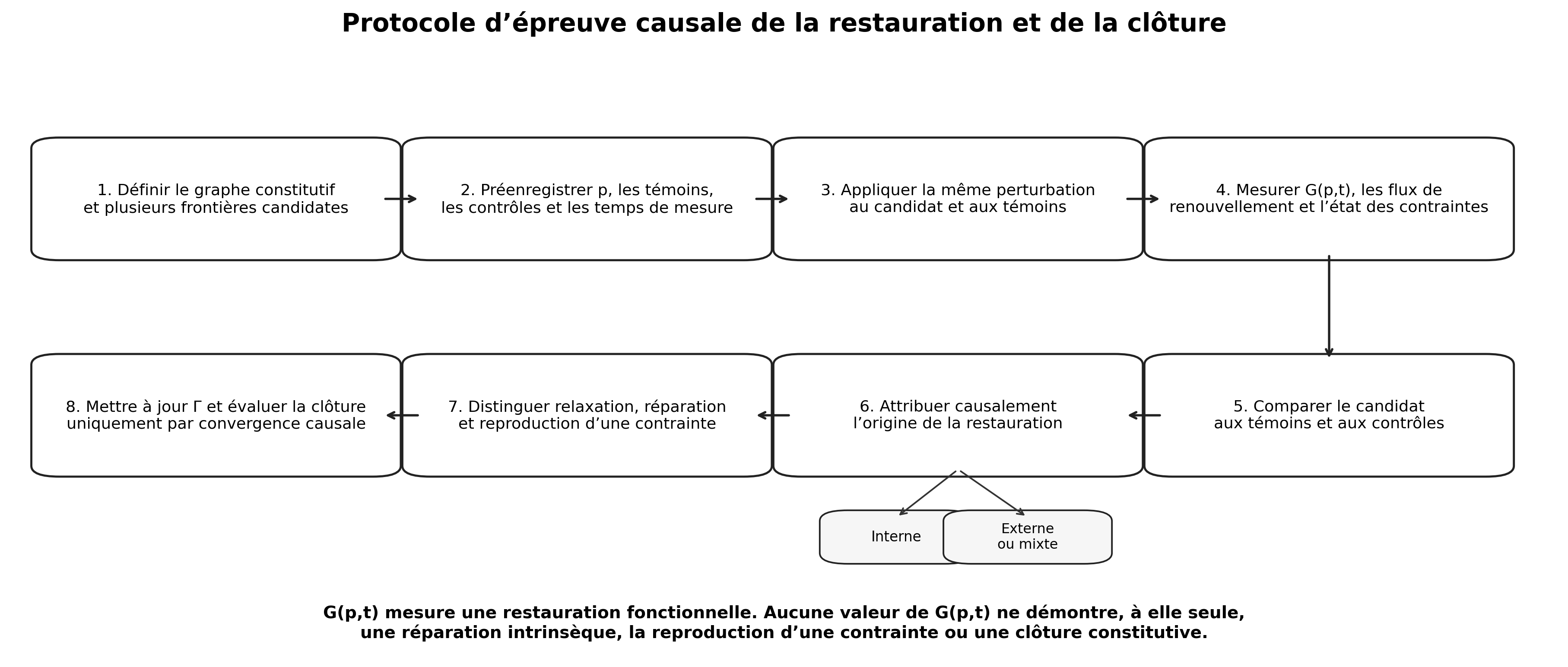
Figure 2. Causal testing protocol. The normalised perturbation is applied to the candidate and to the controls according to pre-registered rules. The function G(p,t) is interpreted together with the renewal fluxes, the comparison with controls, the internal, external or mixed attribution of the restoration, and the constitutive graph. An internal restoration can support the hypothesis of a repair or of the reproduction of a constraint, but no value of G(p,t) suffices to establish constitutive closure.
| Test case | Synthetic reading |
|---|---|
| Dusty plasma | Failure under the delimitation centred on the grain. A wider plasma-dust unit remains to be tested. |
| Titan | A candidate to be tested through cryogenic kinetics, renewal of the interface and attribution of fluxes. |
| Galaxy | A self-organised profile, but closure not established: weak reciprocity, high externalisation and no demonstrated domain of viability. |
References
Bartlett, S., & Wong, M. L. (2020). Defining Lyfe in the Universe: From Three Privileged Functions to Four Pillars. Life, 10(4), 42. https://doi.org/10.3390/life10040042
Bich, L., Mossio, M., Ruiz-Mirazo, K., & Moreno, A. (2016). Biological regulation: controlling the system from within. Biology & Philosophy, 31(2), 237–265. https://doi.org/10.1007/s10539-015-9497-8
England, J. L. (2013). Statistical physics of self-replication. The Journal of Chemical Physics, 139(12), 121923. https://doi.org/10.1063/1.4818538
England, J. L. (2015). Dissipative adaptation in driven self-assembly. Nature Nanotechnology, 10(11), 919–923. https://doi.org/10.1038/nnano.2015.250
Gánti, T. (2003). The Principles of Life. Oxford University Press.
Hordijk, W., & Steel, M. (2010). Autocatalytic sets and the origin of life. Entropy, 12(7), 1733–1742. https://doi.org/10.3390/e12071733
Kauffman, S. A. (1986). Autocatalytic sets of proteins. Journal of Theoretical Biology, 119(1), 1–24. https://doi.org/10.1016/S0022-5193(86)80047-9
Montévil, M., & Mossio, M. (2015). Biological organisation as closure of constraints. Journal of Theoretical Biology, 372, 179–191. https://doi.org/10.1016/j.jtbi.2015.02.029
Moreno, A., & Mossio, M. (2015). Biological Autonomy: A Philosophical and Theoretical Enquiry. Springer. https://doi.org/10.1007/978-94-017-9837-2
Nicolis, G., & Prigogine, I. (1977). Self-Organization in Nonequilibrium Systems. Wiley.
Palmer, M. Y., Cordiner, M. A., Nixon, C. A., Charnley, S. B., Teanby, N. A., Kisiel, Z., Irwin, P. G. J., & Mumma, M. J. (2017). ALMA detection and astrobiological potential of vinyl cyanide on Titan. Science Advances, 3(7), e1700022. https://doi.org/10.1126/sciadv.1700022
Rosen, R. (1991). Life Itself: A Comprehensive Inquiry into the Nature, Origin, and Fabrication of Life. Columbia University Press.
Ruiz-Mirazo, K., Peretó, J., & Moreno, A. (2004). A universal definition of life: autonomy and open-ended evolution. Origins of Life and Evolution of the Biosphere, 34(3), 323–346. https://doi.org/10.1023/B:ORIG.0000016440.53346.dc
Sandström, H., & Rahm, M. (2020). Can polarity-inverted membranes self-assemble on Titan? Science Advances, 6(4), eaax0272. https://doi.org/10.1126/sciadv.aax0272
Stevenson, J., Lunine, J., & Clancy, P. (2015). Membrane alternatives in worlds without oxygen: Creation of an azotosome. Science Advances, 1(1), e1400067. https://doi.org/10.1126/sciadv.1400067
Tsytovich, V. N., Morfill, G. E., Fortov, V. E., Gusein-Zade, N. G., Klumov, B. A., & Vladimirov, S. V. (2007). From plasma crystals and helical structures towards inorganic living matter. New Journal of Physics, 9(8), 263. https://doi.org/10.1088/1367-2630/9/8/263
Varela, F. G., Maturana, H. R., & Uribe, R. (1974). Autopoiesis: the organization of living systems, its characterization and a model. BioSystems, 5(4), 187–196. https://doi.org/10.1016/0303-2647(74)90031-8
Vu, T. H., & Hodyss, R. (2026). Experimental insights into the azotosome hypothesis in Titan’s lake fluids. Science Advances, 12(11), eaed1426. https://doi.org/10.1126/sciadv.aed1426