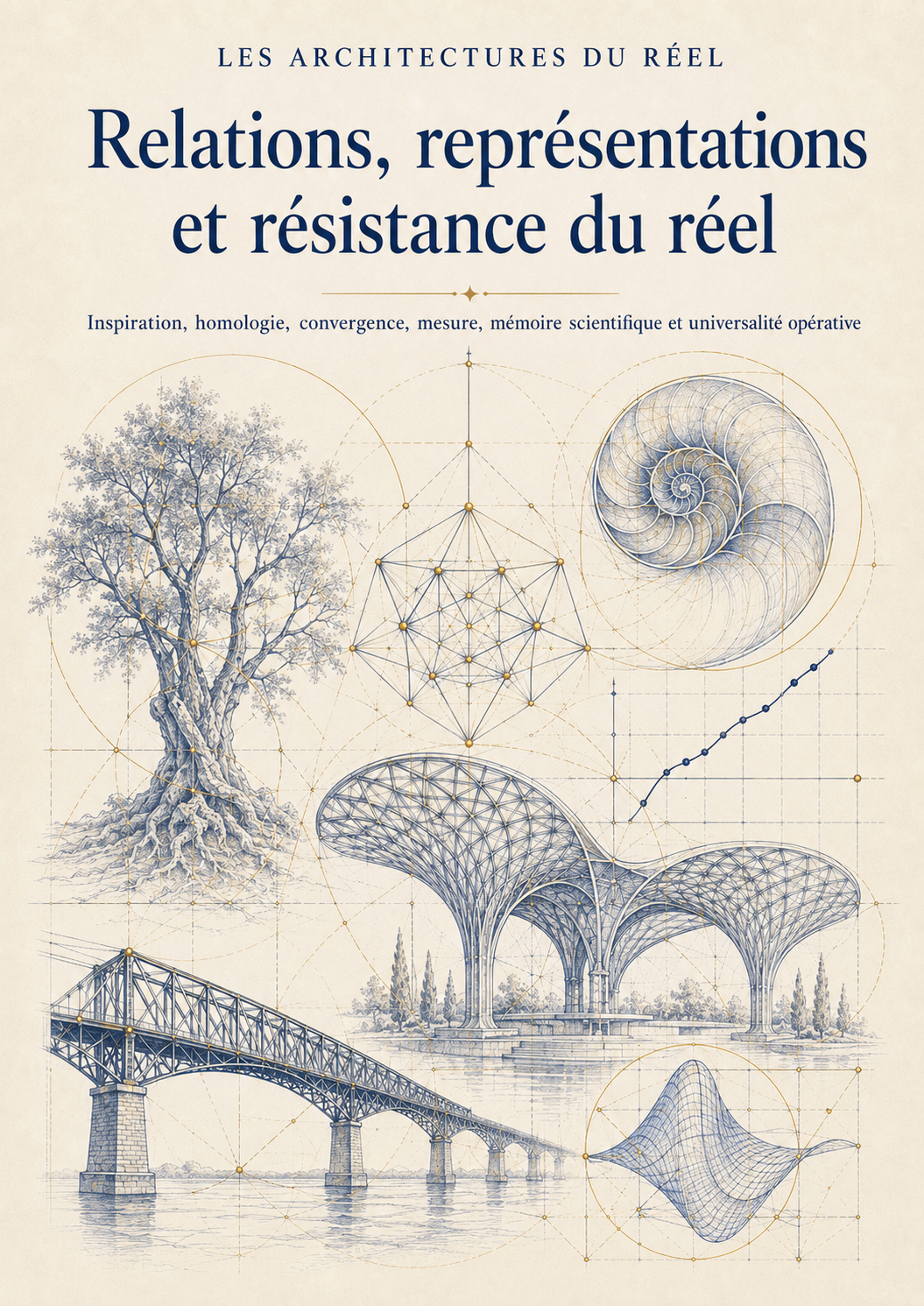
THE ARCHITECTURES OF THE REAL
Relations, representations
and the resistance of the real
Inspiration, homology, convergence, measurement, scientific memory and operative universality
Didier Daloze
ORI-C · ori-c.be · 2026
Abstract
A resemblance between two forms does not suffice to establish what links them. It may come from a documented inspiration, a common ancestry, a convergence under constraint, a coincidence or an analogy constructed by the observer. Scientific representation belongs to another register. It rests on operations of measurement, an explicit correspondence, controllable inferences and a direction of adjustment that exposes the model to failure. This asymmetry becomes cumulative only if anomalies are inscribed, preserved and reactivated in later decisions. Operative universality then designates the limited conservation of certain consequences when the support, the scale or the mechanism changes. It does not turn every resemblance into a law. It supplies a means of distinguishing correspondences that withstand variation from those that depend solely on the analyst's gaze.
General introduction
A similar form can conceal radically different histories, mechanisms and statuses. A natural shell and a human vault may answer comparable mechanical constraints without sharing a filiation. Two organisms may preserve an inherited organisation while employing it for different functions. An experimental device may draw inspiration from a natural phenomenon while materialising an independent mechanism. A mathematical model may finally describe a structure without itself being a material structure. Resemblance is therefore a clue to be qualified, never a sufficient explanation.
Rigour begins when the relation advanced receives its own conditions of proof. Inspiration requires a documentary filiation. Homology requires a common ancestry. Convergence requires the independence of trajectories and the identification of a shared constraint. Analogy remains a chosen comparison as long as no measured correspondence exposes it to a procedure of revision. A scientific representation must, for its part, specify how the quantities are constructed, how the inferences are controlled and what must be revised when the system behaves otherwise. The resistance of the real does not immediately indicate the right correction, but it renders certain imputations progressively untenable as methods, instruments and supports vary.

Resemblance opens the inquiry, but it supplies neither the genealogy, nor the mechanism, nor the causal status. This part builds the instrument of qualification that will serve the two following parts.
I.1 A resemblance is not a history
Human architectures frequently rediscover forms present in matter and in the living. Distribution networks recall vascular systems. Shells distribute loads as certain carapaces do. Tilings repeat cells. D'Arcy Thompson showed the fruitfulness of a regulated comparison of forms, but a resemblance reveals neither its cause, nor its genealogy, nor its status.
The most frequent error consists in passing directly from the visible form to a narrative. A human structure is said to be copied from the living without historical documents. Two organisms are declared convergent without excluding a common ancestry. A roughly similar pattern is treated as the effect of the same constraint. The relation must therefore be qualified before the resemblance is interpreted.
I.2 Six relations to distinguish
I.2.1 Documented inspiration
There is inspiration when an actor observes an earlier organisation, extracts a principle from it and transposes it into another material, at another scale or for another function. Biomimicry belongs to this category when a documentary chain links the observation to the design. Notebooks, patents, prototypes or testimonies here serve as proof. Without them, resemblance demonstrates no copying. Vincent and colleagues insisted precisely on the passage from the biological model to the technical principle rather than on the imitation of the whole object.
I.2.2 Homology by common ancestry
In comparisons between organisms, homology is the hypothesis to examine before convergence. Two structures may resemble one another because they derive from a common ancestral organisation, even if their present functions differ. Proof bears on phylogeny, development, the relative position of the structures and the intermediate transformations. Homology does not designate a mere resemblance. It designates a historical filiation.
Homology and convergence are nevertheless not exclusive. The eyes of vertebrates and cephalopods are the canonical example of convergence, and they nevertheless recruit regulatory circuits inherited from a common ancestral organisation. Shubin, Tabin and Carroll named this situation deep homology and documented it in eyes, tetrapod limbs and beetle horns: structures that appeared independently through modification of ancient, shared generative programmes. Biology therefore had to abandon exclusivity between the two relations for empirical reasons, on its own objects. What section I.3 states as a methodological decision is here a conclusion imposed by the data.
I.2.3 Convergence under comparable constraints
There is convergence when systems without a relevant filiation independently develop comparable organisations under comparable constraints. The proposal requires three supports: the independence of the trajectories, the identification of a common constraint, and the variation of the form when that constraint is relaxed or modified. Convergence is therefore never inferred from a silhouette.
I.2.4 Coincidence or under-determined resemblance
Coincidence constitutes the null hypothesis. Two forms may resemble one another because the descriptor chosen is too coarse, because the space of possible forms is limited, or because a small sample favours a fortuitous rapprochement. As long as no filiation, common constraint or operation of representation is established, the relation must remain undetermined. This hypothesis does not occupy the same rank as the others. It is the starting point that each of them must overcome, and no relation can be asserted before it has been set aside. Without this rule, a multidimensional, non-exclusive instrument would always fill in a profile, which is exactly the reproach addressed here to frameworks that explain after the fact.
I.2.5 Analogy proposed by the observer
Analogy selects a partial relation between two systems. It becomes misleading when it turns that relation into an identity of mechanism. Its distinctive property is the absence of a declared correspondence and of a direction of adjustment. If the comparison fails, the analyst can replace it without the system imposing a procedure of revision. A city may thus be said to be alive without that expression committing anyone to a unified metabolism or a constitutive closure.
I.2.6 Regulated representation
Mathematical representation is not a fourth material form. It establishes an explicit correspondence between a system and a formal structure, by means of operations of measurement and rules of inference. When the consequences fail, the correspondence or the model must give way. This direction of adjustment distinguishes it from analogy. It will be developed in Part II.
I.3 A multidimensional instrument, not a partition
These relations do not form an exclusive taxonomy of objects. They qualify different dimensions of one and the same situation. A human architecture may be inspired by an organism and at the same time converge toward a solution imposed by mechanics. An experimental device may materialise a convergence and simultaneously serve as a representation. The unit of analysis is therefore not the box in which to enclose an object, but the precise relation one claims to establish.
| Relation | Decisive question | Counterfactual test |
|---|---|---|
| Relations to be established · positive burden of proof | Relations to be established · positive burden of proof | Relations to be established · positive burden of proof |
| Inspiration | What documentary filiation? | Without the observation, does the form appear here and now? |
| Homology | What common ancestry? | Does the phylogenetic filiation explain the correspondences? |
| Convergence | What common constraint? | Does the form disperse when the constraint varies? |
| Null hypothesis · to be set aside before any other | Null hypothesis · to be set aside before any other | Null hypothesis · to be set aside before any other |
| Coincidence | Is the descriptor too poor? | Does the resemblance persist with more discriminating measures? |
| Relations involving the observer · separated by the direction of adjustment | Relations involving the observer · separated by the direction of adjustment | Relations involving the observer · separated by the direction of adjustment |
| Analogy | Which property is merely brought alongside? | What must be revised on the system's side if the comparison fails? |
| Representation | What measured correspondence? | If the system diverges, must the model or its interface give way? |
Table 1. Instrument for qualifying relations between forms, genealogies and representations.
I.4 From nature to human architecture
Human beings work under the same general constraints of gravity, resistance, transport and economy of material, but they add representation, comparison and deliberate intervention. They can recognise a solution, calculate it, transmit it, and then modify their own rules of fabrication. The final form therefore does not suffice to place a human construction and a living form in the same operative regime.
A branching can emerge from the local growth of a mycelium. It can also be represented in a plan, used to organise a territory and revised after evaluation. The geometry is comparable. The regime that produces and mobilises it is not.
I.5 The contribution of anthropology
Ron Eglash's work on African fractals shows that certain settlement plans, patterns and kinship systems rest on rules of nesting or repetition across scales. These organisations are not naive copies of natural objects. They are produced by practices, institutions, techniques and cosmologies.
Anthropology thus prevents two symmetrical reductions. It forbids treating every recurrence as biomimicry. It also forbids reducing a social architecture to an organism. Comparison remains legitimate, but its relation must be established.
I.6 What the atlas can assert
The atlas can inventory recurrent geometries and the trade-offs they make possible. It can show that a branching multiplies interfaces, that a network distributes and bypasses, or that a shell distributes loads. It cannot infer from these properties a filiation, an intention, a global optimum or an identity of mechanism.
Each comparison must therefore be accompanied by a profile of relations. Inspiration, homology, convergence, coincidence, analogy and representation can be examined separately, then combined when the evidence permits. Part III will add an operative test: a resemblance becomes more than an analogy when corresponding operations preserve their consequences across several supports.
Mathematical objects do not undergo the physical constraints to which material architectures respond. Their relation to the real requires a distinct relation: representation regulated by measurement, inference and revision.
II.1 A question often badly posed
Asking whether mathematics is discovered in nature or invented by the mind imposes a metaphysical alternative too early. In the sciences, the relation between a formal structure and a physical system is constructed by operations of measurement, choices of variables, idealisations, conventions and tests.
A mathematical circle does not grow, does not withstand a load and has no history of formation. It cannot therefore converge toward a shell as two material architectures can converge under a common constraint. Representation constitutes a relation of another type.
II.2 From measurement to abstraction
Ancient mathematical practices are bound up with material operations of measurement, counting and astronomy. Neugebauer showed the precision and diversity of these traditions before Greek systematisation. Deductive geometry then transforms these practices without abolishing their supports.
Netz describes Greek demonstration as an apparatus combining lettered diagrams, formulaic language and a restricted circle of authors. The diagram takes part in constructing the object demonstrated. Abstraction does not escape its material condition. It changes its support of inscription.
II.3 From analogy to representation
An analogy brings two systems together without declaring a complete correspondence between operations of measurement, variables and consequences. It therefore has no direction of adjustment. It can survive its own failure by shifting to another feature.
A representation, by contrast, makes a correspondence explicit. If the expected consequences diverge robustly, something must give way on the side of the representational apparatus: the calibration, the parameters, the auxiliary hypotheses, the correspondence or the formal structure. The world is not declared false in order to save the model freely.
This rule meets the under-determination brought to light by Duhem. An isolated failure does not automatically designate the faulty component, since a prediction depends on a set of hypotheses and instruments. The procedure of revision must therefore announce which variations, replications or independent measurements will allow the imputations to be decided between.
II.4 To measure is to build an interface
Measurement is not a transparent window. It constitutes an interface between a device, a protocol and a phenomenon. Suppes showed that models of data mediate the relation between experiment and theory. A quantity must be defined, a unit chosen, an instrument calibrated and an uncertainty estimated before the data can enter a formal structure.
This construction does not make measurements arbitrary. They become objective when they can be reproduced, compared, recalibrated and corrected independently of the observer's preferences. A scientific representation therefore comprises a domain, operations of measurement, a correspondence, rules of inference, a domain of validity and a procedure of revision.
II.5 Honeycomb cells: the optimum depends on the correspondence
Hales's honeycomb theorem establishes that the regular hexagonal tiling minimises the perimeter of a partition of the plane into regions of equal area. Its exact reach deserves to be recalled. The result had long been established under the restriction to convex cells, and Fejes Tóth wrote in 1964 that he did not doubt its general validity but that the conjecture had resisted every attempt at proof. It is that restriction that Hales lifted thirty-seven years later. The theorem does not for all that build the hive, and it does not resolve the three-dimensional problem of cell bases.
Fejes Tóth compared the classical three-rhombus base with a closure by two hexagons and two rhombi. He estimated that this second configuration would save, per cell, less than 0.35% of the area of an opening, and a far smaller fraction still of the total surface of the cell. He added at once that the non-uniform thickness of the walls and the irregularity of the openings made this saving illusory. He was not presenting a demonstrated absolute optimum. The first isoperimetric problem remained open, and the solution proposed for another problem was conjectural.
The so-called Fejes Tóth configuration is not merely theoretical. Yang and colleagues identified, in natural combs of Apis cerana cerana and Apis mellifera ligustica, four-plane cells — up to about 18% of the cells observed — distributed in symmetrical clusters on both faces of the comb. Four-plane bases had already been described in the nineteenth century. Real cells nevertheless do not realise the geometric ideal. The dihedral angle between the two hexagonal planes measures on average 108.70° ± 0.16 in the worker cells of both species, against a theoretical value of 120°, a deficit of the order of nine to eleven degrees. Three-rhombus bases likewise depart from their ideal angles.
Weaire and Phelan further argued that the advantage of the Fejes Tóth structure disappears once the wax films are taken into account. The ranking of the two architectures therefore depends on the physical model adopted. As long as the correspondence does not specify thickness, irregularities, volume, construction cost and the behaviour of the bees, the departure from the optimum is not an unequivocally observable quantity.
The real comb contains several architectures, none coincides with its ideal, and the sense of « more economical » changes with the correspondence chosen.
The controversy over the mechanism confirms this lesson. Equilibrium models of softened wax, thermal measurements and the analysis of building behaviour do not distribute the causal work in the same way. Nazzi and Räz show that a correct geometry does not suffice to choose the mechanism.
II.6 Phyllotaxis: one object, several relations
The Douady–Couder apparatus produces phyllotactic organisations with drops of ferrofluid subjected to local repulsion and to a radial dynamic. The parameter Γ, the plastochrone ratio, organises the transitions between regimes. The three parts published in 1996 describe spiral modes, the coexistence of patterns and transient regimes.
The apparatus maintains three simultaneous relations with the apex, and they must be kept distinct. As an artefact, it falls under documented inspiration: it was designed by physicists who had observed phyllotaxis. As a material system, it falls under experimental convergence with certain mechanisms of the apex: the magnetic repulsion between drops was copied from no plant inhibition, and the independence therefore bears on the mechanism, not on the existence of the set-up. As a physical analogue model, it finally constitutes a representation. Its parameters are placed in correspondence with plant processes, its inferences can fail and its domain of validity must be restricted.
The statuses therefore do not form a partition. They qualify simultaneous relations, each founded on different operations and each verifiable separately. Inspiration is proved by documents. Convergence bears on two material dynamics and is tested by varying the constraint. Representation bears on the regulated correspondence between the device and the plant phenomenon, and is tested by the failure of its inferences.
II.7 Minimal criteria of a representation
A formal structure scientifically represents a system if the domain is delimited, if the operations of measurement are explicit, if the correspondences between data and variables are declared, if the inferences produce independently controllable consequences, and if the domain of validity is announced.
A procedure must also indicate, before failure if possible, how to vary the auxiliary hypotheses, the instruments and the parameters. This requirement does not abolish under-determination. It prevents success from being decided after the fact and makes imputations comparable.
II.8 What this distinction changes for the atlas
The atlas can compare spirals, networks, shells or tilings, but it must not place a theorem in the same ontological column as a shell. The theorem becomes an instrument of description when operations of measurement build a correspondence with the system.
Two questions must remain distinct. What material or historical relation links the forms observed? What representation makes it possible to measure some of their properties and to risk their consequences? Part I answers the first. This part answers the second.
Transition to the third part
A measured and revisable correspondence allows the system to resist the model, but failure does not automatically designate what must be corrected. It remains to understand how anomalies are imputed, how their history is preserved, and when the consequences of a structure survive a change of support.
A representation does not correct itself. The provenance of anomalies must be preserved, imputations compared and procedures varied before a resistance becomes cumulatively binding.
III.1 The operative realism of constraints
Part II defined representation by a measured correspondence and a direction of adjustment. This part begins where that definition stops. When a prediction fails, nothing in the discrepancy immediately designates what must be revised. We construct the models, the instruments and the rules of imputation. We do not choose the resistances that reappear when we vary those constructions.
This position may be called the operative realism of constraints. It does not assert that mathematical objects exist independently of all practice. It asserts that the results of our operations are not entirely determined by our conventions. The real does not supply the right representation. It prevents certain representations from remaining indefinitely equivalent.
III.2 Anomaly, imputation and under-determination
A persistent anomaly may be imputed to the initial conditions, to the instrument, to an auxiliary hypothesis, to a calculation error or to the structure of the model. Duhem's under-determination forbids reading the cause of the failure directly off the failure itself.
Neptune and Vulcan make this difficulty visible. The orbital irregularities of Uranus and of Mercury both led to postulating an invisible body. In the first case, the calculations of Le Verrier and Adams directed observation toward Neptune. In the second, the announcements of Vulcan remained fragmentary and incompatible. The logical form of the imputation was comparable. The operative trajectories diverged.
An imputation becomes binding when its fragility reappears across several sets of data, instruments, methods and teams that do not all share the same presuppositions. First-order resistance is the persistence of the anomaly. Second-order resistance is the persistence of the diagnosis when the procedures that establish it are varied.
III.3 Scientific memory produces the asymmetry
An anomaly inscribed in an article or a database constitutes a trace. It becomes a scientific memory only if its provenance is preserved, if it remains accessible and if it is reactivated in a later decision. Without that reactivation, each discrepancy can be treated as a new event and successive adjustments remain invisible to one another.
Persistent anomaly, inscription, provenance, accessibility, reactivation, modification of the next imputation.
The asymmetry between model and world is therefore not merely logical. It is institutionally obtained through documentation, replication, citation, attribution and comparison. A science may continue to produce observations while losing its cumulative capacity for revision when its traces become inaccessible or detached from the decisions that produced them.
This thesis is empirical, hence refutable, and its most accessible test is the circulation of retracted articles. A retraction is an inscription. It becomes a memory only if it is reactivated in subsequent citations. When retracted works continue to be cited positively, without mention of their status, the trace exists and functional memory is absent: exactly the configuration that the chain above declares sterile. The thesis would be falsified if fields with degraded provenance revised their imputations as quickly and as durably as fields with preserved provenance.
III.4 From Wigner to the transportability of abstraction
Wigner insisted on the sometimes astonishing fit of mathematical structures developed without immediate physical application. Hamming proposed several partial explanations, among them the selection of the problems and tools that succeed. Survivorship bias is real: fruitful structures become visible and constructions without lasting application disappear from the story.
This selection does not suffice. An abstraction becomes transportable because it abandons part of the properties of its first support and preserves relations, transformations or invariants. Group theory does not describe a particular substance. It formalises an organisation of operations that can be recognised in several domains.
Efficacy thus decomposes into several mechanisms: the genealogy of tools, the stripping down of abstraction, historical selection, scientific memory and empirical resistance. None suffices alone, but their combination replaces the idea of a single miracle with an architecture of relations.
III.5 Unadjusted surplus
A theory can restore with precision a quantity that did not serve to set its structure. This phenomenon must be defined by the non-mobilisation of the datum, not by its chronological posteriority alone. An already known observation can constitute an unadjusted retrodiction if no degree of freedom of the model was used to absorb it.
The perihelion of Mercury is the decisive case, and doubly so. The anomaly had been known since Le Verrier, so that its restitution is not a temporally prior prediction. It moreover served to orient the search for the theory: in June 1913, Einstein and Besso calculated the advance of the perihelion in the Entwurf theory and obtained about 18 arcseconds per century instead of 43, a result recorded in the Einstein–Besso manuscript and among the reasons for abandoning equations with restricted covariance. The datum therefore weighed on the choice of form. It was nevertheless absorbed by no degree of freedom. Once the equations were fixed by general covariance and the equivalence principle, no free parameter remained to be tuned to the 43 arcseconds per century: the value follows from the structure. The theory could have failed and did not fail.
There is unadjusted predictive or retrodictive surplus when the datum was absorbed by no degree of freedom of the model — that is, when no available latitude allowed the result to be obtained opportunely once the structure was fixed. The criterion therefore does not bear on the heuristic role of the datum in the discovery, which may have been decisive, but on its mobilisation in the adjustment. A fact may guide the search for a theory without being paid for by it. The independence of the data, the latitude available at the moment the structure was fixed, the comparison with competing models and the absence of retrospective reconstruction must all be documented.
Unadjusted does not necessarily mean unanticipated. It means that no available degree of freedom was tuned to the quantity restored.
This distinction has a name. Zahar introduced it in 1973 under the term use-novelty, precisely in order to treat the perihelion of Mercury within Lakatos's methodology — Lakatos acknowledged having modified his position under Zahar's influence: a fact is novel if it did not serve to construct the theory, even if it was known beforehand. The subsequent debate bears exactly on the difficulty met here. Zahar's version makes the verdict depend on what the scientist had in mind when constructing the theory, which Worrall criticised as resting on psychological and historical contingencies. His reformulation makes the criterion bear on a property of the apparatus and not on a biography: a datum is use-novel if it did not serve to fix the free parameters of the theory. This is the no-double-counting rule, and it is the version adopted here.
Unadjusted surplus therefore introduces no unprecedented criterion. It takes up one that is half a century old and adds two operative requirements to it: documenting the latitude actually available at the moment the structure was fixed, and submitting the verdict to the second-order resistance defined above, which demands that it survive a change in the procedures that establish it.
This correction brings together Neptune, Vulcan and Mercury. The first two show that the logical form of the imputation does not decide the result. Mercury shows that a structure without latitude of adjustment can restore an old anomaly and retrospectively constrain its interpretation.
III.6 From resemblance to operative universality
Part I distinguishes inspiration, homology, convergence, coincidence and analogy. Part II adds representation. One question remains: when does a resemblance cease to be merely chosen by the analyst?
A structural isomorphism places objects and relations in correspondence. An operative isomorphism requires more: certain classes of operations must preserve their order of composition, their invariants and their consequences across different supports. Cutting a branch, interrupting a technical route and suppressing an institutional relation are not the same gesture. An operative correspondence exists only if these interventions occupy comparable positions within the organisation and produce transformations governed by corresponding relations.
An analogy becomes a limited operative universality when a stable correspondence between operations and transformations is declared, tested by varying the support and accompanied by conditions of failure. If that correspondence disappears as soon as the scale, the support or the mechanism varies, the analogy remains a choice of description.
III.7 A programme of variation
Operative universality does not look for identical forms everywhere. It asks which consequences survive changes of support, of scale, of representation and of intervention. The test must vary at least one dimension without silently readjusting the others.
Branching provides a textbook case. A tree, a technical network and an institution may share an arborescent representation. To go beyond analogy, one must compare the effects of local removals, the possibilities of redistribution, the thresholds of fragmentation and the mechanisms of repair. Any universality will be local and conditional, never deduced from the drawing alone.
The universality operator Φ therefore does not measure a visual similarity. It qualifies the persistence of operative consequences within a declared domain. Its falsification is as important as its confirmation, since it indicates the place where differences of mechanism become dominant again.
General conclusion
A similar form never suffices to establish what links it to another. Documentary filiation founds inspiration. Common ancestry founds homology. A comparable restriction of the space of solutions founds convergence. The absence of a demonstrated relation maintains coincidence as the null hypothesis. A comparison without a direction of adjustment remains an analogy. A measured correspondence, exposed to failure and accompanied by a procedure of revision, becomes a representation.
That representation nevertheless becomes cumulative only if anomalies are inscribed, attributed, preserved and reactivated. Empirical resistance does not directly deliver the right theory. It renders certain imputations less and less tenable as data, instruments and methods vary. Scientific memory gives that resistance a history and prevents each discrepancy from being treated as a new event.
Operative universality then extends the analysis without turning every resemblance into a law. It asks which operations preserve their consequences when a support, a scale or a mechanism changes. Its value lies as much in the correspondences it confirms as in the places where it fails. It follows neither that the world is a mathematical structure, nor that mathematics is freely projected onto it. A common discipline emerges: qualify the relations, build the interfaces of measurement, preserve the memory of failures and seek the variations capable of genuinely constraining the models.
References
Douady, S. and Couder, Y. (1992). Phyllotaxis as a Physical Self-Organized Growth Process. Physical Review Letters, 68(13), 2098–2101.
Douady, S. and Couder, Y. (1992). Phyllotaxis as a Physical Self-Organized Growth Process. Physical Review Letters, 68(13), 2098–2101. https://doi.org/10.1103/PhysRevLett.68.2098
Douady, S. and Couder, Y. (1996a). Phyllotaxis as a Dynamical Self Organizing Process. Part I. Journal of Theoretical Biology, 178, 255–274.
Douady, S. and Couder, Y. (1996a). Phyllotaxis as a Dynamical Self Organizing Process. Part I: The Spiral Modes Resulting from Time-Periodic Iterations. Journal of Theoretical Biology, 178, 255–274.
Douady, S. and Couder, Y. (1996b). Phyllotaxis as a Dynamical Self Organizing Process. Part II. Journal of Theoretical Biology, 178, 275–294.
Douady, S. and Couder, Y. (1996b). Phyllotaxis as a Dynamical Self Organizing Process. Part II: The Spontaneous Formation of a Periodicity and the Coexistence of Spiral and Whorled Patterns. Journal of Theoretical Biology, 178, 275–294.
Douady, S. and Couder, Y. (1996c). Phyllotaxis as a Dynamical Self Organizing Process. Part III. Journal of Theoretical Biology, 178, 295–312.
Douady, S. and Couder, Y. (1996c). Phyllotaxis as a Dynamical Self Organizing Process. Part III: The Simulation of the Transient Regimes of Ontogeny. Journal of Theoretical Biology, 178, 295–312.
Duhem, P. (1906). La théorie physique, son objet et sa structure. Chevalier et Rivière.
Earman, J. and Janssen, M. (1993). Einstein’s Explanation of the Motion of Mercury’s Perihelion. In J. Earman, M. Janssen and J. D. Norton (eds.), The Attraction of Gravitation: New Studies in the History of General Relativity. Einstein Studies, vol. 5. Birkhäuser.
Eglash, R. (1999). African Fractals: Modern Computing and Indigenous Design. Rutgers University Press.
Einstein, A. (1915). Erklärung der Perihelbewegung des Merkur aus der allgemeinen Relativitätstheorie. Sitzungsberichte der Königlich Preußischen Akademie der Wissenschaften, 831–839.
Fejes Tóth, L. (1964). What the Bees Know and What They Do Not Know. Bulletin of the American Mathematical Society, 70(4), 468–481.
Glymour, C. (1980). Theory and Evidence. Princeton University Press.
Hales, T. C. (2001). The Honeycomb Conjecture. Discrete & Computational Geometry, 25, 1–22.
Hamming, R. W. (1980). The Unreasonable Effectiveness of Mathematics. American Mathematical Monthly, 87(2), 81–90.
Janssen, M. et Renn, J. (2021). Einstein and the Perihelion Motion of Mercury. arXiv:2111.11238.
Le Verrier, U. J. J. (1846). Recherches sur les mouvements d’Uranus. Comptes rendus de l’Académie des sciences.
Le Verrier, U. J. J. (1859). Lettre à M. Faye sur la théorie de Mercure et sur le mouvement du périhélie de cette planète [Letter to M. Faye on the theory of Mercury and the motion of the perihelion of that planet]. Comptes rendus de l’Académie des sciences, 49, 379–383.
Nazzi, F. (2016). The hexagonal shape of the honeycomb cells depends on the construction behavior of bees. Scientific Reports, 6, 28341.
Nazzi, F. (2016). The hexagonal shape of the honeycomb cells depends on the construction behavior of bees. Scientific Reports, 6, 28341. https://doi.org/10.1038/srep28341
Netz, R. (1999). The Shaping of Deduction in Greek Mathematics. Cambridge University Press.
Neugebauer, O. (1957). The Exact Sciences in Antiquity. Brown University Press.
Räz, T. (2017). The silent hexagon: explaining comb structures. Synthese, 194(5), 1703–1724.
Shubin, N., Tabin, C. and Carroll, S. (2009). Deep homology and the origins of evolutionary novelty. Nature, 457(7231), 818–823. https://doi.org/10.1038/nature07891
Suppes, P. (1962). Models of Data. In Logic, Methodology and Philosophy of Science. Stanford University Press.
Thompson, D. W. (1917/1942). On Growth and Form. Cambridge University Press.
Vincent, J. F. V., Bogatyreva, O. A., Bogatyrev, N. R., Bowyer, A. and Pahl, A.-K. (2006). Biomimetics: its practice and theory. Journal of the Royal Society Interface, 3, 471–482.
Weaire, D. and Phelan, R. (1994). Optimal design of honeycombs. Nature, 367, 123.
Wigner, E. P. (1960). The Unreasonable Effectiveness of Mathematics in the Natural Sciences. Communications on Pure and Applied Mathematics, 13, 1–14.
Worrall, J. (1985). Scientific Discovery and Theory-Confirmation. In J. C. Pitt (ed.), Change and Progress in Modern Science. Reidel.
Yang, S., Gong, X., Zhou, D., Zhang, X., Kuang, H. and Dong, K. (2022). Structure of Fejes Tóth cells in natural honey bee combs. Apidologie, 53, 6. https://doi.org/10.1007/s13592-022-00915-8
Zahar, E. (1973). Why did Einstein’s Programme Supersede Lorentz’s? British Journal for the Philosophy of Science, 24(2), 95–123 and 24(3), 223–262.