Abstract. This article examines a precise idea: the forms of matter observed in the Universe can be organised into a nested hierarchy, each level being built from entities of the previous level while possessing properties that also depend on their arrangement, their interactions and the conditions of the medium. The demonstration follows the chain fields and particles → hadrons → nuclei → atoms → molecules → materials and collective phases → planetary minerals → living organisations. It shows that composition is never sufficient on its own. Different constituents can form a new composite entity, while the same constituents can produce radically different kinds of matter when configured otherwise. The hierarchy avoids any scale of value and any obligatory march towards complexity: it describes an architecture of dependencies, constraints and emergent properties. The article finally proposes a multidimensional quantitative profile, an example of comparative calculation, a dynamic that integrates history, criteria of transdisciplinary validity and an explicit distinction between a hierarchy of constitution and modes of persistence.
Status of the demonstration. The article distinguishes three types of statement. Experimental facts establish the existence of composite entities, bonds, phases and polymorphs. The ORI-C grid, founded on composition, configuration, interaction, environment and persistence, provides a descriptive method for comparing transitions. The idea of a single hierarchy of all matter remains a conceptual reconstruction, since science uses several classifications that must not be confused. The quantitative indicators proposed below make up a profile suited to the mechanism under study rather than a single universal measure.
1. The different classifications of matter
The word matter covers several different classifications. Confusing them quickly produces a false hierarchy. A cosmological classification, for example, contrasts ordinary matter, dark matter and antimatter. A thermodynamic classification distinguishes phases such as plasma, gas, liquid, solid or Bose-Einstein condensate. Chemistry classifies substances and compounds. Materials science distinguishes crystalline, amorphous, metallic, polymeric and superconducting structures. Biology, finally, studies chemical organisations capable of upkeep, reproduction and evolution.
| Classification | Question asked | Examples | Not to be confused with |
|---|---|---|---|
| Fundamental constituents | Of which excitations or particles is the system composed? | Quarks, leptons, bosons | Macroscopic phases or materials |
| Composite entities | Which constituents are bound into a new unit? | Hadrons, nuclei, atoms, molecules | Mere juxtaposition without bonding |
| Phases of matter | What collective order appears under certain conditions? | Plasma, crystal, superconductor, condensate | A new chemical element |
| Materials and substances | What properties result from a given composition and structure? | Diamond, graphite, water, alloys, polymers | An additional fundamental level |
| Historical organisations | Does the system maintain and rebuild its organisation? | Cells, lineages, ecosystems | A special substance separate from chemistry |
The present document deals mainly with the third reading: a hierarchy of levels of organisation. It is real in the sense that molecules depend on atoms, atoms on nuclei and electrons, and nuclei on nucleons. It does not mean that the higher level would be morally better, more stable or more fundamental.
Formulation adopted We shall speak of new forms of matter when a collective organisation possesses stable and observable properties that are not those of its isolated constituents. We shall speak of a new level of organisation when a unit thus formed becomes in its turn the constituent of larger organisations. |
|---|
2. The general principle: composition is not enough
The idea of a simple « mixture of structures » must be made precise. In some transitions several types of constituent are indeed coupled: quarks and gluons in hadrons, protons and neutrons in nuclei, nuclei and electrons in atoms. In other cases no new constituent is added. Graphite and diamond are both made of carbon; their difference comes from the geometry of the bonds and from the conditions that stabilise those networks. A new kind of matter can appear without a new composition.
A descriptive grid, not a physical law Observed material form = a function of composition, configuration, the regime of interactions and the environment. Persistence then indicates for how long and under which perturbations that form remains identifiable. |
|---|
This grid takes up five dimensions:
Composition. Which constituents are present, and in what proportions?
Configuration. How are they arranged in space, bound or correlated?
Interaction. Which forces, bonds or couplings stabilise the whole?
Environment. Which temperatures, pressures, densities, fields or availabilities make this organisation possible?
Persistence. What preserves the identity of the whole, and within what limits?
Philip Anderson formulated the general principle under the title « More is different »: when a large number of components is organised, new collective regularities appear and require their own level of description [1]. Renormalisation-group physics then formalised a complementary idea: at a given scale, some microscopic variables become secondary while new collective variables control the observable behaviour [14].
3. The chain of levels of organisation
3.1 Quantum fields and elementary particles. Within the standard model, particles are described as excitations of quantum fields. Quarks and leptons are generally classified as constituents of matter, while gauge bosons mediate the interactions. This level constitutes the base of the hierarchy, but it must not be presented as a set of small balls: the observed properties are quantum, relational and defined by the fields and their symmetries.
3.2 Quarks and gluons → hadrons. Protons, neutrons and other hadrons are not quarks simply placed side by side. In 1964 Gell-Mann proposed a model in which baryons and mesons result from combinations of constituents carrying fractional charges [2]. Deep inelastic scattering experiments then revealed point-like constituents inside the proton [3]. Quantum chromodynamics describes their coupling through the strong interaction; confinement prevents the observation of free quarks under ordinary conditions, as Wilson formalised on the lattice [4].
What appears as new is a globally colour-neutral unit endowed with a mass, a spin, a lifetime and its own channels of transformation. A large part of the proton's mass comes from the energy of the field and from the collective dynamics of the system, far more than from the simple sum of the masses of the light quarks. The hadron is already a property of organisation.
3.3 Protons and neutrons → nuclei. Nucleons can associate into nuclei when the residual nuclear attraction compensates, in certain configurations, the electrical repulsion between protons and the quantum effects. Not every number of protons and neutrons produces the same stability. Mayer's shell model showed that the filling of quantised levels explains the appearance of « magic » numbers associated with particularly stable nuclei [5].
The nucleus possesses properties belonging neither to the isolated proton nor to the isolated neutron: binding energy, excited levels, radioactivity, shape, nuclear spin and possibilities of fusion or fission. Composition matters, but the quantum configuration of the nucleons matters just as much.
3.4 Nuclei and electrons → atoms. An atom appears when electrons occupy bound states around a nucleus. Schrödinger's wave mechanics made it possible to compute the quantised states of the hydrogen atom [6]. The number of protons fixes the chemical identity of the element, but the electronic distribution largely determines its reactivity, its spectra and the bonds it can form.
The atom constitutes a new unit because it presents a stable electronic structure, discrete energy levels and chemical properties absent from its separate constituents. A free proton and a free electron do not, in isolation, possess the spectral and chemical properties of hydrogen.
3.5 Atoms → molecules. A molecule appears when several nuclei and their electrons form a collective bound state. As early as 1927 Heitler and London showed how the quantum exchange of electrons accounts for the covalent bond in the hydrogen molecule [7]. Born and Oppenheimer provided the framework that approximately separates electronic and nuclear motions and makes a systematic description of molecules possible [8].
The molecule possesses its own geometry, vibrations, rotations, polarity and reactivity. These properties are not contained in a list of atoms; they result from their arrangement and from the collective organisation of the electrons.
3.6 Molecules and atoms → phases and materials. At the collective scale, the same atoms or molecules can form different phases. Temperature, pressure, density, external fields and the history of preparation modify the accessible configurations. A crystalline solid, a liquid, a glass, a superconductor or a quantum condensate do not correspond to new elements: they are new collective regimes.
Superconductivity provides a classic demonstration. In a metal cooled below a critical temperature, electrons can form a correlated collective state described by the theory of Bardeen, Cooper and Schrieffer [15]. The chemical constituents remain the same, but a new macroscopic property — notably zero electrical resistance under certain conditions — appears. Likewise, a dilute gas of rubidium atoms formed a Bose-Einstein condensate in 1995 when temperature and density allowed the collective occupation of a single quantum state [16].
3.7 Materials → minerals and planetary matter. Planets transform their chemical elements into minerals through a combination of composition, crystalline structure and geological conditions. Pressure, temperature, the presence of water, the oxidation state and biological activity open or close pathways of formation. The history of a planet thus becomes a material constraint.
The analysis of manganese minerals shows, for example, that the progressive oxidation of the Earth's crust modified over time the valence states and the diversity of the mineral species observed [17]. Planetary matter is historical: some structures become possible only after the transformation of the atmosphere, the oceans or the mantle.
3.8 Organised chemistry → living systems. Living systems remain made of molecules, membranes, reaction networks and information carriers. Their chemical organisation nevertheless takes part in its own reconstruction: it maintains gradients, renews and repairs its components, reproduces itself and transmits a memory liable to vary. To passive and dynamic persistence is thus added an active and historical regime.
This change of regime rests on a coupling between several partial closures. A boundary controls exchanges, a network of reactions produces part of its own components and catalysts, while a physically inscribed memory influences future reconstruction. Models of autocatalytic sets make it possible to formalise certain aspects of this functional closure, notably when a self-sustaining network is coupled to a boundary it itself helps to produce [21]. None of these mechanisms taken in isolation suffices to define life; it is their integration that opens a new regime of persistence.
Synthetic cell experiments make it possible to test this transition without assuming a magical rupture. In 2018, a system enclosed in liposomes used a DNA to produce the proteins required for its own replication [18]. In 2024, protocells sustained cycles of replication, variation and selection [19]. These experiments recreate neither the whole of life nor its complete origin, but they show how the coupling between compartmentation, reactions, memory and selection can move a chemical organisation from local maintenance to a reconstructive and evolutionary continuity.
Table 1: Nested hierarchy of material organisations
| Level | Organised constituents | Stabilising coupling | New property |
|---|---|---|---|
| Particles | Excitations of quantum fields | Fundamental symmetries and interactions | Mass, charge, spin, statistics |
| Hadrons | Quarks and gluons | Strong interaction and confinement | Colour-neutral unit, hadronic spectrum |
| Nuclei | Protons and neutrons | Residual nuclear force, quantum shells | Nuclear binding, isotopes, radioactivity |
| Atoms | Nucleus and electrons | Electromagnetic interaction, orbital states | Chemical identity and atomic spectra |
| Molecules | Atoms and shared electrons | Bonds and molecular geometry | Reactivity, polarity, chemical functions |
| Materials / phases | Large numbers of atoms or molecules | Collective order, correlations, crystalline structure | Conductivity, rigidity, magnetism, superconductivity |
| Minerals / planets | Materials subject to a geological history | Pressure, temperature, redox, fluids, cycles | Mineral diversity and planetary structures |
| Living systems | Molecules, membranes, networks and information | Compartmentation, autocatalytic networks, regulation, reproduction | Active self-reconstruction, transmissible memory and historical evolution |
4. Four direct demonstrations of the role of structure
4.1 Same element, different kinds of matter: carbon. Carbon constitutes the most intuitive proof that composition alone does not define a kind of matter. Graphite, diamond, the C₆₀ fullerene and graphene are all made of carbon, but their bonds and their geometry differ. In 1985 Kroto and colleagues identified a particularly stable structure of sixty carbon atoms forming a closed cage [11]. In 2004 Novoselov and colleagues isolated and characterised carbon films one atom thick, graphene, displaying electronic properties proper to a two-dimensional structure [12]. The experimental conversion of graphite into diamond at high pressure and high temperature directly demonstrates that a change of configuration can transform matter without changing the chemical element [13].
4.2 Same general composition, properties dependent on geometry. At the molecular scale, molecules with the same numbers and types of atoms can display different properties when their connections or their geometry change. Chemical isomerism shows that the empirical formula is not enough to determine the substance. The principle is already visible in the hydrogen molecule: two separate atoms and a bound molecular state do not possess the same energy nor the same modes of rotation and vibration [7][8].
4.3 Same material, different collective phase. Matter can change regime without changing composition or even chemical structure. In superconductivity or Bose-Einstein condensation, the novelty lies in the collective correlations that appear under certain conditions [15][16]. The phase is a property of the whole system and of its environment, not an isolated property of each particle.
4.4 Same chemical inventory, different planetary history. Two planets with similar elements can develop different mineralogies if their pressures, temperatures, atmospheres, oceans and oxidation histories diverge. Mineral databases now make it possible to reconstruct this historical dependence. Changes in the Earth's environment created new windows of stability and new mineral species [17].
| Case | What stays the same | What changes | Conclusion |
|---|---|---|---|
| Graphite → diamond | The element carbon | Bond network, pressure and temperature | Structure transforms material properties |
| H atoms → H₂ molecule | Two nuclei and two electrons | Collective electronic state and bond distance | The bond creates a new unit |
| Normal metal → superconductor | Chemical composition | Electronic correlations and temperature | A collective phase adds a macroscopic property |
| Minerals over time | Available elements | Redox, fluids, geological and biological cycles | Environment and history widen material diversity |
5. A real but multidimensional hierarchy
The hierarchy is real when it expresses a relation of constitution: molecules are composed of atoms, atoms of a nucleus and electrons, nuclei of nucleons. It is equally real when a unit formed at one level becomes a manipulable constituent at the next. A cell uses molecules without having to reconstruct at every instant the quantum theory of their bonds.
It is not, however, a single line. Phases of matter cut across several levels: a plasma may consist of electrons and nuclei, a condensate may be formed of atoms, and a crystal may be molecular or atomic. The hierarchy resembles a nested network more than a simple ladder.
Four axes must remain separate:
Depth of composition. How many levels of entities are nested?
Integration. To what extent do the components lose their autonomy within the whole?
Environmental dependence. What range of conditions is required for maintenance?
Capacity for transformation. Can the system only remain stable, or change phase, repair itself, or evolve?
A point of caution A deeper or more integrated level is not necessarily more durable. A proton can persist far longer than a cell. The hierarchy describes the appearance of new properties and dependencies, not a general superiority. |
|---|
6. The ORI-C grid applied to material transitions
The composition–configuration–interaction–environment–persistence grid makes it possible to compare domains that are usually kept separate without claiming that they all obey the same mechanism. It seeks a common structure of questioning, not an identity between nuclear physics, chemistry, mineralogy and biology.
| Transition | Composition | Configuration | Interaction | Environment | Persistence |
|---|---|---|---|---|---|
| Quarks → hadron | Quarks, antiquarks, gluons | Permitted global colour state | QCD / strong interaction | Energy below the deconfinement regime | Confinement and hadronic stability or lifetime |
| Nucleons → nucleus | Protons and neutrons | Shells, pairings, nuclear shape | Nuclear force + Coulomb repulsion | Proton/neutron ratio, energy | Binding energy and decay channels |
| Nucleus + electrons → atom | Nucleus, electrons | Occupied orbitals | Electromagnetism and quantum exclusion | Temperature, ionisation, radiation | Bound states and electronic stability |
| Atoms → molecule | Atoms | Geometry and electronic distribution | Covalent, ionic and weak bonds | Temperature, pressure, solvent | Dissociation barriers and kinetics |
| Carbon → allotrope | Pure carbon | sp², sp³ network, cage or sheet | Covalent bonds and interlayer interactions | Pressure, temperature, synthesis route | Thermodynamic stability or metastability |
| Molecules → cell | Macromolecules, lipids, metabolites | Compartment, coupled networks, memory carriers | Catalysis, gradients, autocatalysis, regulation and reading of information | Flows of matter and energy | Self-maintenance, repair, reproduction, hereditary memory and evolution |
This comparison shows that novelty is never attributable to a single factor. A compatible composition may remain dispersed if no stable configuration is accessible. A possible configuration may fail to appear if the environment does not allow the energy barriers to be crossed. A structure may finally exist without persisting if it disassembles faster than it forms.
6.1 Measuring transitions without manufacturing a single scale. The absence of a universal score does not mean that the hierarchy remains purely qualitative. Each transition has measurable quantities, but these are not directly commensurable. A binding energy, a critical temperature, a lifetime, a mutual information and a repair rate do not describe the same dimension. The most rigorous solution is to build a vector profile rather than a single scalar ranking.
Several proposals for a general measure of complexity exist. The thermodynamic depth of Lloyd and Pagels, for example, seeks to relate a macroscopic state to the history of the processes that could have produced it [23]. Information-theoretic approaches attempt to quantify autonomy by separating what a system's future state owes to its own dynamics from what it owes to the environment [24]. These tools are useful as candidate indicators, but their results depend on how the system is carved up, on the scale of observation and on the choice of variables.
| Dimension measured | Possible indicators | Domains or examples | Limit of interpretation |
|---|---|---|---|
| Stability of the entity | Binding energy per constituent, lifetime, half-life, dissociation barrier | Nuclei, atoms, molecules, crystal defects | High stability measures neither autonomy nor the capacity to adapt |
| Collective order | Order parameter, critical temperature, correlation length, susceptibility | Magnetism, superconductivity, phase transitions [14][15] | These quantities depend on the phase and do not extend directly to living systems |
| Environmental domain | Phase diagrams, free energy of formation, P–T and Eh–pH ranges, kinetics | Allotropes, polymorphs, minerals | A narrow range may signal strong dependence without indicating weak organisation |
| Integration of components | Correlations, mutual information, response to the removal of a component, network spectrum | Correlated systems, molecular and biological networks | The result depends on the boundary chosen between system and environment |
| Functional closure | Share of reactions belonging to a RAF set, coverage of components, catalytic dependencies | Autocatalytic networks and protocells [21][25] | Autocatalytic closure is necessary in some models, but is not sufficient to produce a living cell |
| Active persistence | Rates of maintenance and repair, growth, reproduction, copying fidelity, recovery after perturbation | Cells, lineages, synthetic systems | These indicators assume an open system and are not comparable to a binding energy |
Cross-cutting limits of the indicators. These quantities are neither interchangeable nor directly convertible. A binding energy tells us about the stability of a state, but not about its capacity to rebuild itself; a critical temperature describes a phase transition without providing on its own a biological equivalent. Their interpretation also depends on the carving adopted: the response to the removal of a component, apparent autonomy or dependence on the medium all change with the boundary chosen between the system and its environment. Finally, any aggregation requires a normalisation and a weighting that introduce theoretical choices. The vector profile must remain an explicit comparison of heterogeneous dimensions rather than becoming a universal index that conceals their differences.
6.1.1 A worked example: sensitivity to removal. A simple indicator can be defined for a target function F: R_F = n_critique / n_testé, where n_critical is the number of single removals that cause the chosen identity or function to be lost. This indicator is interpretable only once the boundary of the system, the granularity of the components, the medium and the function tested have been fixed.
| System and boundary | Function and perturbation | Illustrative calculation | Interpretation |
|---|---|---|---|
| Deuteron: proton + neutron | Preserve the identity of the bound nucleus; dissociate either of the two nucleons. | 2 critical removals / 2 = 1. Binding energy: 2.224566 MeV [30]. | Maximal structural indispensability at this granularity, with no information about repair or autonomy. |
| E. coli K-12: cellular genome | Obtain a viable mutant after deleting a gene under the conditions of the Keio collection. | 303 candidate essential genes / 4,288 targeted ≈ 0.071, i.e. 7.1 % [31]. | High modularity and redundancy, but a result dependent on the medium, on the viability threshold and on the unit chosen. |
This contrast does not rank the cell below the nucleus. It shows on the contrary that the result changes with the definition of the component and of the function: the deuteron has little redundancy but is strongly bound, whereas the cell distributes its functions across thousands of elements and depends on a defined environment. Mutual information calls for the same caution. In a quantum system, I(A:B) = S(A) + S(B) − S(AB) depends on the partition of the wave function; in a cell, a classical mutual information may link the state of a module to a future response. Raw values are comparable only after a common definition of the variables and distributions.
« Organisational depth » must be treated as a set of coordinates: depth of composition, strength of integration, dependence on the medium, capacity for transformation and mode of persistence. An object may be very stable on one coordinate and very poor on another. This approach avoids confusing organisation, complexity, autonomy and duration.
Figure 1 makes this logic intuitive by comparing three deliberately contrasting profiles. It does not provide measured values: it shows why a stable nucleus, a superconducting phase and a living cell cannot be ordered along a single axis. The superconducting phase illustrates in particular that a system can display a high collective order and a strong dependence on conditions without possessing active persistence.
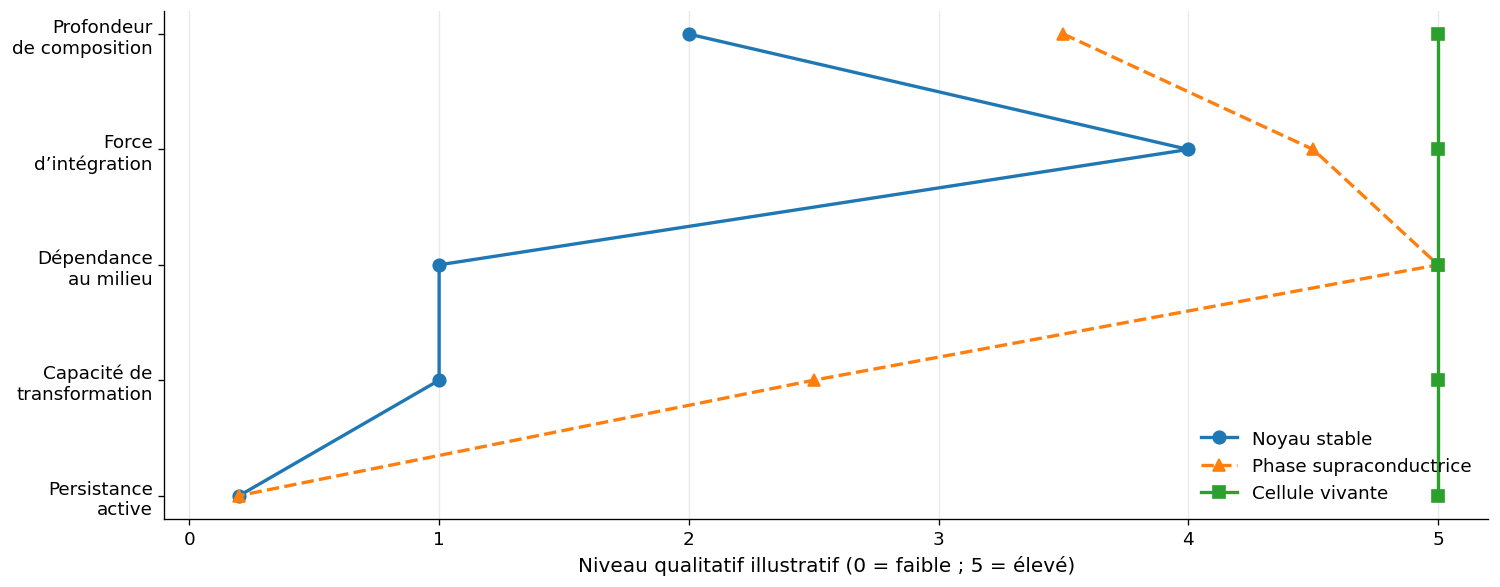
Figure 1: Example of qualitative vector profiles for three systems. The values are ordinal and illustrative; no axis on its own constitutes a measure of superiority.
6.2 From the hierarchy of organisation to modes of persistence. The hierarchy of constitution differs from a hierarchy of duration. A proton can last far longer than a cell, while a cell possesses capacities for regulation and reconstruction absent from the proton. The nature of the mechanism that maintains the identity of the system changes along the chain. These regimes can overlap, and each new regime retains part of the physical constraints of the previous ones.
| Regime | Examples | What persists | Main mechanism | Example of access to the next regime |
|---|---|---|---|---|
| Intrinsic stability | Stable hadron, nucleus, atom | The constituent or the bound state | Confinement, binding energy, symmetries and forbidden transitions | Stable atoms or nuclei become the constituents of a molecule or a crystal lattice. |
| Structural or metastable stability | Molecule, crystal, mineral | A configuration | Bonds, activation barriers, thermodynamic or kinetic domain | Chemical structures feed a reaction network maintained by continuous flows. |
| Dynamic persistence | Vortex, flame, sustained phase | A process or a collective order | Continuous flow and maintenance of external conditions | Compartmentation and regulation couple the flow to upkeep and reconstruction. |
| Active persistence | Cell | An organisation despite the renewal of components | Metabolism, regulation, repair and reconstruction | Reproduction with heritable variation establishes a historical lineage. |
| Historical persistence | Biological lineage | A modifiable continuity | Reproduction, hereditary memory, variation and selection | The lineage pursues its continuity through cumulative modification; no higher regime is required. |
The transition examples indicate the addition of a mechanism, not the necessary and direct transformation of a particular object. A molecule does not automatically « become » a cell, and a stable structure is not required to reach a dynamic or active regime.
This bridge connects the present document directly to the companion article « Living systems, or the invention of active persistence ». The present text establishes the material base: new units and new properties appear through organised coupling. The companion article examines how, within this architecture, the mechanisms of continuity pass from physical stability to upkeep, reconstruction, transmission and anticipation.
7. What the evidence allows us to affirm
The levels of composition are empirically nested: distinct experiments establish the internal constituents of hadrons, nuclei, atoms and molecules.
The properties of a composite entity are not reducible to the numerical sum of the properties of its isolated constituents; they depend on bound states, symmetries and collective interactions.
The same composition can produce several kinds of matter when configuration and conditions change, as the allotropy of carbon demonstrates.
A collective phase can appear with no modification of the chemical composition, as in superconductivity or Bose-Einstein condensation.
Cosmic and planetary history constrains the order of appearance: heavy elements precede the chemistry that uses them, and some mineral species depend on environments that appeared late.
Living systems are compatible with this material continuity, but they mark a change of regime: they use the earlier chemical levels while adding a coupling of self-maintenance, reconstruction, transmissible memory and historical evolution.
8. What remains open
8.1 Weak emergence, reduction and computation. The article uses emergence in a weak, descriptive sense. Three questions must be separated. Physical compatibility asks whether the collective property respects the microscopic laws; derivability asks whether it can be obtained from a model of those laws; practical computability asks whether that derivation can be carried out with finite resources. A property may be reducible in principle while remaining inaccessible to an exact and useful computation. [14][22]
Combinatorial explosion provides a simple case. The state space of N binary quantum degrees of freedom has 2^N dimensions: for 100 units one would already have to track about 1.27 × 10³⁰ complex amplitudes in a general exact representation. Recourse to collective variables, symmetries, approximations or simulations does not introduce a new force; it becomes the only practicable way of describing macroscopic behaviour.
The distinction is not a binary one between « emergent » and « reducible ». A property is weakly emergent here when its production remains entirely physical, but its relevant explanation requires a change of scale, boundary conditions, a history of preparation or a computational execution of the model. Strong emergence would presuppose causal powers or laws irreducible to the underlying physics; the article does not defend that thesis.
8.2 Dark matter: partial integration, not exclusion. Dark matter cannot yet be placed in the microscopic chain quarks → hadrons → nuclei → atoms, because its fundamental nature, its possible non-gravitational interactions and the existence of composite constituents remain unknown. This ignorance does not mean, however, that it is devoid of organisation. Cosmological observations and simulations show that it takes part in the hierarchical formation of filaments, haloes and sub-haloes through gravitational instability. [32][33]
Composition: unknown at the microscopic level; several families of candidates remain open.
Configuration: density fields, filaments, haloes and gravitational substructures observable indirectly.
Interaction: gravitation established; other couplings not yet conclusively detected.
Environment: cosmic expansion, initial fluctuations, mass, velocity and gravitational neighbourhood.
Persistence: gravitational binding and evolution, accretion, merging and dispersal of haloes.
Dark matter can provisionally enter the grid at an effective cosmological level, but not yet within a hierarchy of microscopic substances and bonds. The discovery of particles, self-interactions or « dark atoms » would require a sub-hierarchy of its own to be built.
8.3 Conditions for a kind of matter to enter the grid. An entity or form of matter can be integrated into the hierarchy once its status is operational. An effective description remains possible in the absence of a complete microscopic nature, provided the level of certainty is stated. The minimal criteria are as follows:
an observable boundary or identity allowing the system to be distinguished from its environment,
composition variables or degrees of freedom, even effective ones, that can be estimated,
a configuration whose modification entails distinct predictions at comparable composition,
a coupling or constraint able to explain causally the cohesion, the transformation or the collective order,
a domain of conditions within which the organisation appears, persists or disappears,
observations or interventions able to decide between the model and competing explanations.
When some criteria are missing, the integration must remain partial and explicit. The grid must never convert an unknown into an imaginary constituent, nor a descriptive correlation into an established mechanism.
9. Formalisation programme and breaking tests
This section proposes formalisation tools at three levels: a vector representation of the organisational profile, dynamic models for regime transitions and an evaluation matrix for concrete cases. Each tool is presented as a working proposal, not as a validated law. Together they aim to make the hypotheses computable, comparable and refutable.
Map each transition. Define the constituents, the configuration, the interactions, the conditions of appearance and the mechanism of persistence for each level.
Distinguish composition from organisation. Build a base of cases where composition remains identical but properties change, and of cases where new constituents are genuinely integrated.
Formalise and measure integration. Represent the system by a state vector, identify the functional closures and test indicators of loss of autonomy, robustness and dependence on the medium.
Test the breaking points. Identify the observations that would invalidate the grid or show that a property attributed to configuration in fact comes from another factor.
9.1 Mathematical formalisation of the vector profile. Formalisation must begin by preserving the multidimensional character of the grid. For a system S observed at time t, one can define an organisational state vector whose components represent composition, configuration, interactions, environment and mode of persistence:
x_S(t) = [c_S(t), q_S(t), i_S(t), e_S(t), p_S(t)]
These components are not necessarily single numbers. Composition may be a vector of abundances, configuration a graph or a geometrical tensor, interactions a coupling matrix, environment a set of conditions and flows, and persistence a profile combining stability, repair, reproduction or memory. The global coupling can then be represented by a candidate function:
Γ_S(t) = F(c_S, q_S, i_S, e_S, θ)
where θ gathers the parameters proper to the domain under study. Γ must not be presented as a universal law nor as a « score of superiority ». It designates a family of models to be calibrated. An organisational transition may be sought when Γ changes regime, when a new attractor appears or when a collective property becomes robust within a determined region of parameter space.
Comparing two systems requires three precautions: normalise comparable dimensions separately, justify any weightings and preserve the uncertainties. A single scalar should be constructed only after empirical validation; the vector profile remains the default representation.
9.2 Functional closure and autocatalytic networks. RAF set theory provides a first formal language for functional closure. A system of chemical reactions can be described by a quadruple (X, R, C, F): X is the set of molecular species, R the set of reactions, C the catalysis relations and F the set of resources available in the environment. A subset of reactions is RAF when it is both reflexively autocatalytic — each reaction is catalysed by a species produced or mobilised within the set — and generated from the resource set F. This definition formalises a closure of production without sufficing, on its own, to define living systems. [21][25][26]
For ORI-C, this structure can be supplemented by several candidate indicators:
RAF coverage: φ_RAF = |R_maxRAF| / |R_active|, the proportion of active reactions belonging to the largest RAF detected.
Closure robustness: the proportion of single removals of reactions or catalysts after which a functional RAF subsists.
Coupling to the boundary: β_B, the proportion of the reactions required to produce or maintain the boundary that are supplied by the internal network.
Feed dependence: the minimal quantity and diversity of external resources required to maintain the closure.
Structural evolvability: the number, diversity and accessibility of sub-RAFs able to support several trajectories of reorganisation.
These indicators measure different properties. A high RAF coverage guarantees neither a stable boundary, nor homeostasis, nor faithful reproduction. They must be confronted with actual flows, kinetics, inhibition, compartmentation and sensitivity to perturbations.
9.3 Dynamics of the passage towards active persistence. The passage from a dissipative structure to an active protocell can be studied through a dynamical system coupling internal reactions, exchanges, growth of the boundary and transmissible information. A minimal model can use the following variables: x(t), the vector of internal concentrations; A(t), membrane area; V(t), volume; m(t), the quantity of a replicator or a memory; u(t), external resources.
dx/dt = N·v(x, u, A, V) − D_x x
dA/dt = α·v_mem(x, u) − δ_A A
dV/dt = L_p A(ΔΠ − ΔP)
dm/dt = r_m(x, m) − δ_m m
N is the stoichiometric matrix, v the vector of reaction rates, v_mem the flux of production or incorporation of the membrane constituents, ΔΠ the osmotic pressure difference and ΔP the mechanical constraint. This system is not proposed as a universal model: it constitutes a skeleton to be adapted to the chemistries and compartments under study. Published models already show that it is possible to couple reaction network, membrane growth, homeostasis and division in theoretical or synthetic protocells. [27][28][29]
A transition towards active persistence could be identified when several criteria are satisfied simultaneously:
the internal network produces a measurable fraction of the components required for its boundary or its upkeep,
the ratios between volume, surface and concentrations remain within a viable domain during growth,
after a moderate perturbation, the system returns towards a viable attractor before the damage becomes irreversible,
the maintenance time exceeds the passive relaxation time of the structure in the absence of the active network,
if a memory is present, its replication remains sufficiently coupled to that of the compartment to allow continuity between cycles.
The threshold sought corresponds to the appearance of a causal loop: the network modifies the boundary, the boundary maintains the conditions of the network, and this common organisation improves its own continuity.
9.3.1 Introducing history and slow scales. The preceding equations become autonomous if the environment and the parameters are held constant. Yet material architectures are often produced by environments that drift slowly: enrichment in heavy elements, planetary redox state, oceanic pH, pressure, temperature or the availability of catalysts. This historicity can be represented by a slow–fast system. [17][34]
dx/dt = f(x, λ, H)
dλ/dt = ε·g(λ, x), with 0 < ε ≪ 1
dH/dt = h(x, λ) − μH
x(tₖ⁺) = Jₖ(x(tₖ⁻), λ) lors d’un événement rapide
The vector λ gathers the slow environmental constraints; H represents a state memory, such as an accumulated mineral inventory, an irreversible modification, a damage debt or inherited catalysts. The operators Jₖ describe events that are fast relative to the scale studied: an impact, a redox tipping, an abrupt change of flux or a phase transition. Two systems with the same composition and the same instantaneous environment can then follow different trajectories because their history H and their path through parameter space differ. Hysteresis and path dependence become variables of the model, not mere historical commentary.
9.4 Operational evaluation matrix. The grid can be applied to very different objects provided the boundary of the system, the observed variables and the perturbation studied are made explicit. The following matrix is a working canvas intended to be adapted in a spreadsheet or a notebook for ecosystems, metabolic networks, biomimetic materials and sociotechnical systems.
9.4.1 Criteria of transdisciplinary validity. Application to physics, ecology or sociotechnical systems is valid only if the correspondence bears on a causal role and not merely on the resemblance of words. In each domain, « configuration » must designate relations whose modification changes behaviour at controlled composition; « interaction » must designate a measurable coupling or a mechanism producing change; « environment » must gather variables outside the boundary that modify the accessible states. This requirement converges with the mechanistic approach to scientific explanation. [35]
Explicit boundary: the system, the medium and the scale of observation are defined before the calculation.
Operationalisation: each dimension has variables, units or reproducible categories proper to the domain.
Causal mechanism: a chain of entities, activities or flows explains the relation; correlation alone is not enough.
Intervention or perturbation: the model states what should change when configuration, interaction or environment is modified.
Null model and alternatives: the grid must do better than a description based on composition alone or a competing explanation.
Prediction and breaking point: at least one possible observation must be able to weaken the proposed interpretation.
Traceability of analogies: the functions compared across domains are named, while the different material mechanisms remain distinct.
An incomplete application may retain heuristic value provided it is presented as such. The ORI-C grid then serves to organise the questions without providing an answer by mere analogy.
| Block | Operational question | Variables or indicators | Expected output |
|---|---|---|---|
| Boundary | What belongs to the system? What belongs to the medium? | Spatial contour, membrane, institutional perimeter, resolution of observation | Reproducible definition of the system and its environment |
| Composition | Which constituents and which abundances? | Vector n, concentrations, species, modules | Inventory and uncertainties |
| Configuration | How are the constituents arranged? | Graph G, geometry, modularity, spatial distribution | Classes of configurations and transitions |
| Interactions | Which couplings maintain or transform the whole? | Matrix I, stoichiometry N, catalysis C, forces or flows | Candidate causal network |
| Environment | Which conditions and resources are required? | Temperature, pressure, pH, energy, nutrients, perturbations | Domain of existence and critical dependencies |
| Closure | Which functions are produced by the system itself? | φ_RAF, β_B, feedback loops, boundary production | Degree and type of closure |
| Dynamics | How does the system react to a perturbation? | Recovery time, attractors, thresholds, hysteresis, debt | Regime of stability or transformation |
| Persistence | What continues, and by which mechanism? | Duration, repair, renewal, reproduction, memory | Mode of persistence and provisional verdict |
The verdict must not be a single score. It must indicate the mode of persistence observed, the variables that sustain it, the conditions of rupture, the quality of the data and the degree of confidence. This matrix turns the conceptual grid into a comparable protocol without assuming that the same metrics hold for all domains.
9.5 Breaking tests: concrete protocols
| Proposition | Concrete protocol | Result that would weaken it |
|---|---|---|
| Composition alone does not determine matter | Prepare an identical chemical composition in two verified structures or phases, controlling for purity and defects, then compare the properties. Test cases: graphite/diamond, normal metal/superconductor. | No reproducible difference in properties despite a confirmed structural or collective difference. |
| Each composite level depends on a stabilising coupling | Selectively remove or overcome the expected coupling without changing the inventory of constituents: heat above Tc, dissociate a bond, neutralise an interaction or remove a catalyst. | The unit or the collective order remains unchanged although the coupling supposed to maintain it has effectively disappeared. |
| The environment selects the accessible forms | Map the appearance of a phase or a mineral against temperature, pressure, density, Eh–pH and history of preparation, then compare with stability diagrams. | The structure appears reproducibly outside the expected domain, with no identifiable kinetic route, impurity or alternative constraint. |
| Living systems add an active reconstruction | Interrupt separately the metabolic flows, the repair, the replication or an autocatalytic sub-network while preserving the initial organisation, then measure maintenance and reproduction. | The system maintains and reproduces its organisation indefinitely without energy flow, without repair and without a causally active memory. |
| The hierarchy is multidimensional | Rank the same objects with several indicators: binding energy, duration, stability range, correlation, autonomy and capacity for reconstruction. | A single scalar robustly orders all levels and all phases, independently of the carving, the scale and the perturbation studied. |
10. Scope of the proposal
The research confirms the initial intuition, provided the idea of a simple mixture is replaced by that of an organised coupling. The various kinds of matter in the Universe are not defined only by what they contain. They are defined by the way their constituents are configured, by the interactions that link them, by the conditions that make that configuration accessible and by the mechanisms that make it persist.
The chain quarks → hadrons → nuclei → atoms → molecules demonstrates a hierarchy of constitution. Allotropes, polymorphs and quantum phases demonstrate that, at identical composition, a reorganisation suffices to produce new material properties. Mineralogy shows that environment and planetary history open new possibilities. Living systems finally cross a change of regime: chemical organisation no longer merely stays bound or is passively sustained by a flow; it takes an active part in its own reconstruction and inscribes certain transformations within a historical continuity.
The article thus performs four complementary operations: it establishes an empirically grounded material hierarchy; it proposes a multidimensional measurement framework rather than a single ranking; it articulates the levels of organisation with the different modes of persistence; and finally it provides formalisation tools and testing protocols intended to turn this synthesis into a research programme.
The soundest formulation is not: « successive mixtures created superior kinds of matter ». It is: the Universe presents a nested architecture in which already existing constituents, placed in new configurations and stabilised by interactions under determined conditions, become units endowed with properties of their own. This material hierarchy provides the base for the modes of persistence, but does not order them by duration: each level can add a new way of maintaining, rebuilding or transmitting its organisation. History intervenes when conditions evolve, when trajectories become path-dependent and when earlier structures open or close future possibilities.
Final formulation The Universe presents a succession of levels in which already existing constituents, organised into new configurations and stabilised by interactions under determined conditions, become units endowed with properties of their own. Each level preserves the constraints of the previous levels but opens a new space of behaviours and combinations. |
|---|
Main references
[1] Anderson, P. W. « More Is Different ». Science 177, 393–396 (1972). DOI
[2] Gell-Mann, M. « A Schematic Model of Baryons and Mesons ». Physics Letters 8, 214–215 (1964). DOI
[3] Breidenbach, M. et al. « Observed Behavior of Highly Inelastic Electron-Proton Scattering ». Physical Review Letters 23, 935–939 (1969). DOI
[4] Wilson, K. G. « Confinement of Quarks ». Physical Review D 10, 2445–2459 (1974). DOI
[5] Mayer, M. G. « On Closed Shells in Nuclei. II ». Physical Review 75, 1969–1970 (1949). DOI
[6] Schrödinger, E. « Quantisierung als Eigenwertproblem ». Annalen der Physik 384, 361–376 (1926). DOI
[7] Heitler, W. and London, F. « Wechselwirkung neutraler Atome und homöopolare Bindung nach der Quantenmechanik ». Zeitschrift für Physik 44, 455–472 (1927). DOI
[8] Born, M. and Oppenheimer, R. « Zur Quantentheorie der Molekeln ». Annalen der Physik 389, 457–484 (1927). DOI
[9] Burbidge, E. M., Burbidge, G. R., Fowler, W. A. and Hoyle, F. « Synthesis of the Elements in Stars ». Reviews of Modern Physics 29, 547–650 (1957). DOI
[10] Güsten, R. et al. « Astrophysical Detection of the Helium Hydride Ion HeH+ ». Nature 568, 357–359 (2019). DOI
[11] Kroto, H. W. et al. « C60: Buckminsterfullerene ». Nature 318, 162–163 (1985). DOI
[12] Novoselov, K. S. et al. « Electric Field Effect in Atomically Thin Carbon Films ». Science 306, 666–669 (2004). DOI
[13] Irifune, T. et al. « Ultrahard Polycrystalline Diamond from Graphite ». Nature 421, 599–600 (2003). DOI
[14] Wilson, K. G. « Renormalization Group and Critical Phenomena. I ». Physical Review B 4, 3174–3183 (1971). DOI
[15] Bardeen, J., Cooper, L. N. and Schrieffer, J. R. « Theory of Superconductivity ». Physical Review 108, 1175–1204 (1957). DOI
[16] Anderson, M. H. et al. « Observation of Bose-Einstein Condensation in a Dilute Atomic Vapor ». Science 269, 198–201 (1995). DOI
[17] Hummer, D. R. et al. « Evidence for the Oxidation of Earth’s Crust from the Evolution of Manganese Minerals ». Nature Communications 13, 960 (2022). DOI
[18] van Nies, P. et al. « Self-Replication of DNA by Its Encoded Proteins in Liposome-Based Synthetic Cells ». Nature Communications 9, 1583 (2018). DOI
[19] Abil, Z. et al. « Darwinian Evolution of Self-Replicating DNA in a Synthetic Protocell ». Nature Communications 15, 9091 (2024). DOI
[20] Laughlin, R. B. and Pines, D. « The Theory of Everything ». Proceedings of the National Academy of Sciences 97, 28–31 (2000). DOI
[21] Hordijk, W. and Steel, M. « Autocatalytic Sets and Boundaries ». Journal of Systems Chemistry 6, 1 (2015). DOI
[22] Bedau, M. A. « Weak Emergence ». Philosophical Perspectives 11, 375–399 (1997). DOI
[23] Lloyd, S. and Pagels, H. « Complexity as Thermodynamic Depth ». Annals of Physics 188, 186–213 (1988). DOI
[24] Ay, N., Bertschinger, N., Jost, J. and Olbrich, E. « Autonomy: An Information-Theoretic Perspective ». BioSystems 91, 331–345 (2008). DOI
[25] Hordijk, W., Smith, J. I. and Steel, M. « Algorithms for Detecting and Analysing Autocatalytic Sets ». Algorithms for Molecular Biology 10, 15 (2015). DOI
[26] Hordijk, W., Wills, P. R. and Steel, M. « Autocatalytic Sets and Biological Specificity ». Bulletin of Mathematical Biology 76, 201–224 (2014). DOI
[27] Bigan, E., Paulevé, L., Steyaert, J.-M. and Douady, S. « Necessary and Sufficient Conditions for Protocell Growth ». Journal of Mathematical Biology 73, 1321–1352 (2016). DOI
[28] Higgs, P. G. « When Is a Reaction Network a Metabolism? Criteria for Simple Metabolisms That Support Growth and Division of Protocells ». Life 11, 966 (2021). DOI
[29] Taneja, J. and Higgs, P. G. « Protocell Dynamics: Modelling Growth and Division of Lipid Vesicles Driven by an Autocatalytic Reaction ». Life 15, 724 (2025). DOI
[30] Kessler, E. G. Jr et al. « The Deuteron Binding Energy and the Neutron Mass ». Physics Letters A 255, 221–229 (1999). doi:10.1016/S0375-9601(99)00078-X
[31] Baba, T. et al. « Construction of Escherichia coli K-12 In-Frame, Single-Gene Knockout Mutants: The Keio Collection ». Molecular Systems Biology 2, 2006.0008 (2006). doi:10.1038/msb4100050
[32] Springel, V. et al. « Simulations of the Formation, Evolution and Clustering of Galaxies and Quasars ». Nature 435, 629–636 (2005). doi:10.1038/nature03597
[33] Takahashi, F. et al. (Particle Data Group). « Review of Particle Physics 2026 », Dark Matter section. International Journal of Modern Physics A 41, 2630011 (2026). doi:10.1142/S0217751X26300115
[34] Fenichel, N. « Geometric Singular Perturbation Theory for Ordinary Differential Equations ». Journal of Differential Equations 31, 53–98 (1979). doi:10.1016/0022-0396(79)90152-9
[35] Machamer, P., Darden, L. and Craver, C. F. « Thinking About Mechanisms ». Philosophy of Science 67, 1–25 (2000). doi:10.1086/392759