
THEORETICAL ARTICLE | ORI-C CORPUS | JULY 2026
The architecture of passages
Viability, historicity, autonomy, functional memory, knowledge and responsibility
| Didier Daloze | www.ori-c.be |
|---|
ABSTRACT The sciences describe with growing precision physical transformations, living organisations, memory processes, forms of learning and the mechanisms by which knowledge is produced. The relations between these levels nevertheless remain exposed to two opposite errors: isolating them until their continuities become unintelligible, or joining them too quickly by attributing to one level properties that appear only after the addition of a new organisation. A persistent structure is not necessarily viable. A trace is not yet a memory. An autonomous organisation does not automatically possess a functional memory. A representation is not yet corrigible knowledge, and knowledge does not mechanically produce responsibility. This article proposes a transdisciplinary architecture founded on conditional passages. An organisational axis links flows, constraints, organisation, viability and autonomy. A historical axis links interaction, trace and historicity to reconstructible or predictive forms of memory. Their convergence constitutes the node of the framework: an autonomous organisation acquires a functional memory in the strong sense when certain internal traces take part causally in the maintenance, regulation, recovery or reconstruction of its organisation. Memory can then support learning, embodied know-how, representations and explicit knowledge. Each passage must introduce an additional condition, meet counter-examples and produce testing criteria. The arrows describe logical and functional dependencies, not a universal progression or an obligatory temporal sequence. |
|---|
| Every passage must earn its arrow. |
|---|
KEYWORDS viability, autonomy, trace, historicity, functional memory, learning, knowledge, reflexivity, responsibility
| STATUS OF THE TEXT Comparative architecture and testing programme. The text proposes neither a universal law nor a global empirical validation. |
|---|
Linking levels without abolishing their differences
Scientific specialisation has made it possible to describe reality with a precision that no general theory could have reached on its own. Thermodynamics studies transformations of energy and far-from-equilibrium regimes. Biology analyses the mechanisms of regulation, reproduction, repair and evolution. The cognitive sciences study memory, learning and representation. Epistemology examines the conditions under which knowledge is produced, corrected and justified. Moral and political philosophy questions responsibility, the power to act and the consequences that are transmitted. These separations are necessary because a cell, a galaxy, an organism, an institution and a scientific community rest neither on the same mechanisms nor on the same observables.
Certain difficulties nevertheless appear precisely between domains. How does a transformation become a constraint? From what point do several constraints form an organisation? What distinguishes a functional organisation from a viable one? Can an organisation able to renew some of its conditions be called autonomous? How does an interaction leave a trace? When does the persistence of traces produce historicity? Under what conditions does a preserved history become a functional memory? How does a memory durably transform responses? How can we integrate embodied know-how that remains hard to make explicit? What must be added to a representation before we can speak of corrigible knowledge? Why is knowledge not sufficient to produce responsibility?
The architecture developed in the following sections answers these questions in their logical order. For each passage it distinguishes the level already present, the additional condition allowing a new property to appear, a case in which the first level exists without the second, and a criterion for testing that difference. The aim is therefore not merely to link concepts, but to show under what conditions each change of status can be attributed, limited or refused.
These passages are often told as self-evident continuities. A structure is maintained, and is then said to be organised. An organisation responds to perturbations, and is called living. A present state depends on the past, and is called memory. A system produces complex responses, and is described as knowing. Yet each of these changes of vocabulary can conceal a new property that has not been demonstrated.
Linking two levels requires showing what already exists at the first level, which additional condition makes the second possible, in which case the first can exist without the second, and how that difference could be tested. Material continuity is not enough to establish a functional continuity. The fact that one level physically depends on another does not mean that both can be described as a single property.
The framework therefore does not propose a scale in which matter would necessarily evolve towards life, memory, knowledge and then responsibility. It describes possible passages, realised in some organisations and absent in others. A galaxy is not an unfinished life. A cell is not embryonic knowledge. Knowledge does not carry responsible conduct within it. The levels are not degrees of a single substance. They correspond to distinct architectures, functions and capacities.
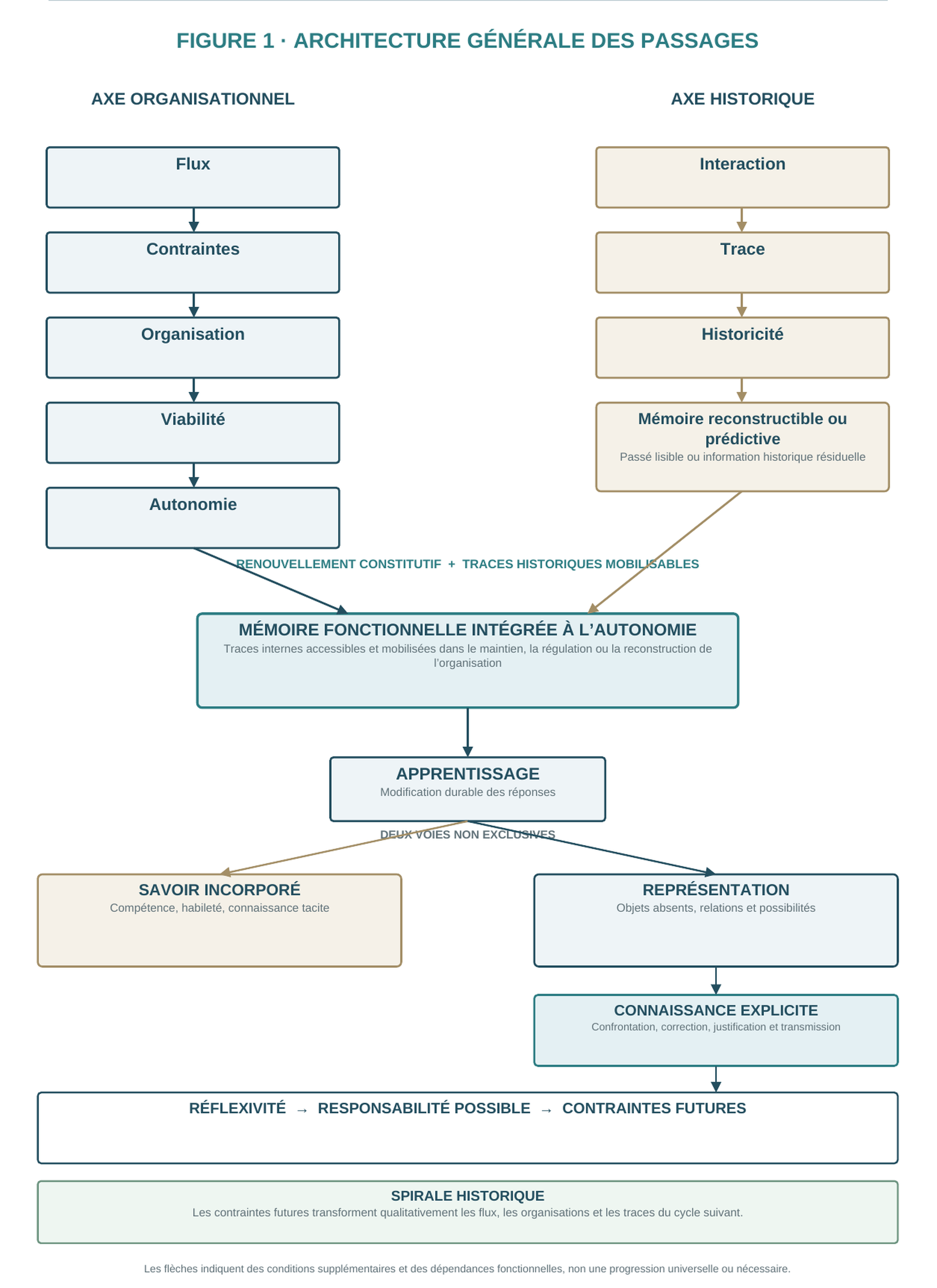
1. From flows to autonomy
| Flows → Constraints → Organisation → Viability → Autonomy |
|---|
Flows designate the transformations, exchanges and transfers that run through a system. Matter circulates, energy dissipates, gradients appear and reactions occur. A flow does not necessarily possess a durable structure. It may be transient, dispersed or entirely determined by external conditions.
A constraint appears when a relatively persistent structure or relation channels these transformations. It does not create the available energy and does not abolish physical laws. It modifies the accessible pathways, favours some interactions, slows others down or maintains differences between several regions. A membrane selects certain exchanges. An enzyme modifies the rate of a reaction. A network of channels redistributes a flow. The passage from flow to constraint therefore requires a channelling stable enough to modify subsequent transformations in a reproducible way.
| Flow + persistent channelling → Constraint |
|---|
The presence of constraints is not, however, sufficient to form an organisation. Several structures may be juxtaposed without their functioning being interdependent. An organisation appears when processes and constraints become integrated to the point where the activity of some depends on the relations maintained with the others. The whole then possesses properties that are no longer reducible to the addition of the elements taken separately.
| Constraints + integrated interdependence → Organisation |
|---|
This organisation is not necessarily living. A machine, a technical network, an institution or a dissipative structure can display complex functional dependencies. The next change appears when some transformations become favourable or unfavourable relative to the continuation of the organisation itself. Viability introduces a domain of states and trajectories compatible with that continuation. Some perturbations can be absorbed. Others require a reorganisation. Some progressively reduce the available margins until recovery becomes impossible.
| Organisation + domain of continuation + capacity for recovery → Viability |
|---|
Viability does not designate the maintenance of a fixed state. A viable organisation can renew its components, modify its priorities, change its structure and abandon responses that have become ineffective. Continuity lies less in the conservation of form than in the preservation or reconstruction of the capacities required to pursue the organisation. This reading converges with a homeodynamic conception of living systems. An organism does not last by remaining identical. It maintains a trajectory compatible with its continuation through renewal, repair, plasticity and the transformation of its responses.
An organisation can nevertheless remain viable thanks to functions entirely ensured by its environment. A machine may operate durably because an external infrastructure supplies its energy, replaces its parts, corrects its errors and adapts its objectives. A cell culture can be maintained because its medium is continually regulated from outside. Observed viability is therefore not enough to establish autonomy.
Autonomy appears when some processes take part in maintaining, renewing or restoring the constraints on which their own continuation depends. It does not mean autarky. A cell depends on external resources, but it transforms those inputs, maintains differences, renews its components and coordinates the processes required for its persistence. Autonomy concerns the organisation of dependencies, not their disappearance.
| Viability + renewal of constitutive conditions → Autonomy |
|---|
1.1. A deliberately graded definition of autonomy
This definition is deliberately more graded than a strict identification of autonomy with autopoiesis. Maturana and Varela (1980) describe autopoiesis as a network of processes that produces the components taking part in the regeneration of the network and in the constitution of its unity. Approaches based on organisational closure subsequently specified the reciprocal dependence between the constraints that make the processes of living systems possible, notably in Moreno and Mossio (2015) and Mossio, Saborido and Moreno (2009). The present framework retains this intuition of constitutive recursivity, but decomposes it in order to compare biological, chemical, technical and artificial systems without granting them the same status from the outset.
This choice widens the field of comparison, but it carries a risk. If autonomy designates only a capacity for persistence or adjustment under external constraint, it becomes hard to distinguish from mere assisted viability. To preserve an operative boundary, a strong requirement must therefore be maintained. The internal processes retained must contribute specifically to the renewal or restoration of the constraints on which the continuation of the system depends. Their suppression must impair that capacity in an identifiable way, beyond a mere general decline in performance.
Autonomy is thus treated as a profile rather than a binary verdict. A system may renew certain components while depending on an external infrastructure for its energy, its maintenance, its objectives or the production of its parts. The boundary adopted, the scale of observation, the temporal horizon and the functions considered must remain explicit. This generalisation therefore does not erase autopoiesis. It situates it as a demanding form of organisational recursivity within a wider comparative space.
2. From interaction to forms of memory
| Interaction → Trace → Historicity → Reconstructible or predictive memory |
|---|
The second trajectory does not begin with history as an already constituted entity. It begins with interaction. An interaction temporarily or durably modifies the systems it links. Not all modifications become traces. Some disappear when the interaction ceases. Others are dissipated, erased or become indiscernible in noise. A trace appears when a difference produced by the interaction remains stable enough to influence a later state or to be distinguished from it.
| Interaction + stabilised inscription → Trace |
|---|
A trace is therefore a present difference dependent on a past transformation. It may be chemical, structural, geometrical, biological, digital or symbolic. A scar, a geological stratum, a magnetic state, an epigenetic modification, a sedimentary deposit or a written archive do not rest on the same mechanisms. Their common property lies solely in the persistence of a difference issuing from an earlier interaction.
History appears when these differences do not remain isolated. Their persistence, their succession and their accumulation produce a partially reconstructible trajectory. Historicity is therefore not to be confused with time used as a variable in an equation. A system can evolve without preserving accessible information about its earlier states. Historicity designates the present presence of differences whose structure depends on the path travelled.
| Traces + differentiated persistence + reconstructible relations → Historicity |
|---|
A shell preserves stages of growth. Tree rings record certain variations of development and environment. A galaxy carries signatures of its assembly history. A material subjected to transformations may display hysteresis. In each of these cases, the past is not present in the form of a representation. It remains inscribed in the current properties of the system.
Historicity is nevertheless not sufficient to establish a functional memory. A rock has a history. A galaxy has an assembly trajectory. A landform preserves the effects of earlier transformations. These traces may allow an observer to reconstruct part of the past without being used by the system that carries them.
Several levels must therefore be distinguished. A trace indicates that a past difference persists. Reconstructible memory designates the possibility of inferring part of the history from that difference. Predictive historical dependence indicates that the past still provides information about future transformations beyond the present description retained. Functional memory demands more. A trace must be accessible, reactivated or mobilised in a later dynamic.
The word memory must therefore always be accompanied by its status. A geological archive may constitute a reconstructible memory for an observer. A material system may display a predictive historical dependence without using its past as an organisational resource. A molecular modification becomes a functional memory in the strong sense when it causally modifies a response contributing to the continuation of the organisation.
3. The central node: from autonomy to functional memory
The convergence of the two trajectories constitutes the main theoretical point. Autonomy and memory are not two independent stages added one after the other. They describe two properties whose encounter transforms the nature of the organisation.
An autonomous organisation can maintain and renew some of its conditions without preserving internal traces influencing its future responses. Conversely, a system may carry a rich history and numerous traces without possessing organisational autonomy. Neither autonomy nor historicity is therefore sufficient on its own to produce a functional memory integrated into the organisation.
The arrow between autonomy and functional memory does not mean that every autonomy necessarily generates a memory. It indicates that an autonomous organisation crosses an additional threshold when internal traces become active components of its maintenance, its regulation or its reconstruction.
| Autonomy + accessible internal traces + causal mobilisation → Functional memory |
|---|
The trace is no longer merely a preserved effect of the past. It now takes part in the present dynamic of the organisation. Access to it modifies a regulation, a response, a repair capacity, a recovery trajectory or a renewal mechanism. The past then becomes functional because some of its consequences are reintroduced into the processes that maintain the organisation.
The relation can be represented by a minimal causal chain:
| T Trace |
→ | A Access |
→ | U Process |
→ | C Integration |
→ | ΔO Organisational effect |
|---|
Figure 2. Minimal causal chain of functional memory. A trace becomes functional when an access mechanism modifies a process integrated into the organisation and produces a specific effect on the maintenance, regulation, recovery or reconstruction of that organisation.
In this notation, T designates the material state of the trace. A designates the mechanism of access, reading or reactivation. U designates the process modified by that access. C designates the insertion of that process into the organisation. ΔO designates the effect produced on the maintenance, regulation, recovery or reconstruction of the organisation.
The theoretical counter-example is an autonomous system able to renew its components and maintain its constitutive constraints without preserving any internal difference influencing its future functioning. Such a system would possess autonomy without functional memory. Its responses would depend solely on its present state and on immediate conditions.
Testing requires intervening on a determined trace. Does modifying its content change the regulation of the system? Does its suppression reduce the capacity for recovery? Does its restoration re-establish an expected response? In some plants, a targeted modification of epigenetic marks associated with the expression of a gene can make it possible to assess whether an earlier experience causally influences a later response. In a neural network, altering or blocking the mechanisms involved in long-term potentiation can serve to test whether a durable synaptic modification effectively contributes to the reactivation of an acquired response, in the line of the founding work of Bliss and Lømo (1973). In both cases, observing a correlation between a trace and a behaviour is not enough. One must show that intervening on the trace specifically modifies the future dynamic.
The observed effect must be distinguished from general damage to the support. Destroying a molecule, a cell or a structure can affect the organisation without demonstrating that its historical content was functional. One must therefore compare several interventions, control for non-specific material effects and, where possible, rewrite or restore the trace.
Living systems offer many cases where this convergence becomes observable. Molecular modifications influence the future expression of certain processes. The immune system transforms its responses after certain exposures. Neural networks durably modify their dynamics. Tissues preserve the effects of development, of mechanical constraints or of earlier repairs. In each of these examples, history does not merely remain inscribed. It becomes a resource, a constraint or an orientation for later activity.
3.1. Implicit memory, explicit memory and levels of access
The notion of functional memory can accommodate several regimes without confusing them. In the cognitive sciences, the distinction between implicit or procedural memory and explicit or declarative memory makes it possible to separate effects of experience that modify action without conscious access from contents that can be recalled, represented and manipulated. Work on memory systems, notably that of Cohen and Squire (1980) and Squire (2004), shows the value of distinguishing know-how from explicitly reportable knowledge. This distinction must not be projected onto all natural systems, but it illuminates the trajectory where cognitive architectures are present.
An implicit or procedural memory can directly modify the process U without producing an explicitly represented content. A motor skill, a habit or certain forms of conditioning can orient action even though the subject cannot describe precisely what has been learned. Explicit memory adds a possibility of representation, voluntary recall, comparison and sometimes communication. It therefore stands closer to the passage towards representation than to mere organisational maintenance.
This distinction shows that access is not a single property. A trace can be causally accessible without becoming conscious, verbally reportable or symbolically manipulable. The framework must therefore specify the type of access under study instead of using the word memory as a homogeneous category.
3.2. CRISPR and the overlap between memory and learning
The CRISPR-Cas system of bacteria and archaea shows why passages must not always be interpreted as chronologically separate stages. When a fragment of an infectious agent is integrated as a spacer into a CRISPR locus, a past interaction produces a durable trace. That trace is then transcribed and mobilised in a response that modifies the future capacity for defence. Acquisition of the spacer corresponds to the process of modification through experience, its conservation constitutes a memory and its use in interference transforms the later response. The founding experiment of Barrangou and colleagues (2007) established the role of these sequences in acquired resistance in bacteria.
The same set of mechanisms therefore achieves acquisition, inscription and durable modification of the response. The distinction between functional memory and learning remains useful, but it becomes a distinction of role rather than an obligatory separation in time. Memory designates the trace preserved and available for mobilisation. Learning designates the process by which experience durably modifies the organisation of responses. In some systems the two are so tightly coupled that they must be analysed within a single causal loop.
This articulation also prevents memory from being reduced to information. A difference can be measurable without being functional. Information can be present without a reading mechanism. A trace can be accessible without being integrated into the continuation of the organisation. Functional memory in the strong sense requires the meeting of an informational dimension and an organisational one.
Information describes differences and dependencies. Organisation describes the relations through which some of those differences become active in the continuation of the system.
| An autonomous organisation becomes historically active when certain internal traces take part causally in the maintenance, regulation or reconstruction of its own conditions of continuation. |
|---|
4. From functional memory to forms of knowledge
Functional memory does not automatically produce learning. A system can preserve and mobilise a trace without durably modifying its way of responding. Learning appears when experience transforms the relations between detection, regulation and action beyond the immediate event.
| Functional memory + durable modification of responses → Learning |
|---|
This distinction must nevertheless remain functional. In some mechanisms, such as CRISPR adaptive immunity, the formation of the trace and the durable modification of responses are two dimensions of a single process. The architecture therefore does not claim to impose a rigid temporal sequence. It separates roles in order to be able to ask what is preserved, how that preservation becomes active and what changes durably in the future dynamic.
Learning does not necessarily lead to an explicit representation. A large part of human and animal competence manifests itself in action before it can be described. Keeping one's balance, recognising a configuration, adjusting a gesture or mastering an instrument cannot be reduced to the conscious application of propositions. These embodied forms of know-how are acquired, stabilised and revised through experience. They can be reliable and highly elaborate without being fully verbalisable.
The notion of tacit knowledge, developed by Michael Polanyi (1966), reminds us that knowledge is not limited to what can be formulated as propositions. An architecture centred exclusively on explicit justification would exclude an important part of practical skills, perceptual competences and embodied practices. At least two routes must therefore be distinguished after learning.
| Learning + stabilisation in action → Embodied know-how or tacit knowledge |
|---|
| Learning + handling of the absent or the possible → Representation |
|---|
Embodied know-how does not necessarily depend on a conscious representation of all the rules mobilised. It manifests itself in a capacity to act appropriately, to detect deviations and to correct a performance through the feedback of experience. Its criterion is not complete explicitation, but situated reliability, sensitivity to errors and the possibility of adjustment.
Representation introduces another capacity. It makes it possible to handle absent objects, relations that are not immediately present, possible states or future consequences. A representation is not necessarily an internal image. It may take the form of a configuration, a model or a state allowing action in relation to something that is not directly present.
A representation is not yet explicit knowledge. A model can be coherent and false. A belief can organise action without being confronted with independent data. A system can produce a plausible response without having its own verification mechanisms. Explicit knowledge appears when representations enter procedures of confrontation, correction, justification and transmission.
| Representation + confrontation + correction + justification → Explicit knowledge |
|---|
This formulation does not reduce all knowledge to the scientific model. It distinguishes several regimes. Embodied know-how can be effective, transmissible through practice and corrected by experience without becoming fully propositional. Explicit knowledge makes certain contents manipulable, comparable and communicable. Scientific knowledge adds stronger public requirements, notably traceability of methods, confrontation with independent data, reproducibility, collective criticism and revision of models.
Science therefore constitutes a particular form of explicit and institutionalised knowledge. It externalises observations, preserves methods, makes claims debatable, compares results and modifies models when data contradict them. Archives then allow a collective organisation to maintain knowledge beyond individual biological memory.
Externalisation is nevertheless not sufficient. A library can preserve errors. A database can accumulate contradictory information. An artificial system can produce complex responses without having an autonomous capacity to verify the provenance, validity or consequences of what it generates. Knowledge therefore depends less on the quantity of information preserved than on the quality of the mechanisms that allow it to be related, used and revised.
5. From knowledge to responsibility
An organisation can produce knowledge without examining the conditions of its production. Reflexivity appears when its own models, methods, limits and effects themselves become objects of analysis.
| Knowledge + critical return on its own conditions → Reflexivity |
|---|
Reflexivity makes it possible to distinguish what is observed from what is interpreted, to recognise the hypotheses introduced, to identify the limits of instruments and to revise procedures when they produce errors. It nevertheless guarantees no particular conduct. An organisation can understand the consequences of its actions and continue to displace their costs onto other populations, onto the environment or onto the future.
Responsibility therefore belongs to another register. It cannot be deduced from physical laws, from complexity or from evolution. It becomes possible when reflexivity is accompanied by a capacity for anticipation, an effective power over future conditions and a recognition of the consequences produced.
| Reflexivity + anticipation + power to act + recognition of consequences → Possible responsibility |
|---|
The word possible remains indispensable. Knowledge opens a capacity without imposing its use. Responsibility also depends on real power. An individual does not bear the same responsibility as an institution with far greater resources, information and capacities for intervention. It must remain proportionate to the knowledge available, the accessible alternatives and the extent of the effects produced.
This caution avoids turning a descriptive trajectory into a moral law. The architecture seeks to show how certain capacities make responsibility practicable, not how nature would impose a norm. Responsibility remains an ethical, political and legal construction that assesses acts, powers, obligations and consequences.
| We are not accountable for everything possible. We are accountable for the part that our power helps to open, preserve, deform or render irreversible. |
|---|
6. The return towards future constraints: why a spiral rather than a loop
The trajectory then returns towards the world. Knowledge becomes techniques, decisions, institutions, infrastructures and transformations of environments. It modifies the constraints to which future organisations will have to respond.
| Knowledge → Decisions → Future constraints → New flows → New organisations → New traces |
|---|
This movement does not form a closed loop, because the return never restores exactly the initial conditions. Knowledge embodied in techniques, institutions or transformations of the milieu qualitatively modifies the field of possibilities. Some trajectories become more accessible. Others become more costly, more improbable or irreversible. The following organisations appear in a space already transformed by the consequences of the previous cycle.
The form is therefore that of a historical spiral. The process returns towards flows, constraints, organisations and traces, but from a different state of the world. Future structures inherit infrastructures, archives, transformed environments, earlier decisions, opened possibilities and irreversibilities already produced. The spiral expresses neither guaranteed progress nor a necessary ascent. It expresses the impossibility of a strict return to the identical when the effects of the past are incorporated into the conditions of the present.
Responsibility can then be understood as a relation to the conditions transmitted. It does not consist in controlling the whole of the future, but in recognising that certain kinds of knowledge and certain decisions modify the landscape of constraints in which other organisations will have to maintain their viability, build their memories and develop their own possibilities for action.
7. What demonstrating the architecture means
A transdisciplinary architecture is not demonstrated like a single equation. It brings together concepts from different domains and therefore cannot receive a global proof in a single experiment. Its soundness depends on several levels of validation that must remain distinct.
| No. | Function | Requirement |
|---|---|---|
| 1 | Conceptual validation | The categories must be defined without circularity and their relations must be coherent. Viability cannot be defined by mere persistence if the aim is precisely to distinguish persistence from viability. Functional memory cannot be identified with every effect of the past if one wants to test the specific mobilisation of a trace. Responsibility cannot be deduced from a descriptive property without explicitly introducing the normative premises. |
| 2 | Discriminatory power | The architecture must produce differences that contrasting cases make visible. A flame and a cell can both maintain a dissipative form, but they do not renew their constraints in the same way. A sedimentary stratum and an epigenetic mark can both preserve a history, but only the second can, under certain conditions, be mobilised in a biological regulation. A language model and an organism can both use acquired traces, but they do not possess the same degree of constitutive autonomy. |
| 3 | Operative translation | Each passage must be translated into the variables and methods proper to the domain under study. Transdisciplinary concepts do not replace local measurements. They indicate what must be distinguished. Biology will have to identify the mechanisms of renewal, the traces and the effects on regulation. The cognitive sciences will have to specify the forms of access, recall and control. The social sciences will have to define organisational boundaries, capacities for correction and the distribution of power. |
| 4 | Empirical test | The additional condition must produce an observable difference. Modifying a constraint must change the flows. Perturbing a relation must affect the organisation. Reducing margins must modify recovery. Removing a constitutive function must reveal the degree of autonomy. Modifying an internal trace must change a regulation or a capacity for maintenance. Interrupting a correction mechanism must degrade the quality of the knowledge produced. |
| 5 | Cross-domain comparison | The same distinctions must remain useful when applied to several domains, while accepting that mechanisms and indicators change. The success of the framework would not be to find an identical law everywhere. It would be to show that certain questions of demarcation remain relevant and that they prevent recurrent confusions. |
| 6 | Critical and independent testing | Counter-examples, negative results, changes of boundary and competing interpretations must be able to modify the architecture. A proposal that survives only because its criteria are adjusted after each result does not constitute a demonstration. Peer confrontation is therefore not a mere step of social acceptance. It serves to verify whether the distinctions remain robust when they are reformulated, tested and criticised independently of their author. |
| The architecture is justified if each level can exist without the next, if the passage requires an identifiable additional condition and if that condition can be tested independently. |
|---|
8. A contemporary test: artificial systems
Artificial systems offer a useful terrain for testing the distinctions of the framework because they now combine several properties that are often confused. A trained model has parameters whose state depends on a learning history. In transformer architectures introduced by Vaswani and colleagues (2017), these parameters constitute stabilised traces of training in the sense that they causally influence subsequent transformations. They are therefore not passive in the strict sense. During inference they take part directly in producing responses.
This functionality is nevertheless not sufficient to establish a constitutive memory in the strong sense proposed here. The parameters serve mainly to transform inputs into outputs. They generally do not take part in renewing the hardware, maintaining the infrastructure, producing energy, defining objectives or autonomously reconstructing the conditions that make computation possible. Training, model updating, the management of external memories, security and maintenance remain largely organised by wider human and technical systems.
Several levels must therefore be distinguished. The weights of a model can be interpreted as traces of learning functionally mobilised in computation. The temporary context can act as a limited working memory. Vector stores, logs or external memories can provide a reconstructible and reusable memory. Yet the whole becomes autonomous in the constitutive sense only if the system's processes genuinely take part in renewing the material, software and organisational constraints on which their continuation depends.
This analysis avoids two excesses. The first would be to deny artificial systems any memory on the grounds that they are not alive. The second would be to infer their autonomy from the mere presence of learned parameters, feedback loops or external memory mechanisms. The framework allows a more precise attribution. A system may possess a computational functional memory without having a memory integrated into an organisational autonomy.
The comparison with living systems therefore does not bear only on the capacity to preserve information. It bears on the relation between traces, their access, the processes they modify and the conditions of continuation they may help to maintain.
9. Table of passages and testing criteria
The following table does not replace the models proper to each discipline. It provides a demarcation grid. Each domain must define its variables, its boundaries, its mechanisms and its measurement methods. The interdisciplinary examples serve to test differences of status, not to assume an identity of mechanisms.
| Passage | Additional condition | Counter-example | Testing criterion | Interdisciplinary examples |
|---|---|---|---|---|
| Flow → constraint | Persistent channelling of transformations | Flow without durable structure | Modify the structure and measure the change in flows | Free current / network of channels. Simple diffusion / selective membrane. |
| Constraints → organisation | Functional interdependence between several constraints | Assembly of components without integrated dependence | Perturb a relation and measure its effects on the whole | Heap of parts / assembled machine. Isolated reactions / metabolic network. |
| Organisation → viability | Domain of continuation, recovery and preservation of capacities | Functional machine maintained entirely from outside | Track margins, recovery and capacities after perturbation | High-performing service that exhausts its teams / regenerative organisation. Injured cell that repairs / structure that degrades. |
| Viability → autonomy | Internal renewal of constitutive constraints | Durable system whose upkeep remains entirely external | Remove or replace certain functions and observe whether the system restores its conditions | Tended flame / cell. Maintained machine / organism that renews its components. |
| Interaction → trace | Sufficiently stable inscription of a produced difference | Event with no durable or identifiable effect | Look for a present difference dependent on the past interaction | Impact without a mark / scar. Fleeting signal / stable modification of a support. |
| Trace → historicity | Differentiated persistence and reconstructible relations | Isolated trace allowing no trajectory | Reconstruct events or sequences from the present state | Single layer / stratigraphic series. Isolated deposit / growth rings. |
| Historicity → reconstructible or predictive memory | Legibility of the past or residual historical information about the future | Past inscribed but impossible to distinguish or exploit | Test reconstruction on independent data, or predictive value beyond the present state | Sedimentary stratum. Hysteresis of a material. Signatures of galactic assembly. |
| Autonomy + memory → integrated functional memory | Internal traces taking part in maintenance, regulation or reconstruction | Autonomous system with no historical state influencing its future responses | Modify an internal trace and measure the effects on regulation, recovery or maintenance | Regulatory methylation. Immune memory. Synaptic plasticity. CRISPR-Cas. |
| Functional memory → learning | Durable modification of the way of responding | Trace reactivated without durable transformation of the response | Compare before and after experience, then test persistence and generalisation | Acquisition of a CRISPR spacer. Conditioning. Durable adaptation of a network. |
| Learning → embodied know-how | Stabilisation of an adjustable competence in action | Learned response that is rigid and non-transferable | Test performance, transfer, correction through feedback and resistance to incomplete verbalisation | Driving, craft gesture, expert perceptual reading, motor skill. |
| Learning → representation | Handling of absent objects, relations or possibilities | Purely reactive adaptation | Test the response when the object or situation is no longer present | Navigating towards an absent place. Planning. Internal model of a relation. |
| Representation → explicit knowledge | Confrontation, correction, justification and transmission | Coherent but unverified model | Examine revision, traceability, out-of-sample correction and reproducibility | Private belief / scientific knowledge. Plausible output of an LLM / verified and sourced result. |
| Knowledge → reflexivity | Critical return on its own models, methods and limits | High-performing system unable to assess its errors | Introduce a contradiction or a limit and observe the revision of procedures | Exact but non-reflexive calculator. Scientific community revising its methods. |
| Reflexivity → responsibility | Anticipation, power to act and recognition of consequences | Knowledge without real purchase or normative commitment | Examine the alternatives, the effective power and the constraints actually transmitted | Expertise without decision / institution able to act. Climate forecast / transformation policy. |
10. Limits and conditions of validity
The architecture proposed does not demonstrate a universal law running through all domains. It does not assume that the same mechanisms produce viability in a cell, an ecosystem, an institution and an artificial system. It does not describe a necessary progression from matter to knowledge. It does not make life a destination of the cosmos. It does not confuse historicity with functional memory. It does not deduce responsibility from physical laws.
Its usefulness depends on its capacity to preserve differences of mechanism while comparing certain relations. The framework must therefore be restricted whenever a notion becomes too general. Viability must always be defined relative to an organisation, a boundary and a temporal horizon. Autonomy must specify the functions whose renewal is being studied. Memory must indicate whether it is reconstructible, predictive, functional or constitutively integrated. Knowledge must specify whether it is embodied, explicit or scientific. Responsibility must remain proportionate to the power to act, the available alternatives and the accessible consequences.
The architecture would lose its value if it became a grid able to explain any result retrospectively. Its strength depends on the contrary on its limits, its counter-examples and its capacity to conclude that certain passages are not demonstrated. It must also accept that several functions may be realised by the same mechanism, as in the case of CRISPR, and that some trajectories branch rather than follow a single line, as in the case of embodied know-how and explicit knowledge.
Finally, compatibility with established scientific traditions does not constitute an automatic validation. It shows that the architecture can enter into dialogue with autopoiesis, organisational closure, viability theory, the sciences of memory, research on tacit knowledge and the epistemology of science. Its own contribution will have to be assessed by its capacity to clarify the passages between these traditions, to produce criteria of demarcation and to generate tests that would not be formulated in the same way without this architecture.
Conclusion
The architecture proposed describes neither an obligatory progression from matter to life nor a hierarchy in which each level would necessarily prepare the next. It distinguishes several changes of status.
Flows can be channelled by constraints. Interdependent constraints can form an organisation. Some organisations possess a domain of viability. Some viable organisations take part in renewing their constitutive conditions and acquire a relative autonomy.
Interactions can leave traces. The persistence, accumulation and articulation of those traces produce a historicity. Some traces make the past reconstructible. Some preserve predictive information beyond the present state. The central passage appears when an autonomous organisation uses internal traces in the maintenance, regulation or reconstruction of its own conditions of continuation.
| Autonomy + mobilisable internal traces → Integrated functional memory |
|---|
This memory can durably modify responses and support learning. Learning can stabilise embodied know-how without requiring complete explicitation. It can also make possible representations of the absent, the possible or internal relations. Representations become explicit knowledge when they are confronted, corrected, justified and transmitted. Knowledge becomes reflexive when it examines its own conditions and limits. Responsibility becomes possible when that reflexivity is accompanied by anticipation, an effective power and a recognition of the consequences transmitted.
The unity of the framework therefore does not lie in a common property applied indiscriminately to matter, living systems, artificial systems and human organisations. It lies in a method of demarcation.
| Identify what already exists, determine the additional condition, construct the counter-example and define the intervention able to confirm or refuse the passage. |
|---|
This method makes it possible to link without reducing. It preserves the material continuity of reality while recognising that organisation, viability, autonomy, functional memory, embodied know-how, explicit knowledge and responsibility become possible only through additional architectures.
Reality does not necessarily advance towards knowledge. But some organisations have become able to preserve the effects of their history, to mobilise some of its traces, to transform their responses, to stabilise competences, to build corrigible representations and to act on the constraints they will transmit. The return towards the world is not a loop back to the identical. It forms a historical spiral in which each cycle inherits the transformations of the previous one and modifies the conditions of what may follow.
Theoretical and bibliographical landmarks
These references do not constitute a single lineage or a validation of the framework. They indicate the traditions with which the architecture enters into dialogue and the empirical examples drawn upon in the text.
Barrangou, R., Fremaux, C., Deveau, H., Richards, M., Boyaval, P., Moineau, S., Romero, D. A. and Horvath, P. (2007). CRISPR provides acquired resistance against viruses in prokaryotes. Science, 315, 1709-1712.
Bliss, T. V. P. and Lømo, T. (1973). Long-lasting potentiation of synaptic transmission in the dentate area of the anaesthetized rabbit following stimulation of the perforant path. The Journal of Physiology, 232, 331-356.
Cohen, N. J. and Squire, L. R. (1980). Preserved learning and retention of pattern-analyzing skill in amnesia. Dissociation of knowing how and knowing that. Science, 210, 207-210.
Maturana, H. R. and Varela, F. J. (1980). Autopoiesis and Cognition. The Realization of the Living. Dordrecht, D. Reidel.
Moreno, A. and Mossio, M. (2015). Biological Autonomy. A Philosophical and Theoretical Enquiry. Dordrecht, Springer.
Mossio, M., Saborido, C. and Moreno, A. (2009). An organizational account of biological functions. The British Journal for the Philosophy of Science, 60, 813-841.
Polanyi, M. (1966). The Tacit Dimension. Chicago, University of Chicago Press.
Squire, L. R. (2004). Memory systems of the brain. A brief history and current perspective. Neurobiology of Learning and Memory, 82, 171-177.
Vaswani, A. et al. (2017). Attention Is All You Need. Advances in Neural Information Processing Systems, 30.
ORI-C corpus drawn upon
Daloze, D. (2026). Functional principle of systemic viability and the coherence of living systems.
Daloze, D. (2026). The coherence of living systems. Reading systems before they tip.
Daloze, D. (2026). From homeostasis to homeodynamics. Why living systems do not seek equilibrium.
Daloze, D. (2026). From constraint to knowledge. Flows, organisation, viability, memory and responsibility in a historical Universe.
Daloze, D. (2026). Ontology of the weave and the trace. Time, inscription, exploitable information and historicity.
Didier Daloze | ORI-C | www.ori-c.be | July 2026